
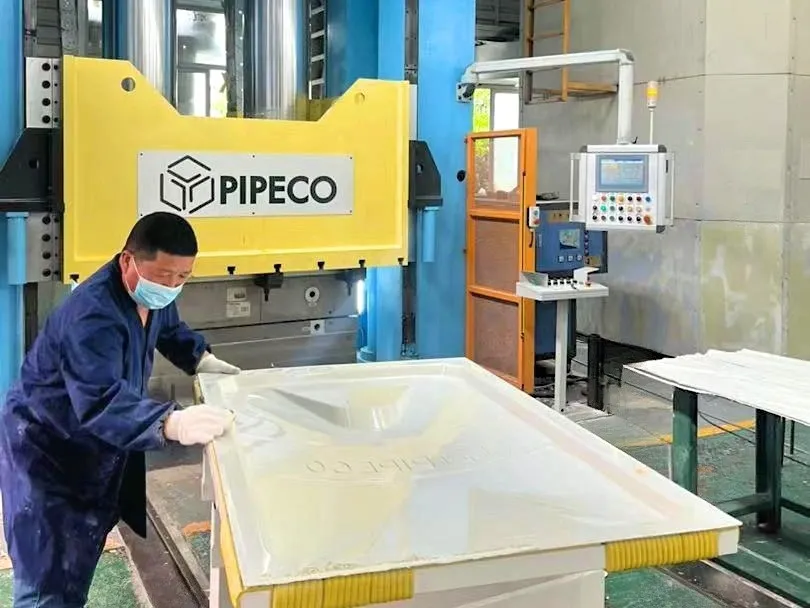
Choosing the right water tank is not simply a matter of selecting the largest available capacity or comparing the lowest quotation. A suitable water storage system must match the project's required capacity, installation space, water application, environmental conditions, structural requirements, access limitations, and long-term operating conditions.
For many commercial, industrial, municipal, agricultural, and infrastructure projects, a GRP water tank provides a practical combination of corrosion resistance, modular construction, relatively low weight, and flexible installation. However, not every GRP tank configuration is suitable for every project.
The correct selection process should therefore begin with the project requirements rather than with a specific tank model.
This guide explains the major factors that engineers, contractors, consultants, procurement teams, and project owners should consider when selecting a GRP sectional water tank. It focuses on practical engineering and purchasing decisions, including tank capacity, dimensions, installation location, water type, environmental exposure, access conditions, foundation requirements, and supplier evaluation.
Before requesting a quotation, it is useful to define the basic operating and installation requirements of the proposed water storage system.
At a minimum, the following questions should be answered:
These factors are interconnected. For example, the required capacity determines the approximate tank volume, while the available footprint may determine the possible length and width. The installation location may then influence the preferred tank height and sectional configuration.
A good tank selection process therefore considers the project as a complete system rather than selecting a tank based on capacity alone.
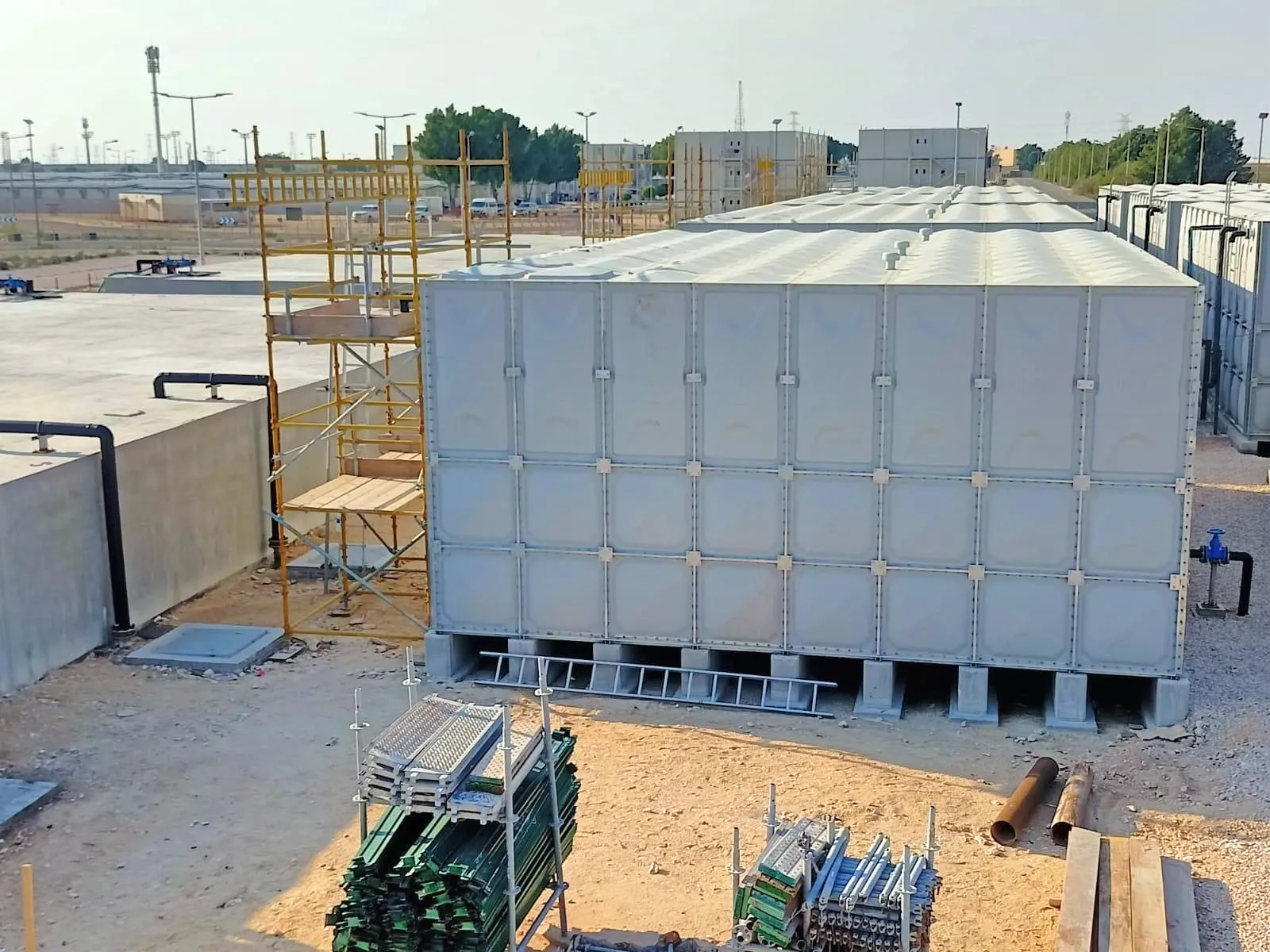
Tank capacity is normally the first specification discussed during procurement, but determining the appropriate capacity requires more than simply estimating daily water consumption.
The required storage volume may depend on the purpose of the tank and the operating strategy of the facility.
For example, a tank may be required for:
Each application can have different storage requirements. A domestic water tank may be sized around expected consumption and supply reliability, while a fire water tank may be governed by the required fire protection strategy and applicable regulations.
One important point when comparing water tank quotations is the difference between nominal capacity and usable storage capacity.
A tank described as having a particular nominal volume does not necessarily mean that the entire geometric volume will be continuously available for operational use.
Factors such as:
may affect the actual usable volume.
For project procurement, it is therefore preferable to specify both the required storage capacity and any operational water-level requirements rather than relying on a tank capacity number alone.
Once the required capacity is known, the next question is how that volume should be distributed between tank length, width, and height.
For a rectangular sectional tank, the basic geometric relationship is:
Tank volume = Length × Width × Water depth
However, practical tank selection is not simply a mathematical exercise.
A taller tank may achieve the required capacity within a smaller footprint, but it can also increase the hydrostatic pressure acting on the lower wall panels. A wider and shorter tank may reduce the required water depth but require more floor space.
The final configuration should therefore balance:
Tank height is an important selection parameter because hydrostatic pressure increases with water depth.
A simplified hydrostatic relationship is:
P = ρgh
where P represents hydrostatic pressure, ρ represents water density, g represents gravitational acceleration, and h represents the water depth.
This means that the lower portion of a tank wall is subjected to greater hydrostatic pressure than the upper portion.
Consequently, changing the tank height is not simply a change in external dimensions. It can also influence the structural loading of the tank system.
When selecting between different tank proportions, buyers should therefore consider both the available installation space and the structural implications of the proposed water depth.
The physical location available for the tank is often the second major factor after capacity.
Before selecting a tank configuration, the project team should measure the available installation area rather than relying on approximate dimensions.
Important dimensions may include:
The tank itself may fit within the proposed location while the installation process does not. This distinction is particularly important for indoor installations and projects located inside existing buildings.
A sectional GRP tank can be configured from modular panels, allowing the overall dimensions to be adapted to the available site conditions.
This can be useful when a project has an irregular or restricted installation area.
For example, the same approximate storage volume may potentially be achieved through different combinations of length, width, and height. The preferred configuration should be selected according to the actual site rather than assuming that one standard tank proportion is suitable for every project.
This is one reason why GRP sectional water tanks are often considered for projects where transportation, access, or installation space creates constraints.
A sectional tank is constructed from individual factory-manufactured panels that are transported to the project site and assembled into the completed water storage structure.
This construction method is particularly useful when a large tank must be installed in a location where transporting a fully assembled or one-piece tank would be impractical.
Potentially suitable situations include:
The main selection question is therefore not simply:
“Is a GRP sectional tank strong enough?”
It should instead be:
“Does sectional construction provide the most practical combination of capacity, transportation, installation, and long-term operation for this project?”
For smaller capacities and easily accessible sites, a one-piece tank may sometimes be practical. However, as tank dimensions increase, transportation and access can become significant limitations.
A sectional GRP tank separates the manufacturing and installation stages:
Factory-manufactured panels → Transportation → Site assembly → Completed tank
Individual panels are generally easier to handle than a large completed tank. This can simplify transportation through restricted access points and allow the tank to be assembled inside buildings or in locations where large lifting equipment is difficult to use.
The suitability of sectional construction should nevertheless be evaluated together with the project foundation, installation conditions, available manpower, and required assembly schedule.
The intended water application is another fundamental selection factor.
A tank intended for potable water may have different material and compliance requirements from one used for industrial process water or other non-potable applications.
Before selecting the tank material system, identify whether the stored liquid is:
The water chemistry, temperature, treatment chemicals, and applicable regulatory requirements should be reviewed before the material specification is finalized.
For potable water applications, the materials that come into contact with the stored water should meet the applicable requirements for the intended market and project.
Buyers should not assume that a general-purpose composite tank automatically meets every potable-water requirement. The required approvals, certifications, or test documentation should be confirmed according to the destination country and project specification.
Fire protection applications may have specific requirements concerning storage volume, system configuration, connections, inspection, and applicable fire protection standards.
The tank should therefore be selected as part of the complete fire water system rather than treated as an independent storage product.
Industrial applications can involve water with different temperatures, chemical characteristics, or treatment processes.
If the stored water contains chemicals or has unusual operating conditions, the composite material system should be evaluated for compatibility with the actual service environment.
The installation environment can significantly influence tank selection.
An indoor tank is generally protected from direct sunlight and some weather exposure, but the installation site may impose strict limitations on access, ventilation, available floor space, and lifting operations.
An outdoor tank, on the other hand, may be exposed to:
The tank specification should therefore reflect the actual installation environment rather than treating indoor and outdoor storage as identical applications.
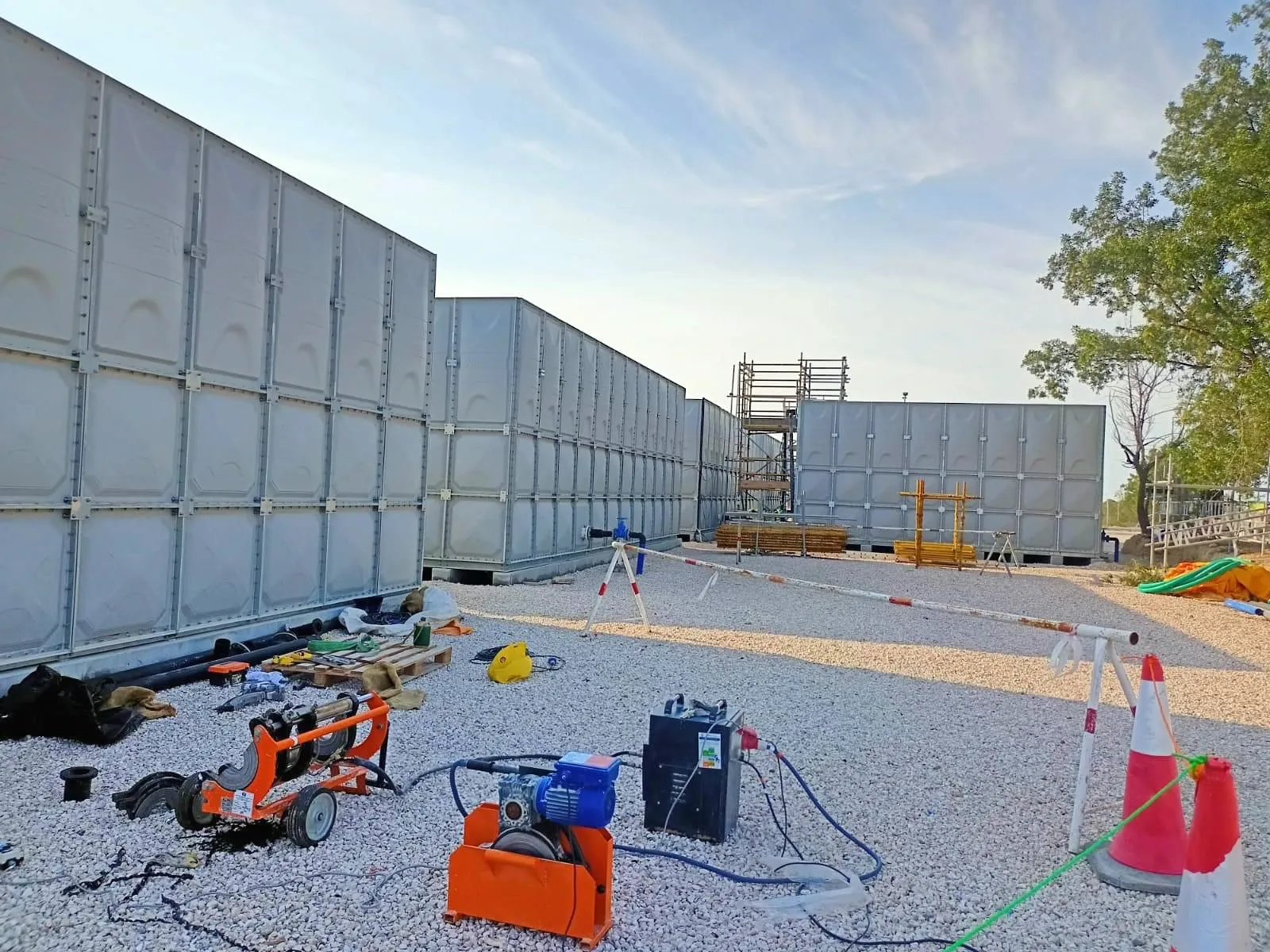
Outdoor installation may require additional consideration of UV exposure, ambient temperature, weather conditions, tank supports, access for maintenance, and external protection requirements.
The exact measures depend on the material system and project environment. For example, a tank installed in a high-UV region may require appropriate surface protection and material specifications designed for the expected exposure.
Similarly, areas with large temperature fluctuations may require consideration of thermal expansion, connection behavior, and associated piping.
One of the practical advantages of a sectional GRP water tank is modular transportation, but buyers should still evaluate the complete logistics route before placing an order.
The following questions should be considered:
These practical details can influence the preferred panel dimensions and overall tank configuration.
A tank may have an ideal capacity and suitable structural design but still be difficult to install if the individual components cannot reach the final installation location.
This is especially important for:
For these projects, the modular nature of a sectional GRP water tank can provide a practical logistical advantage because the tank is assembled after the components have reached the installation area.
Buyer’s principle: Do not select a GRP water tank based on capacity alone. The correct configuration must fit the required storage volume, available space, water application, installation environment, transportation route, and project-specific operating conditions.
The foundation is one of the most important parts of a water tank installation, even though it is not part of the tank itself. A properly selected GRP water tank must be installed on a support system capable of carrying the filled tank and transferring the load safely to the underlying structure.
Water is relatively heavy, and the structural load increases significantly as tank capacity increases. For this reason, the foundation should be considered during tank selection rather than after the tank has already been ordered.
For a project-specific assessment, the following factors should be reviewed:
A sectional GRP water tank transfers its load through the bottom structure and supporting surface. An uneven or poorly prepared foundation can create localized loading and may affect panel alignment, connection performance, and long-term tank stability.
The foundation should therefore provide a sufficiently level, rigid, and continuous supporting surface according to the tank manufacturer's installation requirements.
Small construction deviations that appear insignificant before filling the tank can become more important when the tank contains a large volume of water. This is why foundation inspection should normally be completed before tank assembly begins.
Ground-level installation is often the most straightforward configuration because the tank can be supported directly by a properly designed foundation or slab.
However, “ground installation” does not automatically mean that any concrete floor is suitable.
The project team should confirm:
For new construction, these requirements can normally be incorporated into the civil and structural design before the tank is delivered.
For retrofit projects, the existing structure should be evaluated before the tank configuration is finalized.
Rooftop water storage requires additional structural consideration because the tank and its contents impose loads on an elevated building structure.
The most important point is that the weight of the empty tank is only one component of the total load.
The filled system may also include:
The building structure must therefore be evaluated for the actual operating condition rather than the empty tank condition.
A larger tank footprint can distribute the storage load over a greater area, while a smaller footprint can result in a higher average load intensity.
The appropriate configuration should therefore be coordinated with the structural engineer responsible for the building.
Important questions include:
A GRP water tank should never be selected for a rooftop application based solely on its physical dimensions. The tank configuration and supporting structure should be treated as one engineering system.
The environment surrounding a water tank can affect material selection, accessories, installation details, and long-term maintenance requirements.
Before ordering a tank, identify the expected:
The same basic tank configuration may therefore require different project specifications depending on where it will be installed.
For outdoor installations, long-term exposure to sunlight should be considered during material and surface specification.
Ultraviolet radiation can affect polymeric materials over extended periods, particularly when the surface protection system is not appropriate for the environment.
This does not mean that GRP tanks are unsuitable for outdoor applications. Rather, the tank should be specified with materials and surface protection appropriate for the expected exposure conditions.
Projects in regions with intense solar radiation should pay particular attention to:
This is especially relevant for outdoor water storage in hot and high-UV regions.
Temperature should also be considered when selecting a water storage system.
Very high or very low ambient temperatures can influence the operating environment of the tank, water, seals, piping, and associated equipment.
For example, a tank installed in a cold climate may require a different project strategy from one installed in a tropical environment.
Potential considerations include:
Where freezing conditions are expected, the tank specification should be coordinated with the overall freeze-protection strategy rather than treating insulation as an isolated accessory.
The stored liquid is just as important as the tank's physical environment.
Water chemistry can vary considerably between municipal water, treated water, groundwater, industrial process water, and other applications.
The project specification should identify any unusual characteristics of the stored water, including:
For standard water storage, a suitable GRP material system can provide useful corrosion resistance compared with conventional metallic storage systems. However, unusual chemical exposure should always be evaluated against the specific resin, liner, gasket, and accessory materials proposed for the project.
If the tank is intended for drinking water, the buyer should identify the regulatory requirements applicable to the destination market before ordering.
Different countries and projects may require different certifications, testing procedures, or material approvals for products intended to contact potable water.
A responsible procurement specification should therefore state the intended water application and required compliance criteria clearly.
After capacity and environmental conditions have been established, the next stage is to determine the most practical tank dimensions.
For a sectional GRP tank, several different dimensional combinations may potentially provide a similar storage volume.
The preferred configuration should consider:
Not necessarily.
A taller tank can provide a larger volume within a smaller footprint, which may be useful when floor space is limited. However, increasing water depth also increases hydrostatic pressure on the tank walls.
A lower and wider configuration may provide a different balance between footprint, water depth, structural loading, and access.
The best configuration is therefore the one that satisfies the complete project requirements rather than maximizing one individual parameter.
Suppose two possible configurations can provide approximately the required storage volume:
| Factor | Configuration A | Configuration B |
|---|---|---|
| Tank footprint | Smaller | Larger |
| Tank height | Higher | Lower |
| Water depth | Higher | Lower |
| Floor space requirement | Lower | Higher |
| Hydrostatic depth | Higher | Lower |
| Potential site advantage | Useful for restricted floor area | Useful where floor area is available |
Neither configuration is automatically better. The selection depends on the building, foundation, structural conditions, available space, access requirements, and project priorities.
Pipe connections should be considered during the tank selection stage rather than added as an afterthought.
The project team should identify the approximate requirements for:
The position and size of these connections can influence the tank configuration and the surrounding maintenance space.
The connection arrangement should also be coordinated with the building's existing pipework. Poorly planned pipe routing can create unnecessary bends, difficult maintenance access, or excessive loads on tank connections.
A water tank should support its intended tank loads, while connected piping should be properly supported according to the project design.
Large unsupported pipes can potentially transfer external forces or moments to tank connections. Therefore, pipe support and tank connection design should be coordinated during engineering rather than relying on the tank panel alone to carry external piping loads.
A water tank is a long-term infrastructure asset. Selection should therefore consider not only how the tank will be installed, but also how it will be inspected and maintained throughout its service life.
The installation layout should provide practical access to:
A tank installed tightly against surrounding structures may technically fit the available space but create unnecessary difficulties during inspection and maintenance.
For commercial and industrial projects, a small amount of additional maintenance clearance can provide significant practical benefits over the life of the installation.
The best GRP water tank is not necessarily the tank with the highest nominal capacity, thickest panel, or lowest purchase price. The better solution is the configuration that matches the required volume, site dimensions, structural support, environmental conditions, water quality, connection requirements, installation method, and long-term maintenance strategy.
Once the tank capacity, dimensions, application, installation environment, and basic technical requirements have been established, the next step is supplier evaluation.
Price is naturally an important part of any procurement decision, but it should not be the only comparison point. Two quotations with the same nominal tank capacity may represent substantially different technical specifications, manufacturing processes, accessories, documentation, and installation support.
A meaningful comparison should therefore evaluate the complete water storage solution rather than comparing only the quoted tank price.
Important supplier evaluation criteria include:
A common procurement mistake is to compare two quotations based on capacity alone.
For example, two suppliers may both quote a tank described as a 100 m3 GRP water tank. However, the quotations may differ in tank dimensions, panel configuration, connection details, accessories, material specifications, documentation, and installation scope.
The lower quotation may therefore not represent a lower total project cost.
A proper comparison should normalize the technical scope before comparing prices.
| Comparison Item | What the Buyer Should Check |
|---|---|
| Capacity | Nominal capacity and required usable volume |
| Dimensions | Length, width, height, and site compatibility |
| Panel specification | Material system, thickness, structure, and design requirements |
| Connections | Flanges, bolts, gaskets, openings, and pipe connections |
| Accessories | Ladders, manholes, vents, drains, overflow and level equipment |
| Quality control | Inspection procedures and records |
| Documentation | Drawings, specifications, installation instructions and test documents |
| Installation | Scope of supply and technical support |
| Warranty | Warranty scope and applicable conditions |
A professional quotation should provide enough technical information for the buyer to understand what is actually being supplied.
At minimum, the technical specification should identify the tank capacity, dimensions, configuration, material system, connection arrangement, and major accessories.
For larger projects, buyers may also request engineering drawings showing:
Drawings are particularly important when the tank must fit within an existing building or coordinate with a complex piping system.
A useful project specification can be organized into several categories.
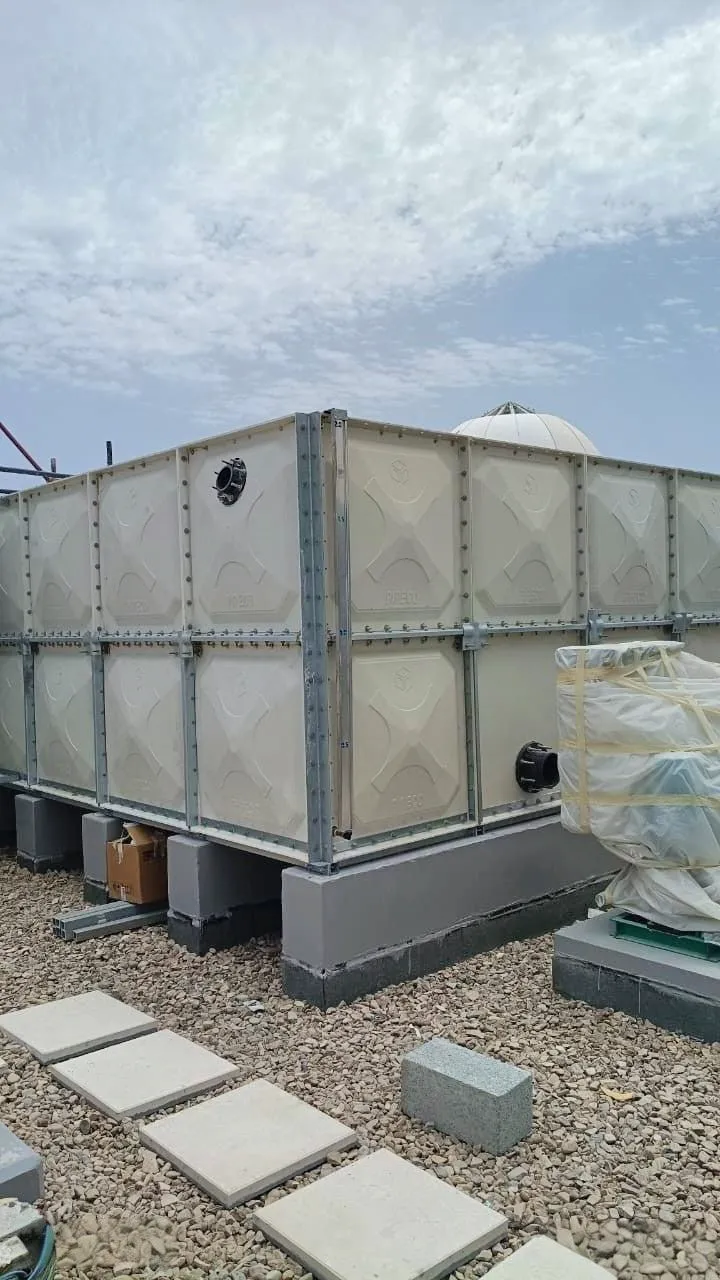
The manufacturing process is an important part of supplier evaluation because it can influence panel consistency, dimensional accuracy, surface quality, and production repeatability.
For compression-molded composite panels, buyers may wish to understand how the manufacturer controls:
The purpose is not necessarily to dictate the manufacturer's production method. Instead, the buyer should confirm that the supplier has a controlled and repeatable manufacturing process appropriate for the intended tank application.
This is particularly important when a project requires a large number of standardized panels.
Quality control should cover more than the appearance of the finished panels.
A professional GRP water tank supplier should have a systematic approach to checking the components before shipment.
Depending on the project requirements, inspection may include:
The exact inspection requirements should be established according to the tank design, applicable standards, customer specification, and intended application.
Sectional GRP tanks depend on multiple panels being assembled into one complete structure. Dimensional variation between individual components can make installation more difficult and may affect alignment at panel joints.
This is why manufacturing consistency is important even when individual panels appear visually acceptable.
A buyer should therefore consider whether the supplier has appropriate dimensional-control procedures rather than evaluating quality only from photographs of finished tanks.
A sectional water tank contains many joints, so the connection and sealing system deserves particular attention during procurement.
The buyer should confirm:
The sealing system should be considered as part of the complete tank design.
A high-quality panel cannot compensate for an incorrectly assembled joint. Conversely, a well-designed connection system depends on panels and flanges being manufactured with appropriate dimensional accuracy.
The scope of installation should be clarified before the purchase order is issued.
Depending on the project, the supplier may provide:
These items should be clearly identified in the commercial and technical quotation.
A quotation that excludes critical installation components may initially appear less expensive but create additional procurement and coordination work later.
The purchase price of the tank is only one part of the total project cost.
A more useful approach is to consider the total cost associated with procurement, transportation, installation, operation, and maintenance.
The project cost may include:
A low initial quotation can become less attractive if it requires significant additional work after delivery.
For example, incomplete technical drawings may create coordination problems. Missing accessories may require local replacement. Poorly defined installation procedures may increase labor time. An unsuitable tank configuration may require modifications to the foundation or surrounding piping.
The better purchasing decision is therefore usually based on the complete project scope rather than the tank price alone.
For international projects, technical manufacturing capability is only one part of supplier qualification.
The buyer should also consider whether the supplier has experience handling:
This becomes particularly important for large sectional tanks because a project may involve many panels, accessories, fasteners, gaskets, and supporting components.
A supplier with an organized project-delivery process can reduce the risk of missing components and technical misunderstandings during installation.
For larger projects, it can be useful to create a structured supplier comparison sheet rather than evaluating quotations informally.
| Evaluation Category | Supplier A | Supplier B | Supplier C |
|---|---|---|---|
| Tank capacity | ✓ | ✓ | ✓ |
| Site dimensions | Review | Review | Review |
| Material specification | Review | Review | Review |
| Panel configuration | Review | Review | Review |
| Connection system | Review | Review | Review |
| Quality documentation | Review | Review | Review |
| Installation support | Review | Review | Review |
| Delivery scope | Review | Review | Review |
| Total project cost | Review | Review | Review |
The purpose of this comparison is not to identify the supplier with the most impressive marketing claims. It is to determine which supplier provides the most complete and technically appropriate solution for the actual project.
Some warning signs deserve additional attention during procurement.
A capacity and price quotation may be sufficient for an initial budget estimate, but it is not enough for detailed engineering procurement.
If important information about dimensions, materials, connections, accessories, or installation requirements is missing, the buyer may not be comparing equivalent products.
A professional supplier should be able to explain why a particular tank configuration is appropriate for the required capacity and site conditions.
The absence of a defined inspection process can make it difficult to evaluate production consistency.
Buyers should carefully check whether gaskets, bolts, ladders, manholes, vents, drains, and other accessories are included or excluded.
A tank should not be selected without considering the available footprint, access route, foundation, and surrounding pipework.
Before placing a purchase order, it is useful to request the technical documents necessary for project review and installation.
Depending on the project, these may include:
Not every project requires every document. The appropriate documentation should be determined by the project specification and applicable regulations.
Procurement checklist: Before approving a GRP water tank quotation, make sure the capacity, dimensions, material specification, connection system, accessories, foundation requirements, installation scope, quality documentation, delivery scope, and warranty conditions are clearly defined.
Before requesting a final quotation, it is useful to prepare a basic project specification. Providing complete information allows the supplier to recommend a suitable tank configuration and reduces the possibility of repeated technical revisions.
The following checklist can be used by project owners, consultants, contractors, and purchasing teams.
| Project Requirement | Information to Provide |
|---|---|
| Tank application | Potable water, fire water, process water, irrigation, etc. |
| Required capacity | Required storage volume |
| Installation location | Indoor, outdoor, rooftop, ground level, basement, etc. |
| Available space | Maximum length, width, and height |
| Water conditions | Water type, temperature, and relevant chemistry |
| Environmental conditions | UV, temperature, humidity, wind, corrosive atmosphere, etc. |
| Foundation | Existing or new foundation and available dimensions |
| Pipe connections | Inlet, outlet, drain, overflow, vent, and other connections |
| Access conditions | Doorways, corridors, lifting equipment, transportation route |
| Applicable requirements | Project specifications, local regulations, standards, and certifications |
| Delivery requirements | Destination, packaging, shipping, and required delivery schedule |
A simple decision matrix can help project teams identify which factors should receive the greatest attention during selection.
| Project Condition | Important Selection Consideration |
|---|---|
| Limited floor space | Optimize tank footprint and height |
| Large storage capacity | Evaluate sectional construction and structural requirements |
| Restricted building access | Consider modular panel transportation and on-site assembly |
| Rooftop installation | Verify structural support and load transfer |
| Outdoor installation | Review UV and environmental exposure |
| Cold climate | Consider insulation and freeze-protection strategy |
| Potable water | Confirm applicable material and regulatory requirements |
| Industrial application | Review water chemistry and material compatibility |
| Remote project | Evaluate transportation, packaging, and installation support |
| Complex building services | Coordinate tank connections with piping and maintenance access |
A detailed RFQ can significantly improve the accuracy of a water tank quotation.
Instead of sending only a message such as “Please quote a 100 m3 GRP water tank,” buyers should provide as much relevant project information as possible.
A useful RFQ may include:
If drawings or site layouts are available, they can also help the supplier evaluate the proposed tank configuration more accurately.
A water tank manufacturer can only make an appropriate recommendation when the relevant project conditions are known.
For example, the same nominal capacity may require different configurations depending on whether the tank is installed:
Providing project information at the beginning of the procurement process can therefore reduce redesign, quotation revisions, installation problems, and unexpected project costs.
Capacity is essential, but it does not define the complete tank configuration. Dimensions, water depth, installation space, foundation, and connections must also be considered.
A lower price may exclude accessories, installation support, documentation, or other project requirements. Always compare equivalent technical scopes.
The foundation should be considered before the tank is ordered. A tank configuration that does not match the available support structure may require expensive modifications.
The tank may fit the final location while individual components cannot reach it. Access routes should be checked before confirming the tank configuration.
Potable water, fire water, process water, and other applications may have different material, regulatory, and operational requirements.
Tank connections should be coordinated with the surrounding pipe system. Pipe support, valve access, drainage, overflow, and maintenance requirements should be considered during design.
The total project cost can include transportation, foundation work, installation, accessories, commissioning, and future maintenance. A complete cost comparison is more useful than comparing tank prices alone.
Start by defining the required storage capacity, water application, installation location, available space, environmental conditions, foundation, access route, and connection requirements. The tank configuration should then be selected according to the complete project conditions rather than capacity alone.
The required tank size depends on the required storage volume and the project's operating requirements. The available footprint and maximum allowable height should also be considered because different combinations of length, width, and height can provide similar storage capacities.
GRP sectional tanks can be suitable for large-capacity water storage when the tank and supporting structure are properly designed. Their modular construction can also simplify transportation and installation where a large one-piece tank would be difficult to move into the final location.
Yes, GRP water tanks can be used for rooftop applications when the building structure and supporting system are designed to carry the filled tank and associated loads. The tank should be selected together with the structural support arrangement rather than considered separately.
A sectional GRP tank is assembled from individual factory-manufactured panels at the project site, while a one-piece tank is normally transported as a completed or largely completed vessel. Sectional construction can be advantageous for large tanks or sites with restricted transportation and access conditions.
Compare more than price and capacity. Review the tank dimensions, material specification, panel configuration, connection system, accessories, quality-control procedures, technical documentation, installation support, delivery scope, and warranty conditions.
Provide the required capacity, installation location, available dimensions, water application, environmental conditions, foundation information, pipe connections, applicable standards, destination, and delivery requirements. Site drawings or layouts can also help the supplier recommend a suitable configuration.
GRP water tanks can be used outdoors when the material system, surface protection, accessories, and overall tank specification are appropriate for the expected environmental conditions. UV exposure, temperature, weather, and maintenance requirements should be considered during project specification.
A sectional GRP water tank generally requires a level, rigid, and adequately supported foundation capable of carrying the filled tank. The exact foundation dimensions and structural requirements depend on tank capacity, configuration, site conditions, and project-specific engineering requirements.
Provide the required capacity, tank dimensions or available space, application, installation location, water type, environmental conditions, foundation information, connection requirements, destination, and any applicable project standards. Providing complete information allows the supplier to prepare a more accurate technical and commercial proposal.
Selecting a GRP water tank is an engineering and procurement decision rather than simply a product comparison.
The most appropriate solution depends on how the tank will actually be used and installed. Capacity, dimensions, water depth, foundation, installation location, environmental exposure, water quality, access conditions, piping, maintenance, and regulatory requirements should all be considered before the final specification is approved.
For projects with restricted access or large storage requirements, a GRP sectional water tank can provide a practical modular solution because the individual panels can be transported separately and assembled at the final installation site.
However, sectional construction alone does not guarantee a successful project. The complete system still depends on appropriate tank configuration, supporting structure, connection details, installation quality, and project-specific engineering.
For buyers comparing different suppliers, the most useful approach is to evaluate the complete technical scope rather than focusing only on price. A reliable quotation should clearly define the tank capacity, dimensions, material specification, accessories, connection system, documentation, installation requirements, and delivery scope.
By establishing these requirements before procurement, project owners and engineers can reduce technical uncertainty, improve quotation comparability, and select a GRP water storage solution that is better matched to the actual site and operating conditions.
PIPECO provides GRP water storage solutions for commercial, industrial, infrastructure, and other project applications. For sectional tank projects, the required capacity, installation conditions, available space, water application, and project specifications can be reviewed before the tank configuration is finalized.
When requesting a quotation, customers can provide the required capacity, installation location, available dimensions, water application, environmental conditions, and other project requirements. This information helps the technical team evaluate a suitable configuration and prepare the corresponding technical and commercial proposal.
Whether you are planning a new water storage system or replacing an existing tank, selecting the appropriate configuration at the beginning of the project can help simplify transportation, installation, coordination, and long-term operation.
Contact PIPECO to discuss your GRP water tank requirements and request a project-specific solution.
Experience the brand Trusted by Renowned Companies across the GLOBE.
Pipeco stands at the forefront of the market, recognized as a premier manufacturer, supplier, and exporter specializing in top-tier GRP water tanks, stainless steel water tanks, and FRP Water Tank, Fiberglass Tank, SMC Water Tank committed to delivering unparalleled quality and excellence.
Get In Touch
Email: master@pipeco.cn
Tel: 0086-576-84616026
Address: No.2 Zhaofeng Road, Xinqian Street, Huangyan District, Taizhou City, Zhejiang Province, China