
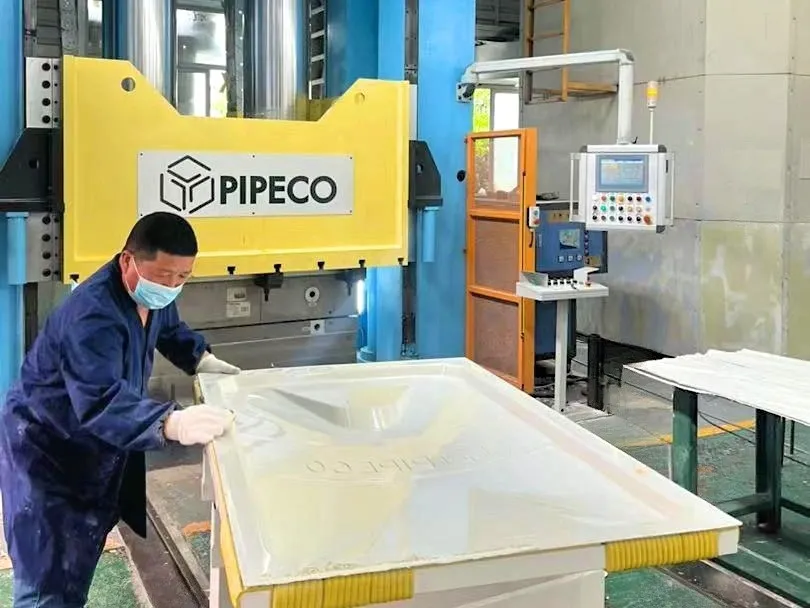
GRP water tank panels are engineered composite components designed to form the structural walls, roof, and other sections of a sectional water storage system. Their performance depends not only on the properties of glass reinforced plastic itself, but also on material formulation, panel structure, molding technology, dimensional accuracy, curing, and quality control.
For this reason, manufacturing a reliable GRP water tank panel is more than simply combining resin and glass fiber. The production process must provide consistent material distribution, controlled thickness, accurate panel geometry, reliable connection areas, and sufficient structural performance under long-term hydrostatic loading.
Modern sectional GRP water tanks commonly use factory-produced panels that are assembled at the installation site. Depending on the product design and manufacturing technology, panels may be produced using SMC compression molding and other composite manufacturing methods. Proper control of these processes helps achieve repeatable panel quality and reliable tank assembly.
This guide explains how GRP water tank panels are manufactured, what materials are used, how panel structure affects performance, and which quality-control procedures are important before the finished panels are shipped to a project site.
GRP stands for Glass Reinforced Plastic. It is a composite material in which glass fibers provide structural reinforcement within a polymer resin matrix. Because the reinforcing glass fibers contribute strength and stiffness while the resin protects and binds the reinforcement, GRP can provide a useful combination of mechanical performance, corrosion resistance, and relatively low weight.
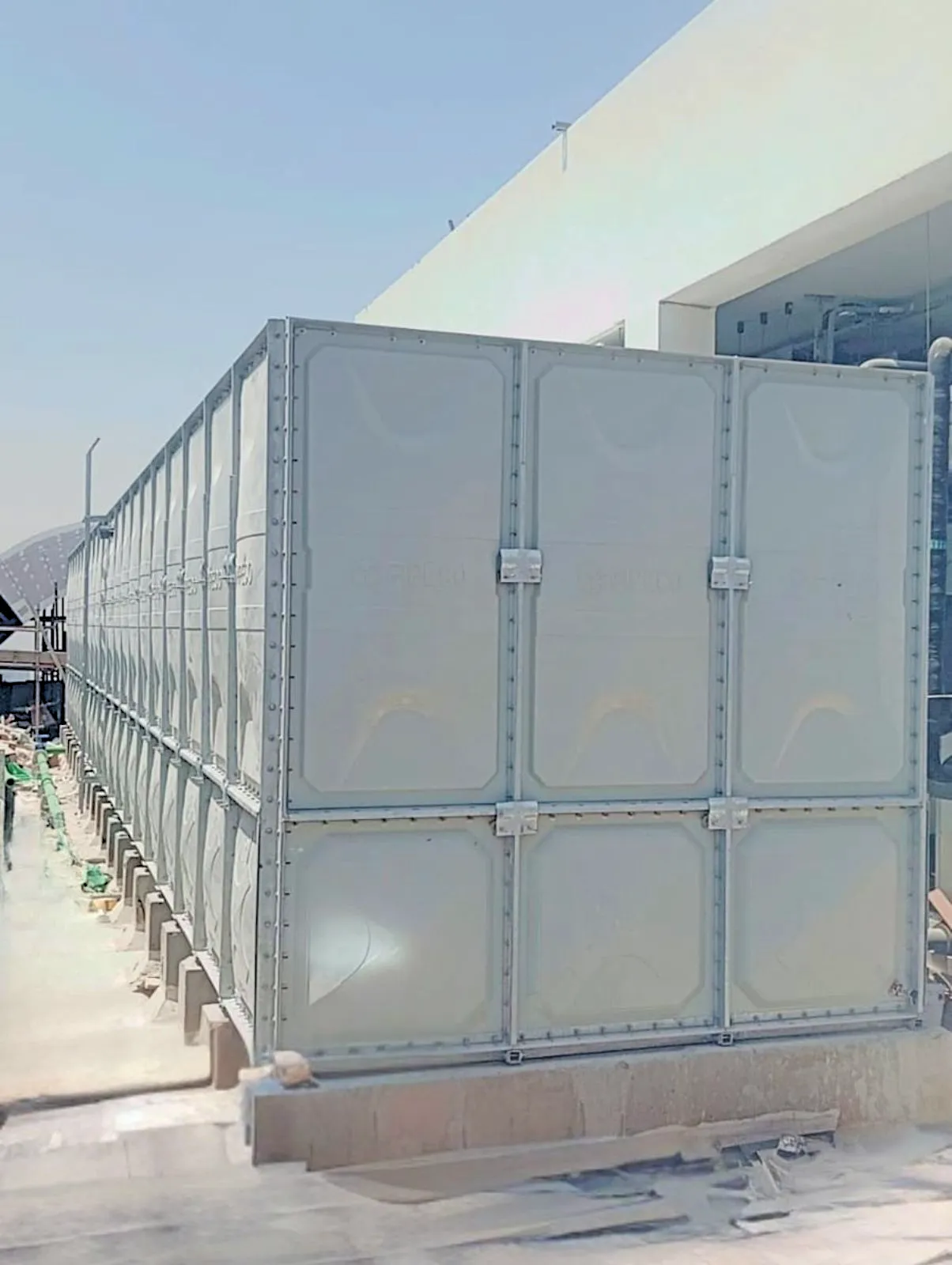
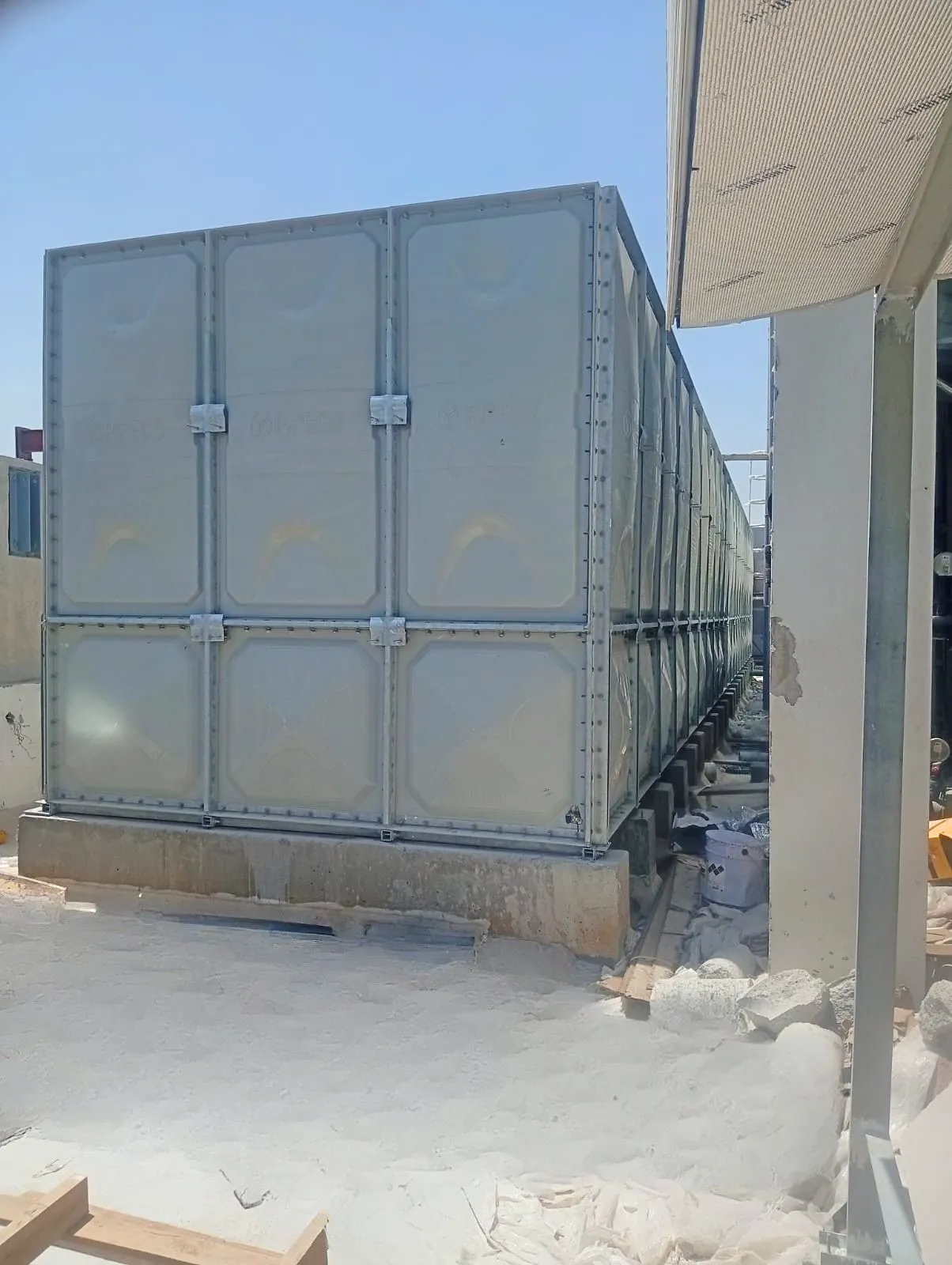
In a sectional water tank, GRP panels are manufactured as individual components rather than producing the complete tank as one large structure. These panels are then connected using bolts, sealing systems, internal or external reinforcement, and supporting components according to the tank design.
This modular construction approach provides several practical advantages for large-capacity water storage projects. Individual panels can be manufactured under controlled factory conditions, packed for transportation, carried into locations with restricted access, and assembled on site.
The final performance of the tank therefore depends on both panel manufacturing quality and assembly quality. A dimensionally accurate panel with consistent mechanical properties makes it easier to achieve proper alignment, reliable bolted connections, and effective sealing during installation.
The terminology used in the composite tank industry can sometimes be confusing because GRP, FRP, and fiberglass are often used in overlapping ways.
FRP means Fiber Reinforced Plastic and is a broad category of polymer composites reinforced with fibers. When the reinforcing fiber is glass, the material is generally described as GRP, or Glass Reinforced Plastic.
The term fiberglass is also widely used in the water tank market, particularly in North American commercial terminology. In many water storage applications, a fiberglass tank therefore refers to a tank manufactured from a glass-fiber-reinforced polymer composite.
For sectional water tanks, the more important engineering question is not which terminology is used, but how the composite material is formulated, how the glass reinforcement is distributed, how the panel is formed, and how the finished component is inspected.
Engineering terminology in simple terms:
The performance of a GRP tank panel begins with its composite material system. A typical composite formulation combines reinforcing fibers, resin, fillers, and additives. The exact formulation depends on the required mechanical properties, manufacturing process, environmental conditions, and intended water storage application.
For water tank panels manufactured using SMC compression molding, material consistency is particularly important because the molding compound must flow and cure correctly inside the mold. Variations in fiber content, resin distribution, moisture, or material preparation can influence the quality of the finished panel.
Glass fiber is the primary structural reinforcement in most GRP water tank panels. It contributes tensile strength, stiffness, and resistance to deformation.
The performance of the finished panel depends not simply on the presence of glass fiber, but on how effectively the reinforcement is distributed throughout the composite. Uneven fiber distribution can create local variations in mechanical properties and may reduce the consistency of panel performance.
For this reason, professional composite manufacturing requires controlled material preparation and molding conditions rather than relying only on the nominal fiber content of the raw material.
The resin matrix surrounds the reinforcing fibers and transfers loads between them. It also provides the composite with much of its resistance to moisture and environmental exposure.
The selected resin system should be appropriate for the intended water storage environment. Factors such as water contact, temperature, chemical exposure, and expected service conditions should be considered when defining the material specification.
For a water tank panel, the resin system therefore plays two roles: it contributes to the mechanical behavior of the composite and helps protect the reinforcing structure from the surrounding environment.
Composite molding compounds may also contain mineral fillers, curing agents, pigments, release additives, and other formulation components. These ingredients can influence processing behavior, dimensional stability, surface appearance, and curing characteristics.
The formulation should be controlled consistently from batch to batch. Even when the basic resin and glass fiber systems remain unchanged, variations in the compound can affect molding behavior and finished panel quality.
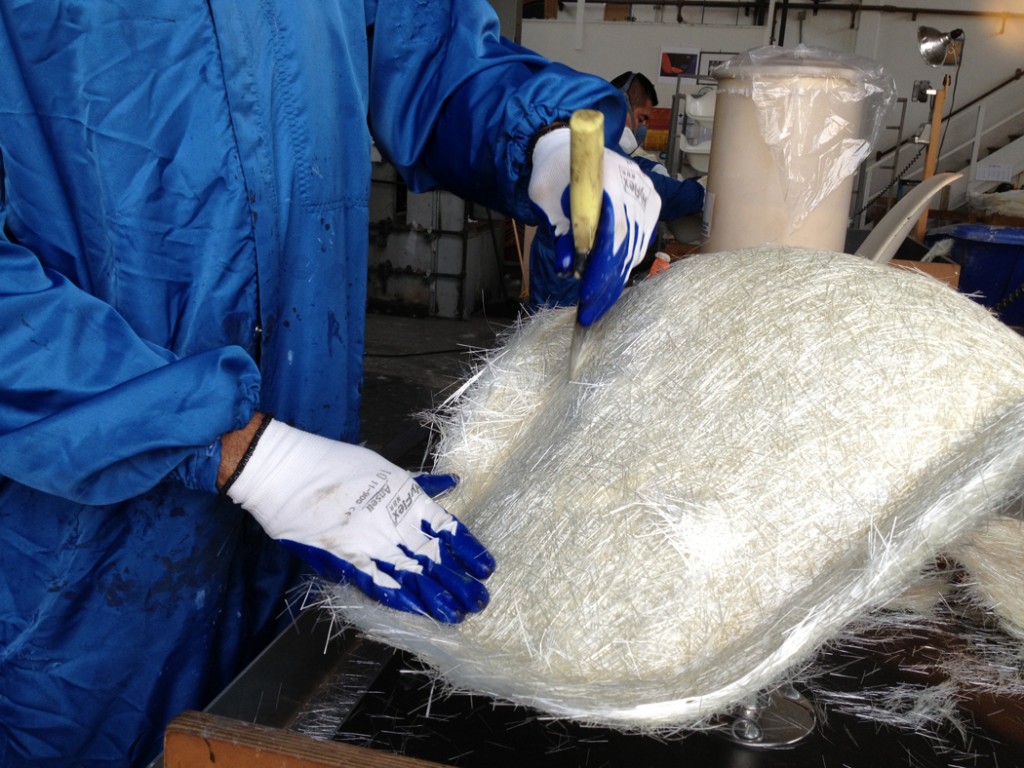
SMC, or Sheet Molding Compound, is a prepared composite material designed for compression molding. It typically contains resin, chopped glass fibers, mineral fillers, and chemical additives formulated into a sheet-like molding compound.
During production, a controlled quantity of SMC is placed into a heated mold. A hydraulic press then applies pressure while the material flows into the mold cavity and cures under controlled temperature conditions.
This process is particularly useful for sectional GRP water tank panels because the same mold geometry can be repeatedly used to produce panels with consistent dimensions.
Compared with manually fabricated composite structures, controlled compression molding can reduce variations between individual panels. This is important for sectional tank construction because multiple panels must fit together accurately during site assembly.
Important: SMC is a molding compound and manufacturing material, not a separate category of water tank comparable to GRP, stainless steel, or HDPE. In many sectional tank applications, SMC is used to manufacture the GRP panels that form the finished water storage structure.
A water tank panel may appear simple from the outside, but it must perform as a structural component throughout the operating life of the tank. Internal hydrostatic pressure creates loads on the panel surfaces, while connections transfer forces between adjacent panels and supporting structures.
If material properties vary significantly from one panel to another, the structural response of the assembled tank may also become less predictable.
Consistent material preparation therefore helps manufacturers control several important characteristics, including:
These factors become particularly important when a large number of identical panels are required for a sectional GRP water tank. Manufacturing consistency allows the panels to be assembled more efficiently while reducing the risk of dimensional mismatch and connection problems.
The manufacturing route can be summarized as a controlled sequence in which material preparation, mold design, forming, curing, finishing, and inspection work together.
Each stage affects the next. For example, inaccurate mold geometry can produce dimensional problems that later affect panel assembly, while insufficient control of molding conditions can influence curing and mechanical consistency.
This is why the manufacturing process should be considered as an integrated system rather than a series of independent production steps.
For many sectional GRP water tanks, panel manufacturing is based on a controlled compression molding process. The objective is not simply to shape the composite material, but to produce panels with repeatable geometry, consistent thickness, stable mechanical properties, and reliable connection dimensions.
The compression molding process combines a prepared SMC charge, a precision mold, controlled temperature, and hydraulic pressure. When these parameters are properly coordinated, the composite material flows through the mold cavity and cures into the required tank panel configuration.
The relationship between these parameters is important. Excessive or insufficient pressure, uneven mold temperature, incorrect material loading, or inadequate curing can all influence the final panel quality.
The mold defines the basic geometry of the GRP water tank panel. Before production begins, the mold surface must be cleaned and prepared so that the composite material can form consistently against the cavity.
Mold accuracy directly affects panel dimensional accuracy. If the cavity contains dimensional deviations, surface damage, contamination, or accumulated release-agent residue, these conditions can be transferred to subsequent panels.
A well-maintained compression mold should therefore provide:
For sectional tank panels, dimensional consistency is particularly important because individual panels must be assembled together at the project site. Small deviations repeated across many panels can accumulate and make alignment more difficult.
Before compression molding, a predetermined quantity of SMC is placed into the mold. The amount and positioning of the material must be controlled according to the panel design.
Material loading is not simply a matter of filling the mold. The initial placement of the SMC influences how the material flows when pressure is applied.
If the charge is poorly positioned, the material may not distribute uniformly throughout the cavity. This can contribute to variations in thickness, local fiber distribution, surface quality, or resin-rich and resin-deficient regions.
For this reason, the charge pattern should be established according to the geometry of the specific GRP tank panel rather than relying on an arbitrary loading arrangement.
After the SMC material is loaded, the hydraulic press closes the mold and applies controlled compression force. The pressure causes the material to flow through the mold cavity before the resin system cures.
The objective is to achieve sufficient material flow to fill the designed cavity while maintaining controlled pressure throughout the molding cycle.
The relationship can be simplified as:
Compression force → Material flow → Cavity filling → Panel geometry → Final structural consistency
If the applied force is not appropriate for the material formulation and mold design, several problems may occur. Insufficient compression can result in incomplete filling or dimensional defects, while unsuitable pressure conditions can affect material distribution and mold loading.
For production of large GRP water tank panels, press capacity, mold rigidity, panel area, material formulation, and processing conditions should therefore be considered together.
Temperature is one of the most important variables in compression molding because the resin system must cure within a controlled thermal environment.
The mold temperature influences material flow, curing speed, surface quality, and the time required for each molding cycle.
If the mold temperature is uneven, different areas of the same panel may cure at different rates. This can contribute to dimensional variation, inconsistent surface appearance, or differences in the final composite structure.
For this reason, professional compression molding equipment uses a controlled heating system to maintain the mold within the required processing range.
Why temperature uniformity matters:
The exact molding temperature and cycle time should be established according to the SMC formulation, panel design, mold construction, and validated production process rather than applying one fixed temperature to every composite product.
During the compression molding cycle, the resin system undergoes a chemical curing reaction. The composite gradually develops the final structure required for the finished panel.
The curing stage must be sufficiently controlled to achieve the required material properties without unnecessarily extending the production cycle.
Incomplete curing can reduce the consistency of the finished composite and may affect dimensional stability and mechanical performance. Excessive or poorly controlled thermal exposure, on the other hand, can also create processing problems.
A reliable manufacturing process therefore defines a repeatable combination of:
Once the curing cycle is completed, the mold is opened and the finished GRP panel is removed.
Demolding should be performed carefully because the panel may still have temperature-related dimensional changes immediately after removal from the mold. Improper handling can also damage edges, connection features, or finished surfaces.
After demolding, the panel may undergo trimming or other finishing operations depending on the product design. Excess material around edges and openings should be removed according to defined dimensional requirements.
At this stage, the panel should already have the basic geometry required for sectional tank assembly. Finishing operations should therefore refine the component rather than compensate for major molding inaccuracies.
The importance of compression molding is not limited to production speed. The process directly influences the consistency of the finished GRP tank panels.
When material preparation, pressure, temperature, mold geometry, and curing are properly controlled, manufacturers can achieve repeatable panel dimensions and more consistent production quality.
This is particularly valuable for sectional water tanks because a complete tank may contain a large number of individual panels. Every panel must work as part of the assembled structure.
For example, dimensional variation in a single panel may appear insignificant. However, when multiple panels are assembled along a wall, repeated dimensional errors can make bolt-hole alignment and sealing more difficult.
Therefore, manufacturing accuracy has a direct relationship with installation quality.
A professional GRP tank panel production line should control the main molding parameters rather than relying solely on operator experience.
| Process Parameter | Why It Matters | Potential Effect of Poor Control |
|---|---|---|
| SMC charge weight | Determines the amount of material available to form the panel | Thickness variation or incomplete filling |
| Material placement | Influences material flow inside the mold | Uneven distribution or local defects |
| Compression force | Controls mold closing and material consolidation | Incomplete filling or unstable molding conditions |
| Mold temperature | Controls material flow and curing behavior | Uneven curing or dimensional instability |
| Cure time | Determines whether the resin system reaches the required cured condition | Insufficient or inconsistent final properties |
| Mold surface condition | Affects panel surface quality and demolding | Surface defects or release problems |
A sectional GRP water tank is assembled from multiple standardized components. This makes manufacturing repeatability one of the most important links between factory production and successful site installation.
If each panel is manufactured within controlled dimensional tolerances, the installation team can align adjacent panels more efficiently. Consistent bolt-hole locations also help maintain connection accuracy, while controlled panel thickness supports more predictable structural behavior.
This creates an important manufacturing chain:
Process control → Panel consistency → Assembly accuracy → Connection quality → Tank performance
In other words, the quality of a finished GRP sectional water tank cannot be separated completely from the manufacturing process used to produce its panels.
Long-term tank performance is influenced by many factors, including material selection, structural design, installation, operating conditions, and maintenance. However, manufacturing quality establishes the initial condition of every panel before it reaches the project site.
Consistent compression molding can help manufacturers control the dimensional and material characteristics required for reliable tank assembly. It also makes it possible to establish repeatable production parameters and inspection procedures.
This is why compression molding should be evaluated as part of the complete GRP water tank engineering process rather than simply as a production method.
For a deeper explanation of how compression molding influences strength, dimensional precision, and service life, readers can also refer to our related technical article: How Compression Molding Maximizes Strength, Precision, and Lifespan of GRP Water Tank Panels.
The material properties of a GRP water tank panel are only one part of its structural performance. The geometry of the panel, its thickness, reinforcement ribs, connection areas, and load-transfer design also determine how the panel behaves after the tank is filled with water.
A sectional GRP water tank is a modular structure. Individual panels are connected together to form the tank walls, while the completed structure transfers hydrostatic loads through the panels, joints, reinforcement members, and supporting foundation.
For this reason, GRP tank panel design should not be evaluated only by looking at material strength. The complete structural system must be considered.
Panel thickness is one of the basic parameters affecting the structural behavior of a GRP water tank panel. A thicker panel generally provides greater resistance to bending and deformation, but thickness alone does not determine the final performance of the component.
The required thickness depends on factors such as panel dimensions, water depth, reinforcement geometry, material properties, connection configuration, and the expected loading conditions.
For a sectional water tank, the hydrostatic pressure increases with water depth. A simplified relationship can be expressed as:
Hydrostatic pressure = Water density × Gravitational acceleration × Water depth
This means that the lower sections of a tank wall generally experience higher hydrostatic pressure than the upper sections.
Consequently, panel design should consider the changing load condition over the height of the tank rather than treating every location as being subjected to identical pressure.
Reinforcement ribs are commonly incorporated into GRP tank panel designs to increase stiffness and control deformation without relying solely on increasing the overall panel thickness.
A properly designed rib changes the effective structural geometry of the panel. Instead of behaving as a relatively flexible flat surface, the reinforced panel can resist bending more effectively under hydrostatic loading.
The effectiveness of a reinforcement rib depends on its geometry, position, connection with the panel, and the loads that it is intended to transfer.
Important considerations include:
The goal is not simply to add as many ribs as possible. Reinforcement should be positioned where it provides meaningful structural benefit while remaining compatible with the manufacturing process and tank assembly requirements.
A reinforcement rib changes the stiffness distribution of a panel. If the geometry is too small, it may provide limited structural benefit. If it is poorly positioned or designed with abrupt transitions, it may create localized stress concentrations.
This is particularly important around areas where the panel changes direction or connects with another structural feature.
A well-designed GRP panel therefore aims to achieve a balance between:
This engineering approach allows the panel to achieve the required structural performance without unnecessarily increasing material consumption.
Water stored inside a tank generates hydrostatic pressure against the surrounding walls. Unlike an empty tank, a filled tank therefore creates a continuous structural load over the entire wetted wall area.
The pressure is relatively low near the water surface and increases with depth. The bottom portions of the tank wall consequently require particular attention during structural design.
The load path can be simplified as:
Stored water → Panel surface → Panel bending and reinforcement → Panel connections → Tank supporting structure → Foundation
This load path is important because a tank panel does not work in isolation. The surrounding panels, bolts, flanges, reinforcement members, and foundation all contribute to the behavior of the completed structure.
In a sectional GRP water tank, adjacent panels are connected through designed joint systems. These connections must maintain alignment while transferring loads between neighboring components.
The quality of the connection therefore affects both structural performance and water tightness.
If adjacent panels do not align correctly, the connection may experience uneven loading. This can increase local stress around bolt holes, flanges, or sealing areas.
Accurate panel manufacturing is therefore directly related to connection performance during installation.
The flange is one of the most important regions of a sectional GRP tank panel because it performs both structural and sealing functions.
Adjacent panels are typically connected through overlapping or mating flange areas using bolts, nuts, washers, sealing materials, and other connection components specified by the tank design.
The flange must therefore provide sufficient local stiffness while maintaining dimensional accuracy.
Several factors should be controlled during manufacturing and assembly:
A panel may have adequate overall structural strength but still experience installation or leakage problems if the flange area is poorly manufactured or incorrectly assembled.
Bolt holes introduce local discontinuities into a panel. Whenever a structural component contains an opening, the load distribution around that opening changes.
For GRP tank panels, bolt-hole areas should therefore be considered during structural design and manufacturing inspection.
Important factors include hole diameter, edge distance, local reinforcement, bolt arrangement, washer dimensions, and tightening conditions.
If the hole is positioned too close to the panel edge, the remaining material may not provide sufficient local resistance. If the connection is overtightened, excessive local compression can also damage the composite around the connection.
Proper connection design distributes the clamping force over an appropriate area while maintaining sufficient contact between the mating surfaces.
When a GRP tank is filled, hydrostatic pressure tends to push the wall panels outward. The panel must resist this load through a combination of material stiffness, panel geometry, reinforcement, and connections.
The resulting deformation depends on the interaction of these factors rather than on material strength alone.
For example, increasing panel stiffness through appropriate reinforcement can reduce deflection without requiring the entire panel to become substantially thicker.
This is one reason why engineering design of composite water tank panels focuses on both material properties and structural geometry.
Strength and stiffness are related but should not be treated as identical properties.
Strength describes the ability of a component to withstand a load without unacceptable failure, while stiffness describes its resistance to deformation under that load.
A panel may have sufficient ultimate strength but still experience excessive deformation if its stiffness is not appropriate for the application.
For water tank engineering, controlling deformation is important because excessive panel movement can influence:
Therefore, a well-designed GRP water tank panel should be evaluated for both structural strength and acceptable deformation under the expected operating loads.
Corners are another important part of a sectional water tank because they connect multiple wall directions and can influence the distribution of structural loads.
A tank corner should maintain the required geometry while allowing the connected panels and sealing system to work together.
Poorly controlled corner dimensions can create assembly difficulties, while inadequate local reinforcement can increase deformation or stress concentration.
For this reason, corner geometry should be considered during mold design, structural analysis, and dimensional inspection.
The roof panels of a sectional GRP water tank operate under different loading conditions from the side wall panels.
Wall panels are primarily influenced by hydrostatic pressure from stored water, while roof structures may experience loads associated with their own weight, maintenance access, environmental conditions, supporting members, and other project-specific requirements.
The design of roof panels should therefore not simply duplicate the design of vertical wall panels.
Where maintenance personnel or equipment may access the tank roof, the applicable project requirements and safety provisions should be considered during structural design.
One of the major advantages of GRP composite construction is its ability to provide useful structural performance at relatively low weight compared with many traditional materials.
The engineering principle is not to make a panel strong simply by adding more material. Instead, the composite material, panel geometry, reinforcement, and load path are designed together.
This can provide a favorable balance between:
For large sectional water tanks, reduced panel weight can be particularly useful when the project has restricted site access or when panels must be transported through narrow entrances, stairways, or other difficult routes.
A GRP water tank should not be evaluated solely by the strength of an individual panel. The completed tank is a system consisting of panels, joints, bolts, sealing components, reinforcement members, roof structures, supports, and foundations.
The interaction between these components determines how loads are transferred through the finished structure.
Depending on the project requirements, structural verification may include analytical calculations, finite element analysis, physical testing, or a combination of these methods.
For large-capacity or technically demanding projects, engineering analysis can help identify high-stress areas and verify that panel deformation and connection behavior remain within the specified design requirements.
Engineering principle: A reliable GRP sectional water tank is not created by material strength alone. Reliable performance comes from the combination of composite material properties, panel geometry, reinforcement, accurate connections, controlled manufacturing, and proper foundation support.
Manufacturing a GRP water tank panel is only the first step. Before panels are released for shipment, their dimensions, surface condition, material consistency, connection features, and other specified characteristics should be inspected according to the applicable product and project requirements.
Quality control is particularly important for sectional GRP water tanks because the finished tank is assembled from many individual panels. A small dimensional or manufacturing variation in one component can become more significant when multiple panels are joined together.
A reliable quality-control system therefore needs to cover both the individual panel and the assembled tank system.
The exact inspection requirements depend on the tank design, applicable standards, project specifications, and manufacturing process. However, professional production typically considers several fundamental inspection categories.
| Inspection Category | What Is Checked | Why It Matters |
|---|---|---|
| Dimensions | Panel length, width, thickness, flange dimensions and geometry | Ensures proper panel fit and assembly |
| Surface condition | Cracks, voids, blisters, exposed fibers and visible defects | Helps maintain panel integrity and surface quality |
| Thickness | Specified panel thickness and local thickness consistency | Supports predictable structural performance |
| Bolt-hole accuracy | Hole diameter, position and spacing | Improves connection alignment during assembly |
| Flange condition | Flatness, geometry and sealing surface condition | Supports reliable bolted joints and sealing |
| Material and process records | Material batch, molding parameters and production records | Improves traceability and process consistency |
Dimensional accuracy is one of the most important quality characteristics for a sectional GRP water tank panel. The panel must conform to the intended mold geometry so that multiple components can be assembled correctly.
Typical dimensional checks may include:
Dimensional inspection is particularly valuable when large numbers of identical panels are produced. Statistical process monitoring can help identify gradual changes in mold condition or manufacturing parameters before they result in significant production problems.
A sectional GRP tank depends on the accurate alignment of adjacent panels. If dimensions vary beyond the intended tolerance, installers may encounter difficulty aligning bolt holes or maintaining consistent joint geometry.
Improper alignment can then affect sealing and connection quality.
The relationship can therefore be expressed as:
Dimensional control → Panel alignment → Connection accuracy → Sealing quality → Tank reliability
This is why dimensional inspection should not be considered merely an aesthetic or manufacturing requirement. It directly affects the installation performance of the finished tank.
Panel thickness is another important quality characteristic because structural calculations and product specifications are based on defined material and geometric properties.
Thickness should be checked at appropriate locations according to the applicable inspection procedure. The objective is not simply to confirm one nominal measurement, but to identify unacceptable local variation.
Potential causes of thickness variation include:
If significant thickness variation is detected, the manufacturing process should be investigated rather than simply accepting the individual panel.
The surface of a GRP water tank panel should be visually inspected for defects that could indicate problems with material preparation, molding, curing, handling, or finishing.
Depending on the panel design and specification, inspection may consider visible conditions such as:
Not every visible surface variation represents a structural defect. Acceptance criteria should therefore be based on defined product specifications rather than subjective visual judgment alone.
The flange area requires particular attention because it contributes to both structural connection and water tightness.
During inspection, manufacturers should verify that the flange geometry is consistent with the specified design and that the connection surfaces are free from damage that could interfere with sealing.
Bolt-hole locations should also be checked for dimensional accuracy. Incorrect hole spacing can make assembly difficult and may force installers to apply excessive adjustment or mechanical force during installation.
The objective is to ensure that adjacent panels can be connected without creating unintended local stresses.
The curing condition of a composite panel has a direct relationship with its final material properties. For compression-molded SMC panels, curing is controlled through the combination of material formulation, mold temperature, pressure, and cycle time.
Manufacturers should establish production parameters based on the validated material and molding process rather than relying only on visual appearance.
Process records can be particularly useful because they provide evidence that panels were manufactured under the intended conditions.
Depending on the manufacturer's quality system, production records may include:
Where required by the product specification or applicable standard, representative GRP panels may undergo mechanical testing to verify specified performance characteristics.
Depending on the design, testing may evaluate properties such as:
The specific tests and acceptance criteria should be determined according to the applicable product standards, project requirements, and material system.
It is important to distinguish between material testing and complete tank structural verification. A material test provides information about a particular property of the composite, while full tank performance also depends on panel geometry, connections, reinforcement, supports, and installation conditions.
For a water storage tank, structural strength alone is not sufficient. The completed system must also maintain water tightness.
Potential leakage paths may occur at:
This means leakage prevention is not determined by the GRP panel material alone. It depends on the combination of accurate panel manufacturing, proper sealing materials, connection design, bolt installation, and site assembly.
After installation, the completed tank may be subjected to a controlled filling and inspection procedure according to the project requirements. The purpose is to identify leakage or abnormal deformation before the tank enters normal service.
Understanding common manufacturing problems helps buyers and quality engineers evaluate the production process more effectively.
| Potential Problem | Possible Manufacturing Cause | Potential Effect |
|---|---|---|
| Uneven thickness | Incorrect charge weight or material distribution | Inconsistent structural behavior |
| Incomplete molding | Insufficient material flow or unsuitable process conditions | Dimensional or surface defects |
| Surface voids | Material, molding or processing problems | Reduced surface quality and possible local weakness |
| Warping | Uneven curing, temperature variation or residual stress | Difficult panel alignment |
| Incorrect bolt-hole position | Mold or machining dimensional error | Assembly difficulty |
| Damaged flange | Demolding, handling or transportation damage | Connection or sealing problems |
| Inconsistent surface finish | Mold surface condition or process variation | Appearance and quality concerns |
Not every problem found in a GRP water tank originates in the factory. Some defects are caused during transportation, handling, or site installation.
For example, a correctly manufactured panel can still be damaged if it is dropped during unloading. Similarly, a correctly positioned bolt hole does not guarantee a leak-free joint if the sealing material is incorrectly installed or the bolts are improperly tightened.
For this reason, quality assurance should cover the entire supply chain:
Material → Manufacturing → Inspection → Packaging → Transportation → Installation → Commissioning
A professional supplier should therefore provide not only consistent panels, but also appropriate installation guidance and technical documentation for the project.
Before GRP water tank panels leave the factory, final inspection should confirm that the products meet the applicable specifications and are suitable for transportation and site assembly.
A practical factory inspection program may include:
The exact inspection plan should be established according to the tank design, applicable standards, customer requirements, and quality-control system used by the manufacturer.
Factory quality control establishes the condition of the panels before shipment, but the final performance of a sectional GRP water tank also depends on site conditions.
During installation, the following factors can affect the finished tank:
Therefore, the best GRP water tank manufacturing process should be supported by clear installation instructions and technical documentation.
Key takeaway: Quality control of a GRP water tank panel is not limited to checking whether the finished component looks good. Effective quality assurance verifies the dimensions, material consistency, structural features, connection areas, manufacturing records, and other characteristics that influence the performance of the completed tank.
The performance of a GRP water tank is determined by more than the nominal properties of its composite material. Manufacturing quality influences the dimensional accuracy, structural consistency, connection performance, and installation behavior of every individual panel.
This is particularly important for sectional tanks because the final structure is assembled from multiple factory-manufactured components. The quality of the complete tank is therefore closely related to the consistency of the individual panels.
A useful engineering relationship can be expressed as:
Material Quality + Manufacturing Accuracy + Structural Design + Assembly Quality = Overall GRP Tank Performance
If one of these factors is significantly below the required level, the performance of the completed water storage system may be affected.
Manufacturing problems do not always appear immediately after a panel leaves the production line. Some effects may only become visible during assembly, tank filling, or long-term operation.
Understanding the relationship between manufacturing defects and potential field problems is therefore important when evaluating a GRP water tank supplier.
| Manufacturing or Quality Issue | Possible Result During Installation | Potential Long-Term Effect |
|---|---|---|
| Dimensional variation | Difficulty aligning adjacent panels | Connection stress or sealing problems |
| Flange deformation | Uneven joint contact | Potential leakage at panel connections |
| Incorrect bolt-hole position | Difficulty installing bolts | Uneven connection loading |
| Uneven panel thickness | Inconsistent component fit | Variation in structural behavior |
| Insufficient curing | Unstable panel characteristics | Potential reduction in expected performance |
| Surface or laminate defects | Additional inspection or rejection | Possible local durability concerns depending on severity |
| Warped panels | Difficulty maintaining alignment | Additional stress at joints or supports |
A properly designed and manufactured GRP water tank can provide long-term service, but composite structures can still experience problems when material selection, manufacturing, structural design, installation, or operating conditions are not properly controlled.
The following failure modes are particularly relevant when evaluating sectional GRP water tank systems.
When a tank is filled, hydrostatic pressure acts against the wall panels. If panel stiffness or reinforcement is insufficient for the design condition, the panel may experience excessive deformation.
Some deformation under load is normal for structural components. The important consideration is whether the calculated or measured deformation remains within the applicable design requirements.
Potential causes include:
Structural analysis and appropriate design verification can help identify these issues before production.
Leakage in a sectional GRP water tank most commonly requires investigation of the connection system rather than assuming that the GRP material itself is defective.
Potential causes may include:
This demonstrates why panel dimensional accuracy and installation quality are closely connected to water tightness.
Connection areas are subjected to localized loads generated by bolt clamping and the structural forces transferred between adjacent panels.
Damage may occur if the connection is improperly designed, incorrectly drilled, overtightened, or subjected to excessive external loads.
During installation, bolts should therefore be tightened according to the manufacturer's specified procedure rather than simply applying the maximum available torque.
Composite panels may be damaged by impact during handling, transportation, or installation. Local damage can be more important than it initially appears because the affected region may be located near a connection or load-bearing feature.
Panels should therefore be inspected after transportation and before installation. Any significant damage should be evaluated according to the manufacturer's repair or rejection criteria.
Even a correctly manufactured GRP water tank panel can perform poorly if the tank is installed on an unsuitable foundation.
The supporting foundation should provide the required levelness, stiffness, and load distribution for the tank design.
An uneven foundation can introduce unintended loads into the tank structure and may make panel alignment more difficult.
This highlights an important engineering principle:
Good panels cannot compensate for an unsuitable supporting structure.
Factory production and site installation are two stages of the same engineering process. The manufacturer controls the panel geometry and material quality, while the installation team determines how those components are assembled into the final structure.
For example, accurate bolt-hole positioning has limited value if the panels are assembled incorrectly. Similarly, a carefully manufactured flange cannot provide reliable sealing if the gasket is damaged or improperly positioned.
The complete performance chain is therefore:
Factory Manufacturing → Quality Inspection → Transportation → Site Assembly → Commissioning → Operation
A professional GRP water tank supplier should understand this complete chain rather than treating panel manufacturing as an isolated activity.
When comparing GRP water tank manufacturers, buyers should look beyond product photographs and nominal tank capacity. A reliable supplier should be able to explain how the panels are manufactured, how dimensions are controlled, and how finished components are inspected.
The following questions can help buyers evaluate a potential supplier.
Ask whether the manufacturer has direct control over the key production stages, including material preparation, molding, curing, trimming, inspection, and packaging.
Direct process control can make it easier to maintain consistent production parameters and trace manufacturing problems when they occur.
For compression-molded GRP or SMC panels, buyers should understand the basic molding technology used to produce the panels.
Important questions include:
The objective is not to select a supplier based on one machine specification, but to determine whether the manufacturer has a controlled and repeatable production process.
A professional supplier should be able to provide appropriate technical information for the proposed tank system.
Depending on the project, this may include:
The exact documentation required will depend on the application, project specifications, local regulations, and applicable standards.
Water storage projects do not always have identical site conditions. Available installation space, tank capacity, access limitations, water quality, environmental conditions, and foundation configuration may vary significantly between projects.
A capable GRP water tank manufacturer should therefore be able to evaluate project-specific requirements rather than simply offering one standard configuration for every application.
Before requesting a quotation, buyers should prepare sufficient project information so that the supplier can recommend an appropriate tank configuration.
Useful information may include:
Providing this information early can help reduce unnecessary changes during the design and quotation process.
The same basic GRP sectional tank technology can be adapted to different project environments, but environmental conditions should still be considered during material selection and structural design.
Outdoor tanks are exposed to sunlight, temperature changes, wind, rain, and other environmental conditions. Material selection and tank design should therefore consider the expected outdoor environment.
Rooftop installations require particular attention to structural support, foundation conditions, access, and overall building loads. The tank should not be treated as an independent object without considering the structure supporting it.
Industrial or water treatment projects may involve operating conditions that differ from ordinary potable water storage. Chemical exposure, temperature, water composition, and cleaning procedures should be considered when defining the appropriate composite material system.
One practical advantage of sectional GRP tanks is that individual panels can be transported and assembled at locations where moving a large one-piece tank would be difficult.
This can be useful for rooftop projects, buildings with restricted access, remote infrastructure projects, and other locations where transportation constraints affect tank selection.
The manufacture of a GRP water tank panel is only one stage in the development of a complete water storage system. Reliable performance requires the integration of materials, molding technology, panel structure, quality inspection, connection design, installation, and foundation conditions.
The overall engineering process can be summarized as:
Engineering takeaway: The quality of a GRP water tank is established long before the tank is filled with water. Material selection, panel structure, compression molding, dimensional accuracy, quality inspection, connection design, and installation all contribute to the reliability of the finished system.
A sectional GRP water tank may remain in service for many years, which means the initial quality of its panels can have a long-term influence on system performance.
Consistent manufacturing helps ensure that panels begin their service life with predictable dimensions, material characteristics, and connection geometry. Combined with appropriate structural design and correct installation, this provides a stronger foundation for reliable water storage.
For project owners and procurement teams, the key question should therefore not simply be “What material is the tank made from?” but also:
These questions provide a more complete way to evaluate the quality of a GRP water tank system.
GRP water tank panels are generally manufactured from a glass-fiber-reinforced polymer composite. Depending on the manufacturing technology, the material system may include glass fiber, polymer resin, mineral fillers, curing agents, and other additives. SMC (Sheet Molding Compound) is one commonly used prepared composite material for compression-molded tank panels.
GRP water tank panels can be manufactured using controlled composite molding processes. For SMC compression-molded panels, the process generally includes mold preparation, controlled material loading, compression molding, temperature control, curing, demolding, finishing, and quality inspection. The exact process depends on the panel design and specified material system.
GRP describes the glass-reinforced polymer composite material, while SMC describes a prepared molding compound used in compression molding. In many sectional water tank applications, SMC is used as the molding material to manufacture GRP tank panels. Therefore, SMC and GRP are not simply two competing tank materials; they describe different aspects of the material and manufacturing system.
Compression molding allows composite material to be formed under controlled pressure and temperature using a defined mold geometry. This can provide repeatable panel dimensions, consistent surface characteristics, controlled curing, and efficient production of multiple standardized panels. These characteristics are particularly useful for sectional GRP water tanks that require many panels to fit together accurately.
Panel thickness influences the stiffness and structural behavior of a GRP tank panel, but thickness alone does not determine the performance of the complete tank. Panel dimensions, reinforcement ribs, material properties, hydrostatic pressure, connection design, support conditions, and other project-specific factors must also be considered when determining the appropriate panel structure.
Reinforcement ribs increase the stiffness of a panel and can help control deformation under hydrostatic loading. Properly designed ribs allow structural performance to be improved without relying only on increasing the overall panel thickness. Their geometry, spacing, position, and connection with the panel should be considered as part of the overall structural design.
Yes. Factory inspection can include dimensional measurements, thickness checks, visual inspection, flange and bolt-hole inspection, surface-quality evaluation, manufacturing record verification, and other tests specified by the project or applicable standards. The exact inspection plan depends on the tank design and customer requirements.
Leakage can have several causes and does not necessarily indicate a problem with the GRP material itself. Potential causes include incorrect gasket installation, damaged sealing surfaces, panel misalignment, incorrect bolt tightening, flange deformation, or problems around pipe penetrations. Reliable water tightness depends on panel manufacturing, connection design, sealing materials, and correct site installation.
GRP sectional tanks can be used for a wide range of water storage applications when the tank is properly designed for the required capacity, water depth, environmental conditions, and installation requirements. Because sectional tanks are assembled from individual panels, they can also be practical for projects where transportation or site access limits the use of large one-piece tanks.
Buyers should ask about the panel material system, manufacturing process, panel dimensions, structural design, quality-control procedures, applicable standards, connection system, installation requirements, and available technical documentation. Project information such as capacity, installation location, available footprint, water type, foundation conditions, and site access should also be provided so the supplier can evaluate the appropriate tank configuration.
A GRP water tank panel may look like a relatively simple composite component, but its final performance is determined by a combination of material science, manufacturing technology, structural engineering, and quality control.
The manufacturing process begins with the selection and preparation of a suitable composite material. For compression-molded panels, SMC provides a controlled molding compound that can be formed into repeatable panel geometries under controlled pressure and temperature.
From there, mold accuracy, material loading, compression force, temperature control, curing, and demolding all influence the quality of the finished component.
The engineering process does not end when the panel leaves the mold. Panel thickness, reinforcement ribs, flange geometry, bolt-hole accuracy, dimensional consistency, and surface condition all affect how individual panels perform when assembled into a complete sectional GRP water tank.
Quality control therefore needs to connect manufacturing parameters with real tank performance. Dimensional accuracy affects panel alignment. Panel alignment affects connection quality. Connection quality affects sealing and load transfer. Together, these factors contribute to the reliability of the finished water storage system.
For project owners and procurement teams, evaluating a GRP water tank manufacturer should therefore involve more than comparing tank capacity or material descriptions. Understanding how GRP water tank panels are manufactured provides a much more useful basis for evaluating product consistency, engineering capability, and long-term project reliability.
Pipeco provides GRP and composite water storage solutions for projects requiring sectional tank construction, factory-manufactured panels, and practical on-site assembly.
For a project quotation, customers can provide the required tank capacity, installation location, dimensions, application, environmental conditions, and other project requirements. Pipeco can then evaluate the appropriate tank configuration and provide the corresponding technical information.
Whether the project involves commercial water storage, industrial applications, firefighting water storage, infrastructure projects, or other sectional tank requirements, the right panel design and manufacturing process should be selected according to the actual operating conditions.
Contact Pipeco to discuss your GRP water tank project and obtain a suitable technical solution.
Experience the brand Trusted by Renowned Companies across the GLOBE.
Pipeco stands at the forefront of the market, recognized as a premier manufacturer, supplier, and exporter specializing in top-tier GRP water tanks, stainless steel water tanks, and FRP Water Tank, Fiberglass Tank, SMC Water Tank committed to delivering unparalleled quality and excellence.
Get In Touch
Email: master@pipeco.cn
Tel: 0086-576-84616026
Address: No.2 Zhaofeng Road, Xinqian Street, Huangyan District, Taizhou City, Zhejiang Province, China