
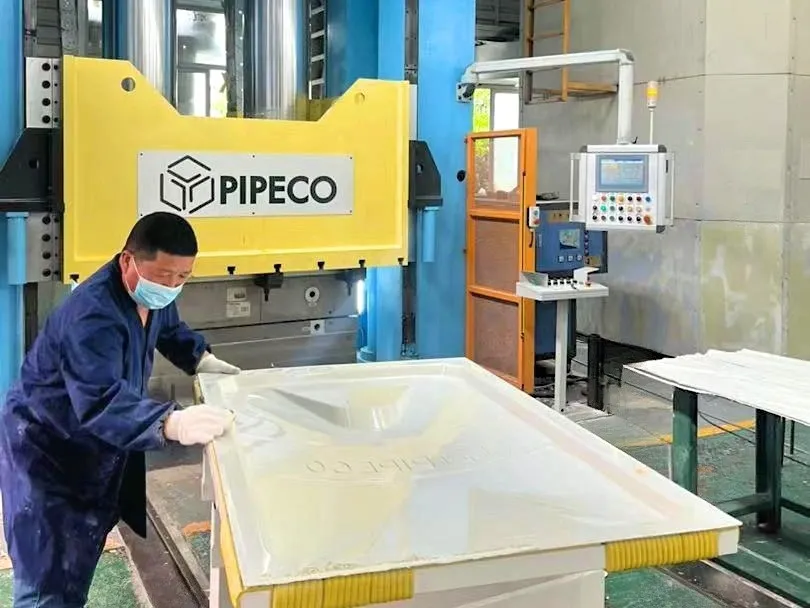
The performance of a GRP water tank depends not only on its design, but also on how its panels are manufactured. Two tanks may appear similar from the outside, yet differences in production technology can significantly influence structural strength, dimensional accuracy, surface quality, long-term durability, and installation performance.
Among the various manufacturing methods used for composite products, compression molding has become one of the most widely adopted technologies for producing high-quality GRP water tank panels. By applying controlled heat and pressure within precision-engineered molds, manufacturers can achieve consistent panel geometry, stable mechanical properties, and repeatable production quality.
This article explains how compression molding contributes to stronger, more accurate, and more durable GRP water tank panels. Rather than focusing solely on manufacturing, we examine the engineering principles behind the process and how they affect the performance of the finished water storage system.
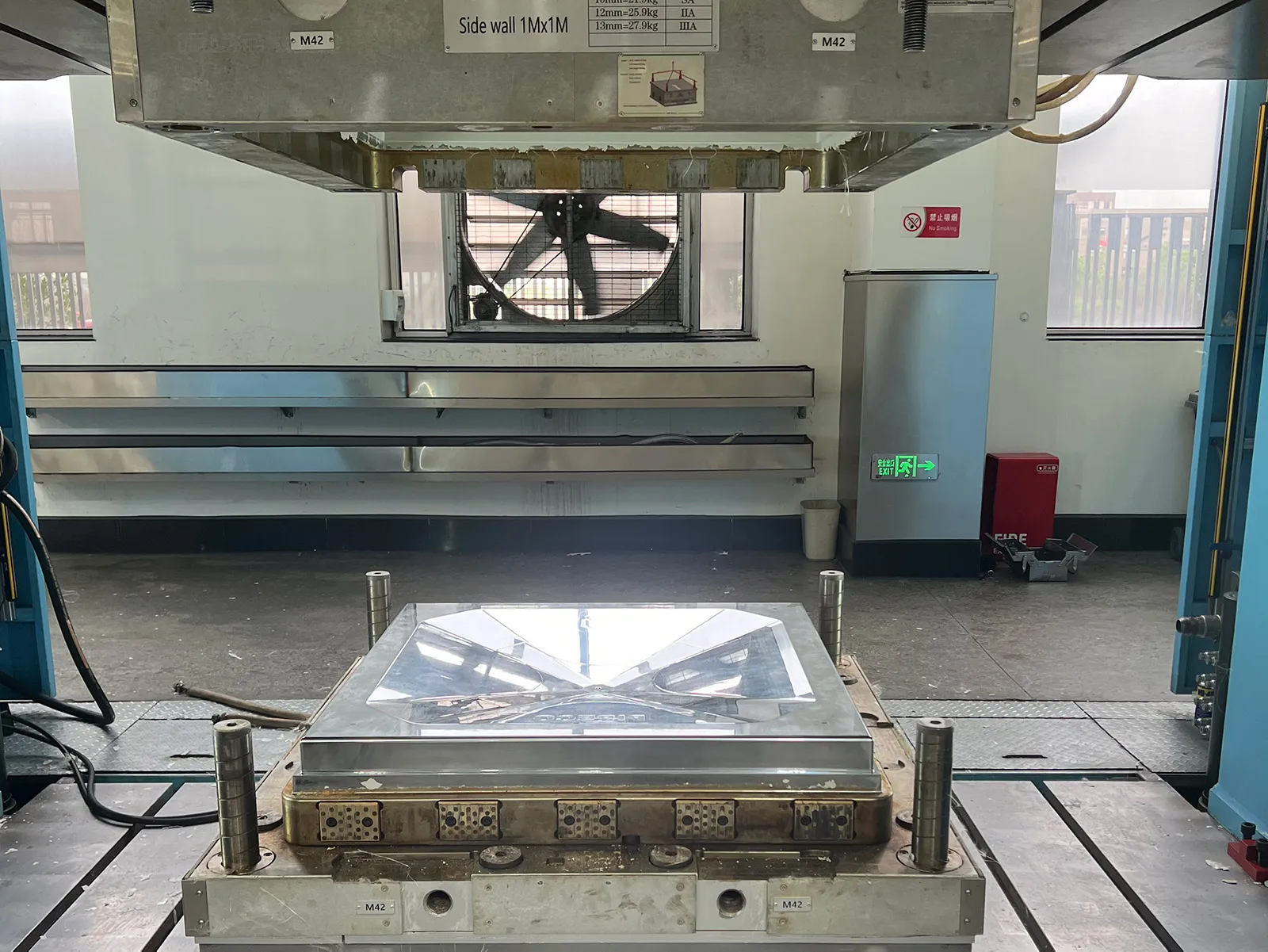
When engineers specify a water storage system, they evaluate much more than the material itself. Manufacturing quality influences almost every aspect of a GRP panel, including thickness consistency, fiber distribution, dimensional tolerance, surface finish, stiffness, and long-term structural reliability.
Even when two manufacturers use similar raw materials, differences in molding technology can produce noticeably different results. Factors such as curing pressure, mold precision, temperature control, and process repeatability all contribute to the final quality of the composite panel.
For sectional GRP water tanks, these characteristics directly affect installation quality, sealing reliability, and overall service life.
Compression molding is a manufacturing process in which a measured quantity of composite material—commonly Sheet Molding Compound (SMC)—is placed into a heated precision mold. The mold then closes under controlled pressure, allowing the material to flow, fill the cavity, and cure into its final shape.
Unlike open-mold processes, compression molding uses matched metal molds that define both sides of the finished panel. This helps produce accurate dimensions, consistent thickness, and repeatable surface quality from one production cycle to the next.
| Production Stage | Purpose |
|---|---|
| SMC Material Preparation | Prepare composite charge with controlled fiber and resin content. |
| Material Placement | Position material inside the mold cavity. |
| Mold Closing | Apply pressure to distribute the material uniformly. |
| Heat and Cure | Polymerize the resin under controlled temperature. |
| Demolding | Remove the finished GRP panel. |
| Inspection | Verify dimensions and surface quality. |
One of the primary engineering advantages of compression molding is its ability to consolidate the composite material under pressure. As the mold closes, the SMC flows throughout the cavity, distributing reinforcing fibers while reducing internal voids and improving material density.
A well-controlled molding process contributes to more uniform mechanical properties across the entire panel. Consistent fiber distribution helps improve structural performance and reduces localized weak areas that could affect long-term reliability.
Controlled Pressure → Uniform Material Flow → Improved Fiber Distribution → Reduced Voids → Stable Mechanical Performance
Although final mechanical properties depend on factors such as material formulation, mold design, processing parameters, and quality control, compression molding provides an effective foundation for producing high-performance composite panels.
A sectional GRP water tank may contain dozens—or even hundreds—of individual panels connected by bolts and gaskets. Small dimensional deviations can accumulate during assembly, increasing installation time and making alignment more difficult.
Because compression molding uses precision-machined matched molds, panel dimensions can be controlled more consistently than with many open-mold manufacturing methods. Better dimensional accuracy supports smoother assembly, improved gasket compression, and more uniform bolt loading across panel joints.
| Engineering Benefit | Impact on Tank Performance |
|---|---|
| Consistent Panel Size | Simplifies installation. |
| Controlled Thickness | Improves structural consistency. |
| Better Flatness | Enhances sealing performance. |
| Repeatable Production | Supports quality control. |
Maintaining consistent panel thickness is one of the fundamental objectives in composite manufacturing. Thickness variations can influence stiffness, load distribution, bolt alignment, and the overall dimensional consistency of a sectional GRP water tank.
During compression molding, the SMC charge flows throughout the mold cavity under controlled heat and pressure. When the mold design, material charge, and processing parameters are properly engineered, the process can produce panels with highly repeatable thickness and geometry.
Uniform thickness helps ensure that structural loads are distributed more evenly across the tank wall rather than concentrating in isolated areas. This contributes to predictable structural behavior throughout the service life of the tank.
Uniform Thickness
↓
More Consistent Stiffness
↓
Better Load Distribution
↓
Improved Structural Stability
The mechanical performance of a composite panel depends not only on the resin system but also on how reinforcing glass fibers are distributed throughout the laminate.
Compression molding applies pressure while the material cures, encouraging the SMC to flow and fill the mold cavity. Under properly controlled conditions, this process can improve fiber distribution and reduce internal voids compared with some open-mold manufacturing methods.
Lower void content generally contributes to improved structural integrity, better surface quality, and more stable mechanical properties. Actual results depend on material formulation, mold design, curing conditions, and production quality control.
| Manufacturing Characteristic | Potential Engineering Benefit |
|---|---|
| Controlled Material Flow | More uniform fiber distribution. |
| Pressure During Cure | Reduced void formation. |
| Matched Metal Molds | Improved dimensional repeatability. |
| Stable Process Parameters | Consistent production quality. |
The quality of the sealing surface is essential for sectional GRP water tanks because individual panels are joined together using bolts and sealing gaskets. Even small deviations in flatness may influence gasket compression and joint performance.
Compression molding produces both sides of the panel against precision-machined mold surfaces. This manufacturing approach helps achieve smooth finishes and consistent flatness, supporting reliable gasket contact during installation.
Leak prevention ultimately depends on multiple engineering factors, including panel accuracy, gasket quality, bolt tightening sequence, installation workmanship, support frame alignment, and ongoing maintenance. Manufacturing precision is one important part of this system.
Better Surface Flatness
↓
More Uniform Gasket Compression
↓
Even Bolt Loading
↓
Reliable Joint Sealing
Large sectional water tanks may contain dozens or even hundreds of individual panels. During assembly, dimensional tolerances accumulate across the structure, making manufacturing precision increasingly important.
Panels produced by compression molding benefit from matched mold construction and repeatable processing conditions. Accurate dimensions help reduce alignment adjustments during installation and improve assembly efficiency.
| Panel Characteristic | Installation Benefit |
|---|---|
| Accurate Hole Position | Faster bolt installation. |
| Consistent Panel Size | Improved structural alignment. |
| Stable Thickness | More uniform gasket compression. |
| Repeatable Geometry | Reduced installation adjustments. |
Hand lay-up has been widely used in the composite industry for many years and remains suitable for certain products, particularly low-volume or highly customized components. However, the process relies heavily on operator skill, making production consistency more difficult to maintain in high-volume manufacturing.
Compression molding, by contrast, is designed for repeatable industrial production. Automated control of pressure, temperature, and curing conditions helps improve consistency from one production cycle to the next.
| Comparison Item | Compression Molding | Hand Lay-Up |
|---|---|---|
| Production Consistency | High | Operator dependent |
| Dimensional Accuracy | High | Moderate |
| Surface Finish | Excellent | Variable |
| Thickness Uniformity | High | Variable |
| Production Efficiency | Suitable for volume production | Suitable for low-volume production |
| Repeatability | Excellent | Depends on workmanship |
Spray-up manufacturing is another open-mold composite process in which chopped glass fibers and resin are sprayed simultaneously onto a mold surface. It is commonly used for certain large composite components where production flexibility is important.
Compared with spray-up processes, compression molding generally offers greater dimensional consistency, better control of laminate thickness, and improved repeatability, particularly for engineered structural panels produced in higher volumes.
| Engineering Factor | Compression Molding | Spray-Up |
|---|---|---|
| Fiber Distribution | Controlled through SMC formulation and molding. | Depends on spray process. |
| Thickness Control | Excellent | Moderate |
| Automation Potential | High | Limited |
| Repeatability | Excellent | Moderate |
A sectional GRP water tank is only as reliable as the consistency of its individual panels. Differences in thickness, flatness, hole position, or mechanical properties can increase assembly complexity and influence long-term structural behavior.
Compression molding supports manufacturing repeatability by combining precision tooling with controlled processing parameters. While material quality, mold maintenance, curing conditions, and inspection procedures all remain important, a stable production process helps manufacturers deliver panels with predictable performance across multiple production batches.
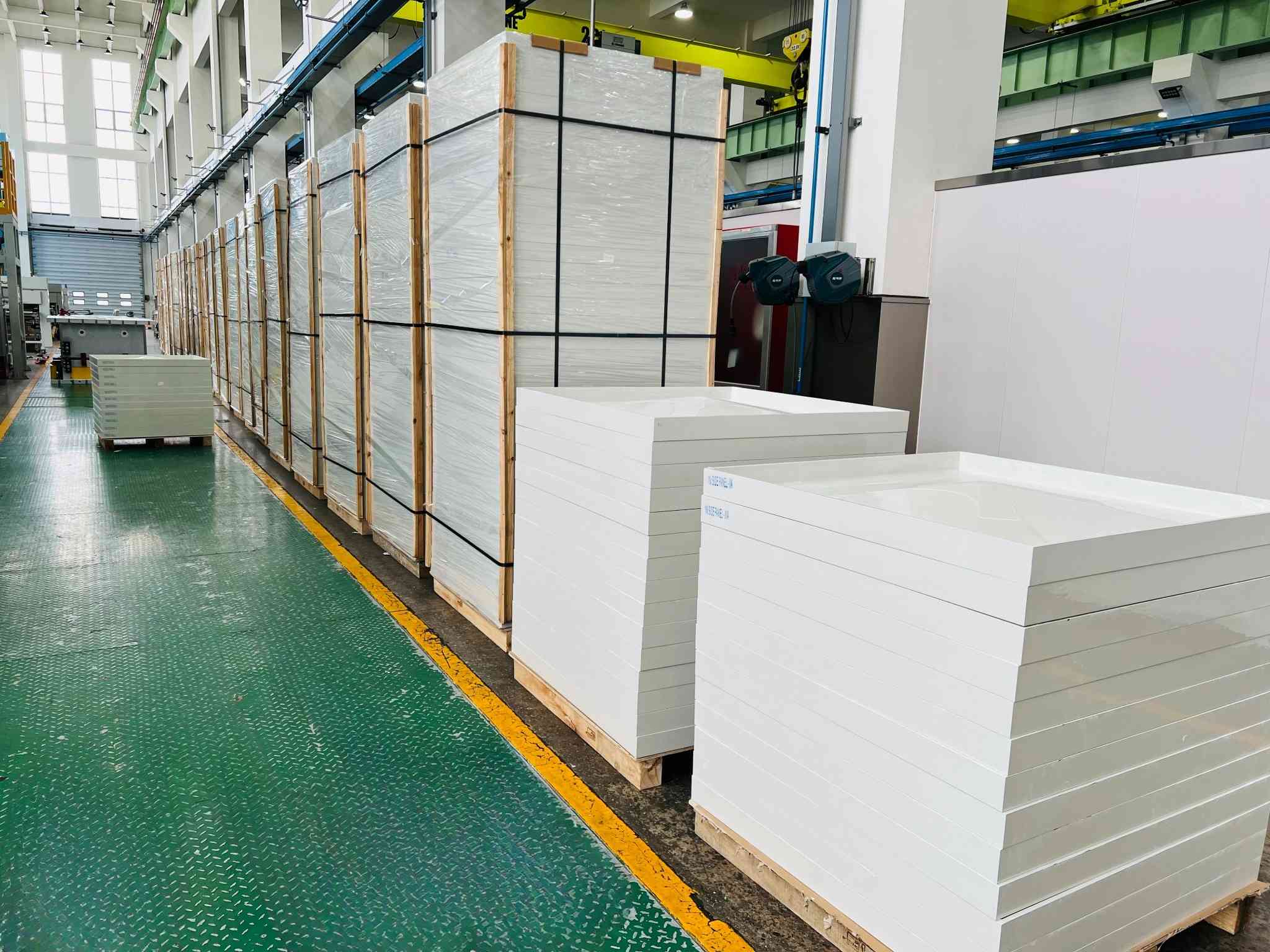
A sectional GRP water tank functions as an integrated structural system rather than a collection of individual panels. Every panel, bolt, gasket, internal tie rod, and steel support member contributes to the tank's overall performance.
When compression-molded panels are manufactured with consistent dimensions and mechanical properties, the assembled tank can achieve more predictable load transfer and improved structural uniformity. Although the final performance also depends on engineering design, installation quality, support frame construction, and maintenance, manufacturing consistency provides an important foundation for reliable operation.
Compression Molding
↓
Consistent GRP Panels
↓
Accurate Assembly
↓
Uniform Load Distribution
↓
Improved Structural Reliability
Every water tank is subjected to hydrostatic pressure generated by the weight of stored water. This pressure increases with depth, meaning the lower panels experience significantly higher loads than the upper sections of the tank.
To perform reliably, each panel must transfer these loads efficiently to adjacent panels, bolted joints, internal reinforcements, and the supporting steel framework. Consistent panel geometry helps maintain proper contact between connected components, reducing localized stress concentrations caused by dimensional variation.
Compression molding contributes to this objective by producing repeatable panel thickness and accurate edge profiles, supporting more uniform structural behavior throughout the assembled tank.
| Structural Requirement | Importance |
|---|---|
| Panel Flatness | Supports uniform joint contact. |
| Edge Accuracy | Improves panel alignment. |
| Consistent Thickness | Helps distribute structural loads. |
| Stable Mechanical Properties | Contributes to predictable performance. |
Unlike one-piece molded tanks, sectional GRP water tanks rely on mechanical connections between panels. Hundreds of bolts may be used in a large installation, making joint design a critical engineering consideration.
When panel dimensions are consistent, bolt holes align more accurately and sealing gaskets are compressed more evenly. This allows tightening forces to be distributed more uniformly across the connection instead of concentrating around isolated points.
Although proper bolt torque, installation sequence, gasket quality, and support frame alignment remain essential, accurate panel manufacturing reduces the likelihood of assembly-related challenges.
Accurate Panel Geometry
↓
Improved Hole Alignment
↓
More Uniform Bolt Loading
↓
Reliable Joint Performance
Large sectional GRP water tanks are typically supported by galvanized or stainless steel frameworks designed to transfer loads safely to the foundation. The composite panels and support structure must work together as a coordinated engineering system.
If panel dimensions vary significantly, assembly adjustments may introduce unnecessary stress into the structure. Compression-molded panels with repeatable geometry help simplify installation and improve compatibility with engineered support frames.
This coordinated behavior becomes increasingly important as tank dimensions increase, particularly in commercial and municipal installations where storage capacities may reach hundreds of cubic meters.
| Component | Primary Function |
|---|---|
| GRP Panels | Contain stored water and transfer hydrostatic loads. |
| Steel Framework | Provide structural support. |
| Tie Rods | Control internal deformation. |
| Bolted Connections | Connect adjacent panels. |
| Foundation | Transfer loads safely to the ground. |
Water storage tanks experience repeated loading throughout their service life. Filling and emptying cycles, temperature fluctuations, maintenance operations, and environmental influences all contribute to cyclic stresses within the structure.
Although fatigue performance depends on material formulation, structural design, manufacturing quality, and operating conditions, production consistency helps reduce unnecessary stress concentrations that may influence long-term durability.
Compression molding supports repeatable panel quality by maintaining controlled processing parameters during production. Combined with appropriate engineering design and regular inspection, this contributes to reliable long-term operation.
Many GRP water tanks are installed outdoors where they are continuously exposed to sunlight, rainfall, wind, humidity, and temperature variation. Outdoor performance depends on the combined effects of material selection, resin chemistry, protective surface layers, manufacturing quality, and maintenance.
Compression molding produces dense composite panels with consistent surface characteristics that provide a suitable base for protective gel coats or UV-resistant finishes. The long-term weather resistance of the complete panel ultimately depends on the selected material system and environmental conditions.
Modern infrastructure projects increasingly emphasize durability, resource efficiency, and reduced lifecycle costs. Composite water tanks manufactured with repeatable industrial processes can support these objectives by providing reliable structural performance, efficient transportation, and modular installation.
Because sectional GRP tanks are shipped as individual panels, transportation volume can often be optimized compared with large one-piece storage systems. Modular construction also allows future capacity expansion in many applications without replacing the complete tank, helping extend the useful life of the overall water storage system.
From an engineering perspective, sustainability is achieved not only through material selection but also through manufacturing quality, structural design, maintenance planning, and the ability to adapt infrastructure as water demand evolves.
| Engineering Characteristic | Contribution to Water Tank Performance |
|---|---|
| Matched Metal Molds | Improved dimensional accuracy and repeatability. |
| Controlled Pressure | Supports uniform material consolidation. |
| Consistent Thickness | More predictable structural behavior. |
| Stable Fiber Distribution | Improved mechanical consistency. |
| Smooth Panel Surfaces | Supports effective gasket sealing. |
| Repeatable Production | Reliable quality across production batches. |
| Modular Compatibility | Simplifies assembly and future expansion. |
| Industrial Manufacturing | Suitable for consistent high-volume production. |
The performance of a GRP water tank is determined by the complete engineering chain from material selection to manufacturing, assembly, and operation. Compression molding is not an isolated production step; it is a foundation that influences the quality and reliability of the entire water storage system.
High-quality raw materials combined with precision compression molding technology help manufacturers produce GRP panels with consistent mechanical properties, accurate dimensions, and reliable surface quality. These characteristics support easier installation, improved sealing performance, and predictable structural behavior during long-term service.
Quality Materials
↓
Precision Compression Molding
↓
Consistent GRP Panels
↓
Accurate Tank Assembly
↓
Reliable Sealing Performance
↓
Long-Term Water Storage Performance
For engineers and project owners, evaluating the manufacturing process provides valuable insight into the expected performance of a GRP sectional water tank. A well-designed tank is not only defined by its appearance but also by the accuracy, consistency, and reliability of every individual component.
Modern water infrastructure projects increasingly require storage systems that provide durability, installation efficiency, and predictable long-term performance. Manufacturing consistency has therefore become an important consideration when selecting composite water tank suppliers.
Compression molding provides manufacturers with a controlled production environment where mold temperature, pressure, curing time, and material placement can be carefully managed. This repeatability allows GRP panels to meet demanding engineering requirements for commercial, industrial, and municipal applications.
| Compression Molding Advantage | Impact on GRP Water Tank Performance |
|---|---|
| Precision Mold Control | Improves panel accuracy and assembly compatibility. |
| Controlled Pressure | Enhances material consolidation. |
| Stable Curing Process | Supports consistent mechanical properties. |
| Repeatable Production | Provides reliable quality between batches. |
| Industrial Manufacturing Capability | Suitable for large-scale project requirements. |
Compression molding is used because it provides controlled pressure, temperature, and mold accuracy during composite panel production. This helps manufacturers achieve consistent thickness, dimensional accuracy, and repeatable panel quality.
Compression molding can improve panel consistency by enhancing material consolidation, reducing manufacturing variation, and supporting more uniform fiber distribution. The final strength of a GRP water tank also depends on material selection, structural design, and quality control.
Hand lay-up relies more heavily on manual operation, while compression molding uses precision molds and controlled pressure. Compression molding generally provides higher repeatability, better dimensional accuracy, and more consistent surface quality for industrial production.
Sectional GRP tanks are assembled from multiple panels connected by bolts and gaskets. Accurate panel dimensions help improve alignment, ensure more uniform gasket compression, and reduce installation difficulties.
Compression molding contributes to better panel flatness and dimensional consistency, which can support improved sealing performance. However, leakage prevention also depends on gasket selection, bolt tightening procedures, installation quality, and maintenance.
Yes. Compression molded GRP panels are widely used for sectional water tanks because their consistent quality and modular design make them suitable for commercial, industrial, and municipal storage applications.
Sheet Molding Compound (SMC) is widely used in composite manufacturing because it combines glass fiber reinforcement with resin systems to produce strong and consistent molded components. The suitability of SMC depends on the specific tank design and application requirements.
Compression molding uses controlled process parameters, including mold temperature, pressure, and curing conditions. This reduces production variation and allows manufacturers to produce multiple panels with similar characteristics.
Buyers should evaluate manufacturing technology, mold quality, material selection, quality control procedures, engineering capability, installation support, and previous project experience rather than comparing price alone.
PIPECO provides engineered GRP sectional water tank solutions for commercial, industrial, municipal, and infrastructure projects. Our team supports customers with product selection, technical communication, configuration recommendations, and export project assistance.
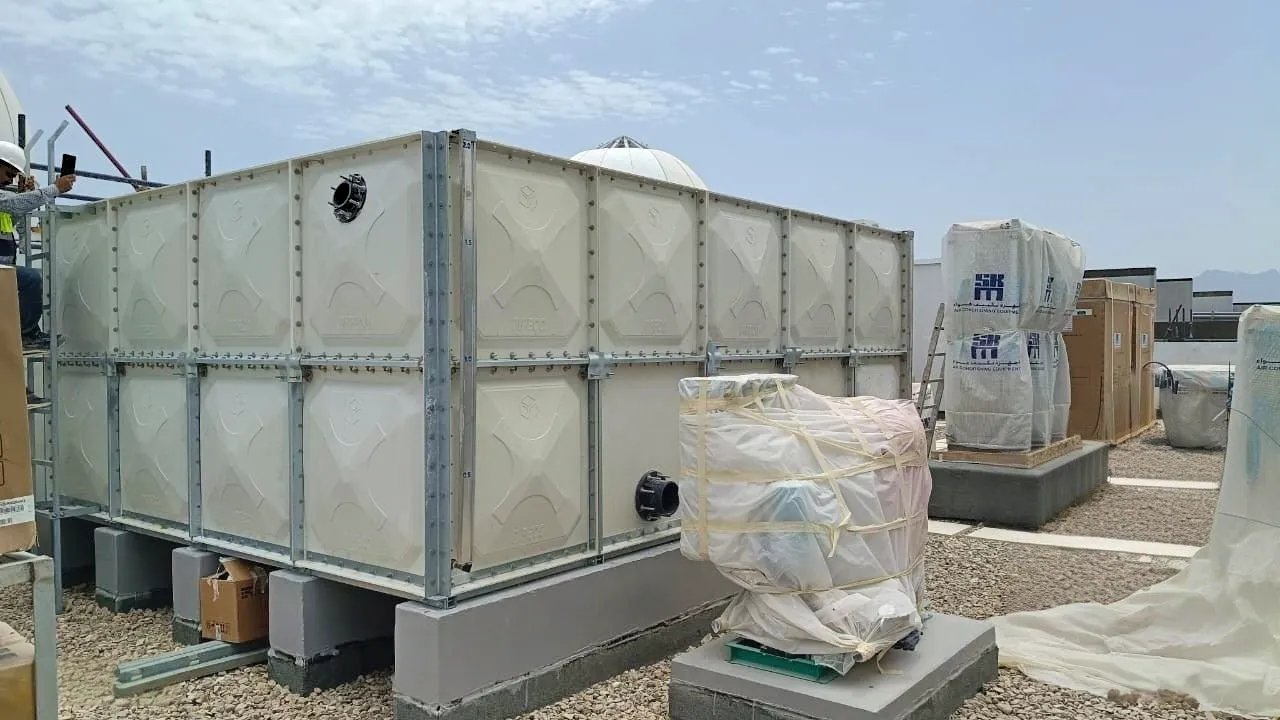
Compression molding plays an important role in improving the quality and reliability of GRP water tank panels. Through controlled pressure, precision tooling, and repeatable manufacturing conditions, this technology helps produce composite panels with improved dimensional accuracy, consistent mechanical properties, and reliable surface quality.
However, the performance of a GRP water tank depends on more than the manufacturing process alone. Material selection, structural design, support framework, installation quality, and maintenance practices all contribute to the final service performance of the complete system.
For modern water storage projects, selecting a manufacturer with advanced production capabilities and engineering experience is an important step toward achieving a durable and reliable solution.
Whether your project involves municipal water storage, industrial facilities, commercial buildings, agricultural applications, or infrastructure development, understanding the manufacturing process helps you make a more informed engineering decision.
PIPECO provides GRP sectional water tank solutions manufactured with advanced composite technologies and strict quality control procedures. Our team works with international customers, distributors, contractors, and project owners to deliver reliable water storage solutions designed for different environments and project requirements.
Experience the brand Trusted by Renowned Companies across the GLOBE.
Pipeco stands at the forefront of the market, recognized as a premier manufacturer, supplier, and exporter specializing in top-tier GRP water tanks, stainless steel water tanks, and FRP Water Tank, Fiberglass Tank, SMC Water Tank committed to delivering unparalleled quality and excellence.
Get In Touch
Email: master@pipeco.cn
Tel: 0086-576-84616026
Address: No.2 Zhaofeng Road, Xinqian Street, Huangyan District, Taizhou City, Zhejiang Province, China