
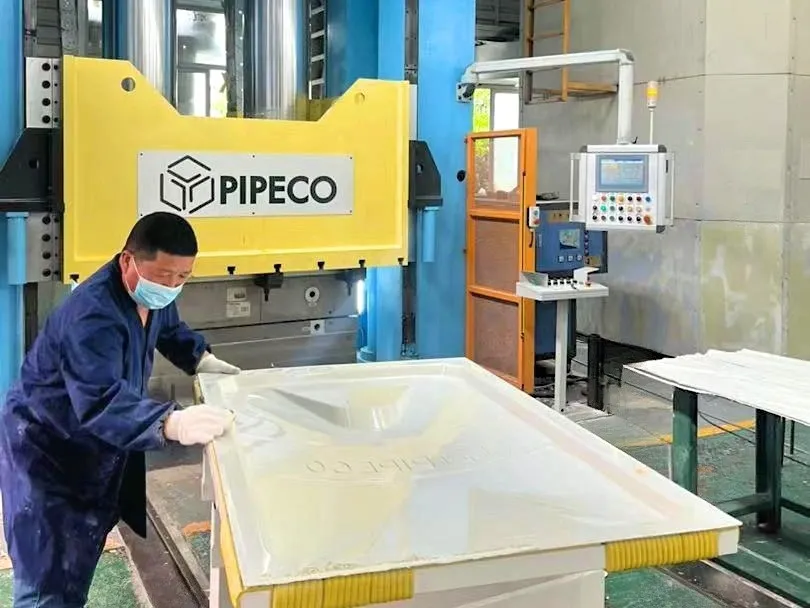
Reliable access to clean water remains one of the most significant infrastructure challenges across many regions of Africa. Rapid urbanization, population growth, climate variability, seasonal droughts, and aging water infrastructure continue to place enormous pressure on municipal authorities, industries, agricultural operations, and humanitarian organizations.
Effective water storage is far more than simply installing a tank. A modern water storage system must safely preserve water quality, withstand harsh environmental conditions, resist corrosion, minimize maintenance, and remain economically sustainable throughout decades of operation.
Among the various technologies available today, Glass Reinforced Plastic (GRP) sectional water tanks have emerged as an increasingly popular solution for African infrastructure projects. Their lightweight construction, modular design, corrosion resistance, long service life, and ease of transportation make them particularly suitable for projects ranging from urban municipal water systems to remote rural communities.
Across Africa, access to reliable water storage has become increasingly important as communities face growing pressure from population expansion, industrial development, and climate change. While many countries continue investing heavily in water infrastructure, seasonal rainfall patterns and uneven water distribution make storage capacity a critical component of sustainable water management.
In many regions, rainfall is concentrated within only a few months each year. During wet seasons, significant quantities of water become available, yet without adequate storage infrastructure much of this valuable resource cannot be preserved for later use. During dry seasons, communities may then experience severe shortages despite having received sufficient annual rainfall.
This imbalance highlights an important engineering principle: reliable water supply depends not only on water availability but also on efficient storage.
As governments, utilities, NGOs, and private developers invest in long-term infrastructure, selecting durable and cost-effective storage systems has become an essential engineering decision.
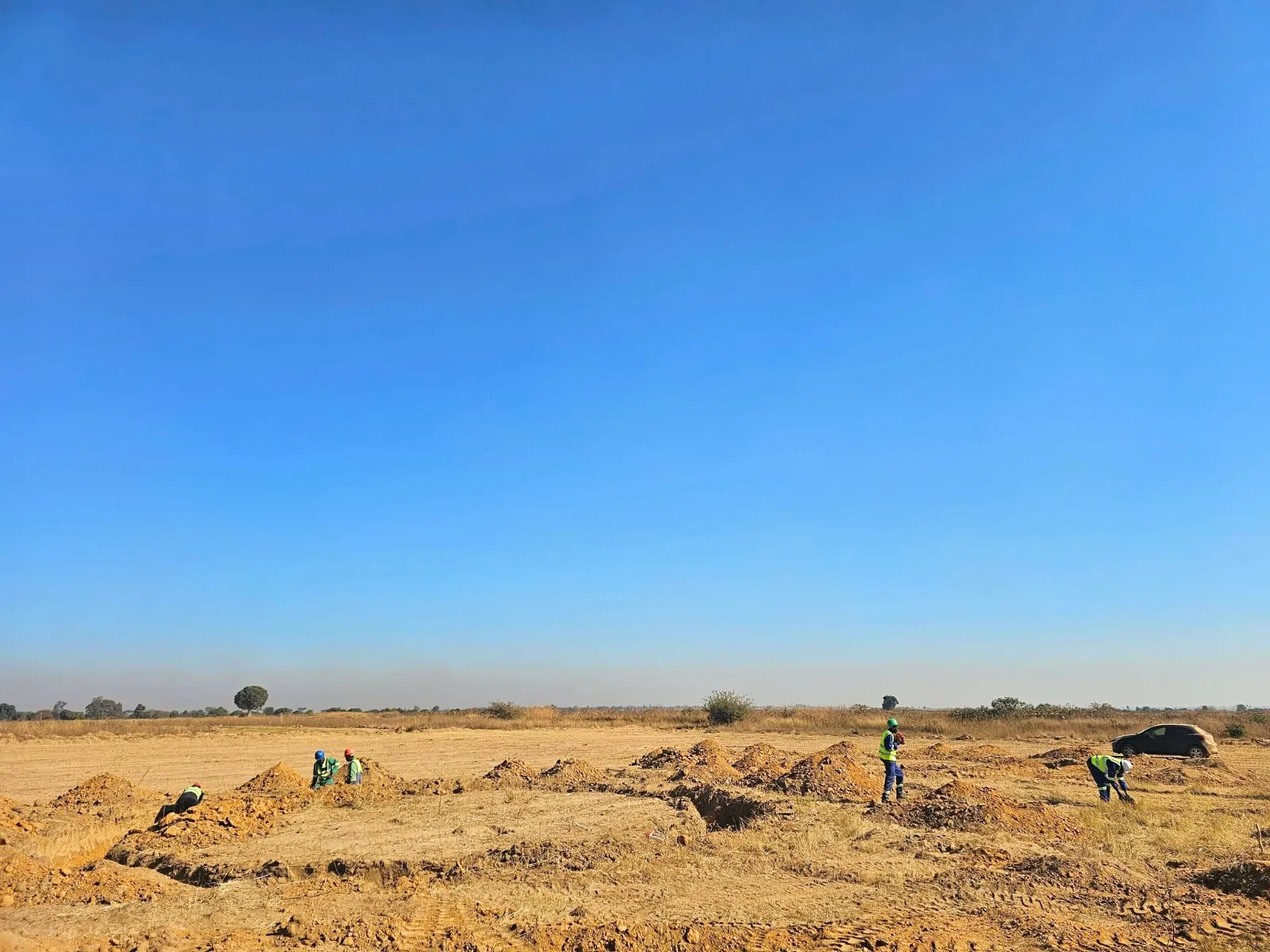
Many discussions surrounding water infrastructure focus primarily on water sources such as rivers, lakes, reservoirs, groundwater, or rainwater harvesting systems. While securing water resources is essential, the ability to safely store water often determines whether these resources can actually meet long-term demand.
Without sufficient storage capacity, fluctuations in supply can quickly disrupt residential communities, hospitals, schools, factories, farms, and emergency services.
Modern water storage systems perform multiple functions beyond simply holding water. They help stabilize supply, balance daily consumption, maintain water pressure, improve emergency preparedness, and protect water quality during transportation and distribution.
| Function | Benefit |
|---|---|
| Supply balancing | Provide stable water availability. |
| Emergency reserve | Support disaster response. |
| Pressure regulation | Improve distribution efficiency. |
| Water quality protection | Reduce contamination risks. |
| Seasonal storage | Capture surplus rainfall. |
For many African infrastructure projects, investing in high-quality storage systems provides one of the most practical methods of improving overall water security.
Africa spans a wide range of climate zones, from humid tropical regions and coastal environments to arid deserts and high-altitude plateaus. As a result, water storage systems must perform reliably under significantly different environmental conditions. A tank suitable for one region may not provide the same level of performance in another without appropriate engineering considerations.
In many countries, prolonged dry seasons are followed by short periods of intense rainfall. Water storage systems must therefore capture and preserve large volumes of water during the rainy season while maintaining structural integrity throughout extended periods of storage.
High ambient temperatures, strong ultraviolet (UV) radiation, seasonal sandstorms, and heavy rainfall all place additional demands on water tank materials. These environmental factors can accelerate aging, increase maintenance requirements, and shorten the service life of poorly designed storage systems.
Selecting a storage system that can withstand these conditions is essential for ensuring reliable water supply throughout its intended service life.
Many African regions experience prolonged periods of high solar radiation and elevated ambient temperatures. Conventional storage systems may gradually deteriorate when exposed to these conditions year after year.
Steel tanks can experience thermal expansion during the day and contraction at night. Repeated thermal cycling may increase stress on welded joints and mechanical connections. Concrete structures may develop shrinkage cracks if thermal movement is not properly accommodated, particularly where temperature variations are significant.
Composite GRP water tanks offer excellent resistance to environmental exposure because the material does not rust and demonstrates good long-term stability when manufactured using high-quality resins and gel coats designed for outdoor applications.
| Environmental Factor | Engineering Consideration |
|---|---|
| High temperature | Evaluate thermal expansion and structural stability. |
| Strong UV radiation | Select weather-resistant composite materials. |
| Daily temperature cycles | Reduce long-term fatigue caused by expansion and contraction. |
| Outdoor exposure | Improve long-term durability through appropriate material selection. |
Proper engineering design and material selection help ensure that GRP water tanks maintain structural performance and appearance even after years of outdoor service.
Many African communities rely on seasonal rainfall to replenish water supplies. During wet months, reservoirs, boreholes, and rainwater harvesting systems may provide abundant water, while extended dry periods can place severe pressure on available resources.
An effective water storage strategy therefore requires tanks capable of storing water safely over extended periods without compromising water quality or structural performance.
GRP sectional water tanks are well suited for this application because they are designed to maintain water-tight performance, resist corrosion, and require relatively low maintenance throughout long storage cycles.
Corrosion remains one of the most common causes of premature water tank deterioration. Environmental humidity, saline groundwater, industrial pollutants, and naturally occurring minerals may all accelerate corrosion in conventional metallic storage systems.
For projects located in coastal regions, mining operations, or industrial facilities, corrosion protection becomes a major engineering consideration. Frequent maintenance, protective coatings, and periodic repairs can significantly increase lifecycle costs.
GRP composite materials offer a major advantage because they do not rust in the same manner as conventional steel structures. This inherent corrosion resistance contributes to longer service life while reducing maintenance requirements throughout the operational lifetime of the tank.
| Tank Material | Corrosion Resistance |
|---|---|
| Carbon Steel | Requires protective coatings and maintenance. |
| Concrete | May experience reinforcement corrosion if cracking occurs. |
| GRP Composite | Naturally resistant to corrosion under normal operating conditions. |
Safe water storage is not only a structural issue but also a public health consideration. Municipal drinking water systems, hospitals, schools, food processing facilities, and residential developments all require storage systems capable of helping preserve water quality.
Corrosion products, deteriorating internal surfaces, and inadequate maintenance can negatively affect stored water over time. Engineering design therefore considers not only structural performance but also material compatibility with potable water applications.
GRP water tanks manufactured using suitable food-grade materials and production processes provide smooth internal surfaces that are easy to clean and help support hygienic water storage.
Many infrastructure projects across Africa are located far from major transportation hubs. Mining operations, agricultural developments, rural communities, and humanitarian projects often require equipment to be delivered over long distances using roads that may have limited load capacity or seasonal accessibility.
Large welded steel tanks and cast concrete reservoirs can be difficult and expensive to transport because of their size and weight. In contrast, sectional GRP water tanks are supplied as modular panels that can be packaged efficiently and transported using conventional trucks or shipping containers.
This modular approach simplifies logistics while reducing transportation costs and allowing installation in locations where heavy lifting equipment may not be readily available.
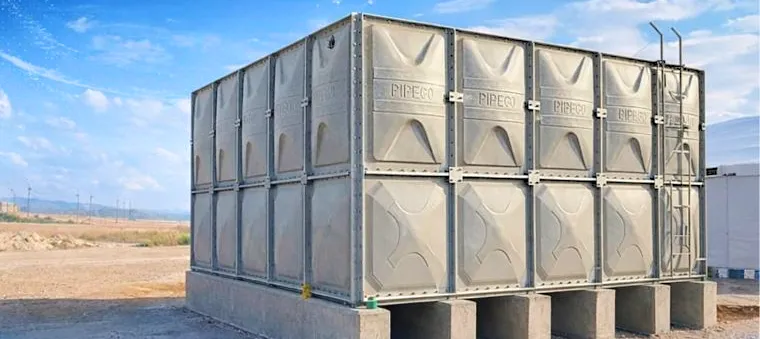
Selecting the most appropriate water storage system depends on project requirements, environmental conditions, installation methods, maintenance expectations, and lifecycle costs. Each material offers distinct advantages, but composite GRP tanks provide a balanced combination of durability, corrosion resistance, lightweight construction, and modular flexibility.
| Comparison | Concrete Tank | Steel Tank | GRP Sectional Tank |
|---|---|---|---|
| Weight | Very Heavy | Heavy | Lightweight |
| Transportation | Difficult | Moderate | Easy |
| Corrosion Resistance | Moderate | Requires Protection | Excellent |
| Installation Speed | Slow | Moderate | Fast |
| Expansion Capability | Limited | Limited | Modular Expansion |
| Maintenance | Moderate | Higher | Lower |
| Lifecycle Cost | Moderate | Higher | Competitive |
For projects requiring reliable long-term performance with flexible transportation and installation, GRP sectional water tanks have become an increasingly preferred solution across municipal, commercial, industrial, agricultural, and humanitarian applications.
Rapid urbanization across many African countries has created increasing demand for reliable municipal water infrastructure. Expanding cities require storage systems capable of balancing fluctuations in water consumption while supporting continuous distribution to residential communities, commercial buildings, schools, hospitals, and public facilities.
Municipal water tanks often serve as balancing reservoirs between water treatment plants and distribution networks. During periods of low demand, water is stored for later use, while peak consumption periods require stable reserve capacity to maintain pressure throughout the supply system.
GRP sectional water tanks are well suited for municipal projects because they combine structural durability with installation flexibility. Their modular construction allows engineers to configure tank dimensions according to available space while simplifying transportation and on-site assembly.
Agriculture remains one of the most important sectors across Africa, supporting food production, employment, and rural economic development. However, agricultural productivity often depends heavily on seasonal rainfall, making reliable water storage essential for irrigation systems.
Rainwater harvesting has become an increasingly practical solution in regions where rainfall is concentrated within relatively short wet seasons. Capturing surplus rainwater and storing it safely enables farmers to maintain irrigation during extended dry periods.
GRP composite water tanks provide an efficient storage solution for agricultural applications due to their corrosion resistance, lightweight construction, and ability to accommodate different storage capacities.
| Agricultural Application | Typical Purpose |
|---|---|
| Rainwater Harvesting | Capture seasonal rainfall. |
| Irrigation Storage | Support crop production during dry seasons. |
| Livestock Water Supply | Provide reliable drinking water for animals. |
| Farm Processing | Support food processing operations. |
Reliable water storage contributes not only to improved agricultural productivity but also to greater food security and more sustainable use of available water resources.
Africa is home to many of the world's largest mining operations, producing minerals such as copper, gold, cobalt, platinum, lithium, manganese, iron ore, and rare earth elements. These industries require dependable water storage systems for mineral processing, dust suppression, equipment cleaning, fire protection, and domestic water supply.
Mining environments often expose storage systems to challenging operating conditions including corrosive groundwater, abrasive dust, elevated temperatures, and remote installation sites.
Composite GRP water tanks provide several advantages under these demanding conditions. Their corrosion-resistant construction helps reduce maintenance requirements while modular transportation simplifies delivery to remote mining locations where logistics may be difficult.
Reliable access to clean water is fundamental to education and healthcare. Schools require dependable water supplies for drinking, sanitation, kitchens, and hygiene facilities, while hospitals depend on continuous water availability for medical treatment, sterilization, emergency preparedness, and patient care.
Interruptions to water supply can significantly affect daily operations. For this reason, many educational campuses and healthcare facilities incorporate dedicated water storage systems capable of maintaining reserve capacity during supply interruptions.
GRP sectional water tanks are frequently selected because they provide hygienic storage, efficient use of available space, and relatively simple installation compared with many traditional alternatives.
International development agencies, humanitarian organizations, and non-governmental organizations (NGOs) play an important role in expanding access to safe water throughout Africa. Emergency response programs, refugee settlements, disaster recovery projects, and rural community development initiatives all require practical and dependable water storage solutions.
In these situations, transportation efficiency and installation speed are often just as important as structural performance. Equipment may need to be delivered to locations with limited infrastructure, challenging road conditions, or minimal construction resources.
Because GRP sectional tanks are supplied as modular panels, they can be transported efficiently and assembled on site without the need for large-scale welding or extensive heavy construction work.
Choosing the appropriate water storage system requires more than comparing initial purchase prices. Engineers typically evaluate the complete operating environment, expected service life, installation conditions, maintenance requirements, and long-term lifecycle costs before selecting a suitable solution.
Important engineering factors include:
| Engineering Factor | Why It Matters |
|---|---|
| Storage Capacity | Determines panel configuration and structural loading. |
| Installation Environment | Influences material selection and structural design. |
| Wind and Seismic Loads | Required for structural verification in exposed locations. |
| Water Quality | Affects material compatibility and hygiene requirements. |
| Foundation Conditions | Determines support structure design. |
| Future Expansion | Supports long-term infrastructure planning. |
| Maintenance Strategy | Influences lifecycle operating costs. |
Evaluating these factors during the planning stage enables project owners to select a water storage system that delivers reliable performance while minimizing operational risks over the entire service life of the installation.
For many infrastructure projects, the purchase price of a water tank represents only a portion of the total investment. Transportation, installation, inspection, maintenance, repairs, and eventual replacement all contribute to the overall lifecycle cost of the system.
Although initial procurement costs are important, many project owners now evaluate long-term value rather than focusing solely on the lowest purchase price. A storage system that requires less maintenance, experiences fewer operational interruptions, and delivers reliable performance over many years often provides greater economic benefits throughout its service life.
For projects in remote regions or critical public infrastructure, reducing maintenance visits and extending operational life can provide significant financial and operational advantages over the long term.
A remote infrastructure project required a dependable water storage system capable of supporting daily operations under challenging environmental conditions. The installation site was located several hundred kilometers from the nearest major city, where transportation capacity, construction equipment, and maintenance resources were limited.
Project engineers identified several key design requirements before selecting the storage solution:
Instead of selecting a conventional welded steel or cast-in-place concrete tank, the project adopted a modular GRP sectional water tank system. Individual panels were transported efficiently, assembled on-site, and integrated with the project's pipework and support structure.
The modular approach reduced transportation complexity, simplified installation planning, and provided the flexibility to increase storage capacity in the future by adding additional panel sections when demand increased.
Although every project has unique engineering requirements, this example demonstrates how modular composite water tanks can help address common infrastructure challenges found in many regions across Africa.
As governments, utilities, contractors, and international development organizations invest in water infrastructure, engineering priorities are evolving beyond initial construction costs. Greater emphasis is now placed on durability, operational efficiency, sustainability, and lifecycle value.
Composite GRP sectional water tanks align well with these priorities by offering a balanced combination of structural performance, corrosion resistance, modular flexibility, and ease of installation. Their suitability for diverse environmental conditions makes them an increasingly practical solution for projects ranging from municipal water supply to agricultural irrigation, industrial facilities, educational institutions, healthcare centers, and humanitarian programs.
Equally important, modular GRP systems can often be adapted to changing project requirements, allowing storage capacity to expand alongside growing communities or industrial operations without replacing the entire installation.
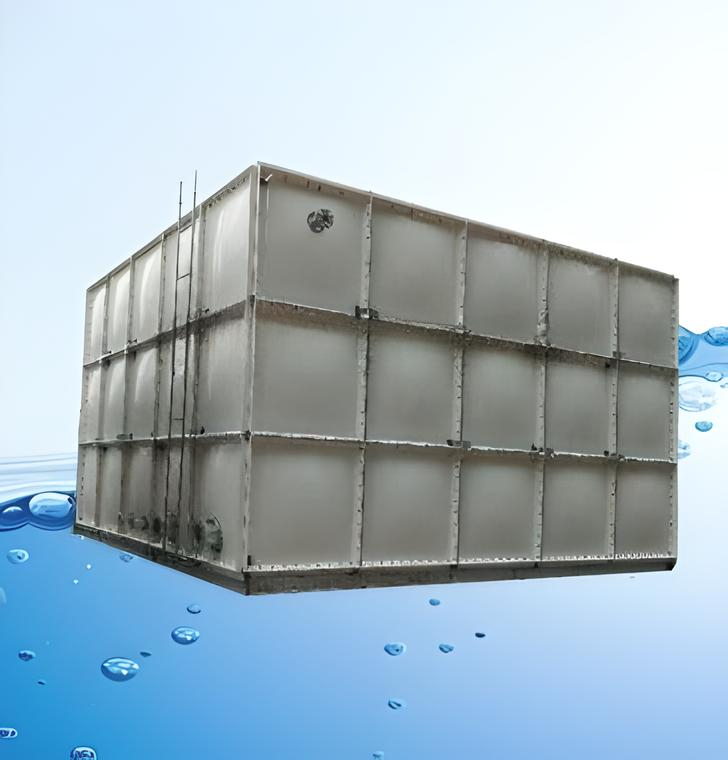
At PIPECO, we understand that every water storage project presents its own technical, environmental, and logistical challenges. Rather than offering a one-size-fits-all solution, we focus on providing GRP sectional water tanks that can be configured to match specific project requirements.
Our team supports customers throughout the project lifecycle by providing technical communication, product recommendations, manufacturing expertise, and export experience for international markets. Whether the application involves municipal infrastructure, industrial facilities, commercial buildings, agricultural developments, or humanitarian water projects, our goal is to deliver reliable storage solutions backed by consistent product quality.
Reliable water storage helps bridge seasonal differences between water availability and water demand. It improves water security for communities, agriculture, industries, hospitals, schools, and emergency services while supporting sustainable infrastructure development.
GRP water tanks offer corrosion resistance, lightweight construction, and long-term durability. They are well suited to environments where high temperatures, UV exposure, seasonal rainfall, and remote installation conditions must all be considered.
Yes. Because the tanks are supplied as modular panels, they can be packed efficiently into shipping containers and transported using conventional trucks, making them suitable for projects with challenging logistics.
GRP water tanks manufactured with appropriate materials and production processes can be used for potable water storage, subject to applicable local regulations and project specifications.
Service life depends on design, manufacturing quality, operating conditions, maintenance, and environmental exposure. Properly engineered GRP tanks are widely recognized for providing long-term durability with relatively low maintenance requirements.
Yes. One of the major advantages of sectional GRP tanks is their modular design, which allows storage capacity to be increased in many applications by adding compatible panel sections.
Municipal water utilities, agriculture, mining, manufacturing, commercial buildings, hospitals, schools, hotels, fire protection systems, and humanitarian organizations all utilize GRP water storage solutions.
Lifecycle cost includes transportation, installation, maintenance, repairs, and operational performance throughout the service life of the tank. Considering these factors provides a more complete evaluation than comparing purchase price alone.
Project owners should ideally provide tank capacity, dimensions, installation location, foundation information, water application, environmental conditions, and any relevant engineering standards or project specifications.
PIPECO focuses on providing high-quality GRP sectional water tank solutions supported by manufacturing expertise, flexible customization, and international project experience. Our objective is to help customers implement reliable and cost-effective water storage systems for a wide range of applications.
Across Africa, improving access to safe and dependable water storage remains a critical component of sustainable development. As urban populations expand, agricultural production increases, and infrastructure projects become more ambitious, the demand for durable and efficient water storage systems will continue to grow.
Composite GRP sectional water tanks address many of the practical challenges associated with traditional storage methods by combining corrosion resistance, lightweight construction, modular flexibility, and long-term durability. Their adaptability makes them suitable for municipal water supply, industrial operations, agricultural irrigation, educational institutions, healthcare facilities, and humanitarian initiatives across a wide range of environmental conditions.
By selecting engineering-focused storage solutions that consider transportation, installation, maintenance, and lifecycle performance, project owners can improve operational reliability while supporting long-term water security for the communities and industries they serve.
Whether you are planning a municipal water supply project, agricultural irrigation system, industrial facility, commercial development, or humanitarian infrastructure program, selecting the right water storage solution is an important engineering decision.
PIPECO offers modular GRP sectional water tanks designed to support a wide range of project requirements. If you would like to discuss your application, our team is ready to provide product information, technical support, and customized solutions based on your specific project needs.
Experience the brand Trusted by Renowned Companies across the GLOBE.
Pipeco stands at the forefront of the market, recognized as a premier manufacturer, supplier, and exporter specializing in top-tier GRP water tanks, stainless steel water tanks, and FRP Water Tank, Fiberglass Tank, SMC Water Tank committed to delivering unparalleled quality and excellence.
Get In Touch
Email: master@pipeco.cn
Tel: 0086-576-84616026
Address: No.2 Zhaofeng Road, Xinqian Street, Huangyan District, Taizhou City, Zhejiang Province, China