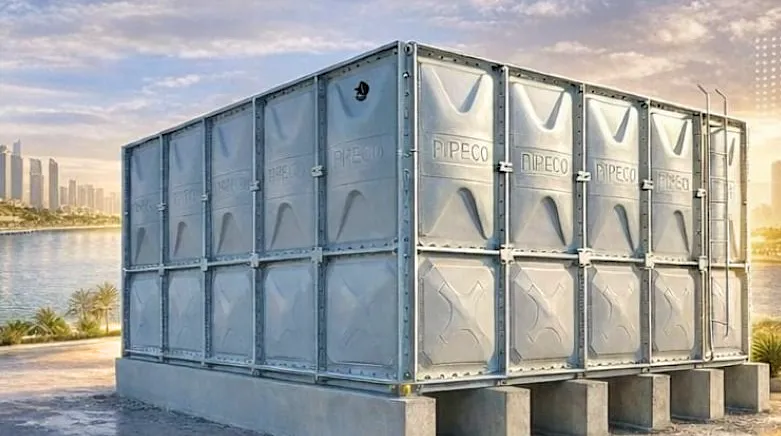
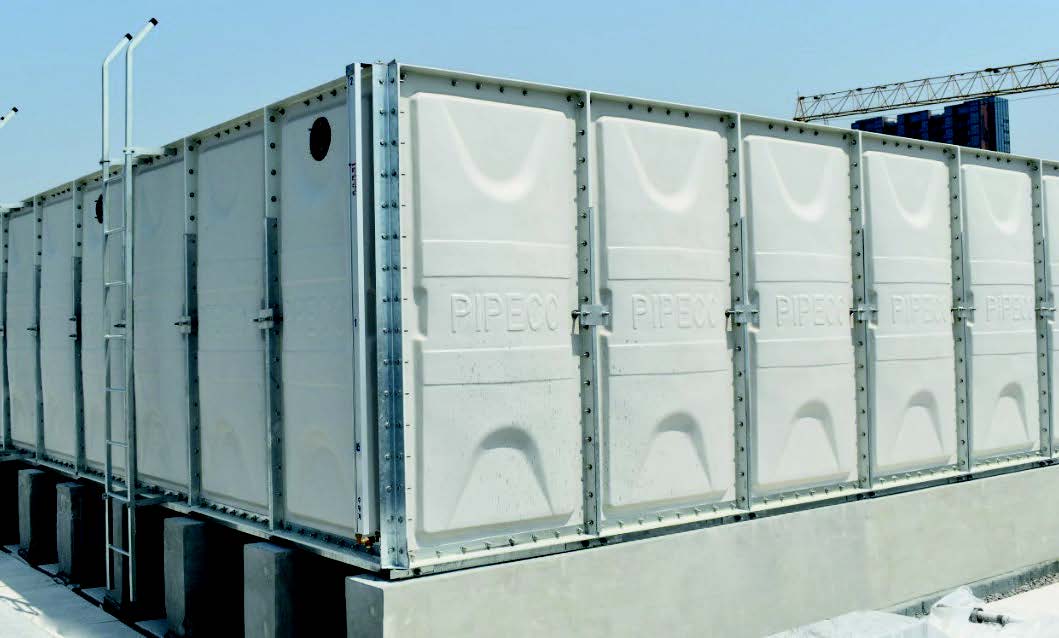
With the global shift toward carbon neutrality, resource efficiency, and sustainable manufacturing, the concept of the circular economy has become a core strategy across industries. Fiberglass tanks, including FRP water tanks and GRP sectional tanks, are widely used in water storage, chemical processing, and infrastructure due to their corrosion resistance, high strength, and long service life.
However, as thermoset composite products, fiberglass tanks present unique challenges at the end of their lifecycle. For manufacturers like PIPECO, developing efficient recycling pathways and advanced material reuse technologies is essential for achieving sustainability and enhancing long-term competitiveness.
Fiberglass tanks are typically made from glass fiber reinforcements combined with thermosetting resins such as polyester, vinyl ester, or epoxy. While these materials provide excellent durability and structural integrity, they are difficult to remelt or reshape, unlike thermoplastics.
Traditional disposal methods such as landfilling and incineration are still commonly used, but they lead to resource waste and environmental burden. Therefore, innovative recycling solutions are critical for aligning fiberglass tank applications with circular economy principles.
Mechanical recycling is currently the most mature and widely adopted method for FRP tank waste. The process includes:
Applications include:
Although this method is cost-effective, the recycled fibers typically have reduced mechanical performance, making it suitable for downcycled applications.
Thermal recycling involves decomposing the resin matrix at high temperatures (450–700°C), enabling the recovery of glass fibers and energy.
This method allows partial recovery of fibers, though mechanical strength may decrease. It is suitable for industrial-scale recycling of composite tanks.
Chemical recycling uses solvents or supercritical fluids to break down thermoset resins at lower temperatures, enabling:
This advanced technology offers higher recycling quality but requires complex processing systems and higher investment.
Fiberglass waste can also be used in cement kilns as an alternative fuel and raw material. While this reduces landfill waste, it represents a low-value recovery method.
Emerging technologies now allow fiberglass waste to be converted into high-performance materials such as silicon carbide (SiC). These processes significantly enhance the value of recycled materials while reducing environmental impact.
Closed-loop recycling integrates recovered materials back into new products:
This approach supports resource efficiency and reduces dependence on virgin raw materials.
Mobile recycling units enable on-site processing of large fiberglass tanks, reducing transportation costs and carbon emissions while improving operational efficiency.
In addition to recycling, reuse strategies play a critical role in extending the lifecycle of fiberglass tanks:
These strategies align with the Reduce–Reuse–Recycle (3R) framework and significantly improve sustainability performance.
The next generation of fiberglass tanks will focus on design for recyclability and smart material innovation:
These innovations will transform fiberglass tanks from traditional durable products into fully circular, sustainable systems.
Fiberglass tank recycling is transitioning from basic waste management to high-value material recovery and circular manufacturing. By combining mechanical, thermal, and chemical recycling technologies with innovative reuse strategies, manufacturers can significantly reduce environmental impact.
For PIPECO, adopting circular economy practices not only supports environmental goals but also enhances product innovation, brand value, and global competitiveness. The future of FRP and GRP water tanks lies in sustainable design, advanced recycling, and continuous material innovation.
Experience the brand Trusted by Renowned Companies across the GLOBE.
Pipeco stands at the forefront of the market, recognized as a premier manufacturer, supplier, and exporter specializing in top-tier GRP water tanks, stainless steel water tanks, and FRP Water Tank, Fiberglass Tank, SMC Water Tank committed to delivering unparalleled quality and excellence.
Get In Touch
Email: master@pipeco.cn
Tel: 0086-576-84616026
Address: No.2 Zhaofeng Road, Xinqian Street, Huangyan District, Taizhou City, Zhejiang Province, China