
In coastal regions, water storage systems must withstand some of the most challenging environmental conditions. High humidity, strong ultraviolet radiation, salt-laden air, and temperature fluctuations can significantly accelerate material degradation and increase long-term maintenance costs.
Traditionally, the stainless steel water tank has been widely used for municipal and commercial water storage. However, with the advancement of composite materials, the GRP Square Shape Tank — also known as GRP Water Tank or FRP Water Tank — has become an increasingly popular solution for modern infrastructure.
When evaluating water storage systems for coastal projects, focusing only on the initial purchase price can be misleading. Instead, engineers and procurement managers rely on Total Cost of Ownership (TCO) to determine the real economic value of a system over its entire lifecycle.
This article provides a comprehensive 20-year lifecycle comparison between GRP Square Shape Tanks and stainless steel water tanks, focusing on installation costs, corrosion resistance, maintenance requirements, durability, and long-term investment efficiency.
Total Cost of Ownership (TCO) refers to the complete lifecycle expense associated with a product. For water storage tanks, this includes much more than the initial purchase price.
The major cost components include:
For large-scale infrastructure such as municipal water systems, desalination plants, hotels, hospitals, and coastal industrial facilities, evaluating a tank system over a 20-year operational lifecycle provides a far more realistic financial assessment.
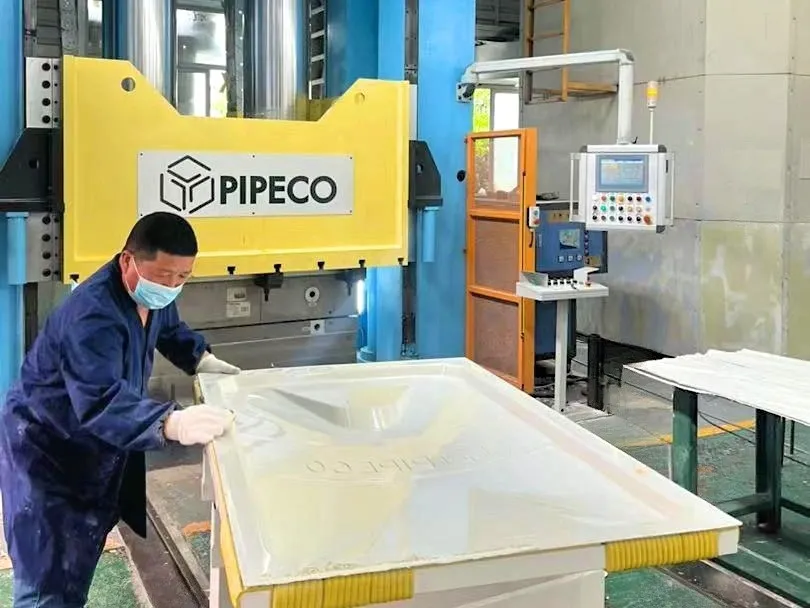
A GRP Square Shape Tank is manufactured from Glass Reinforced Plastic (GRP), a composite material combining glass fiber reinforcement with high-performance thermosetting resins.
This material structure provides excellent mechanical performance and long-term durability while maintaining relatively low weight.
Key advantages of GRP tanks include:
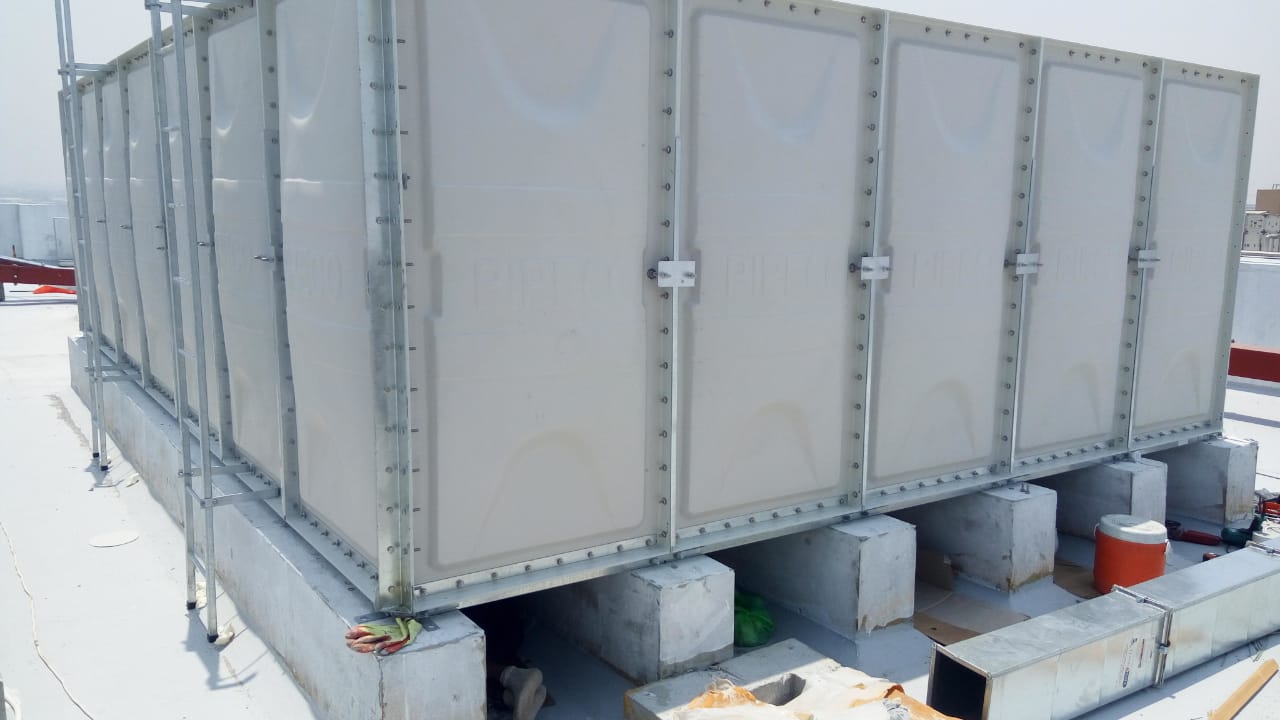
Most GRP water tank systems use modular panels that can be assembled on-site, allowing tank capacities ranging from a few cubic meters to several thousand cubic meters.
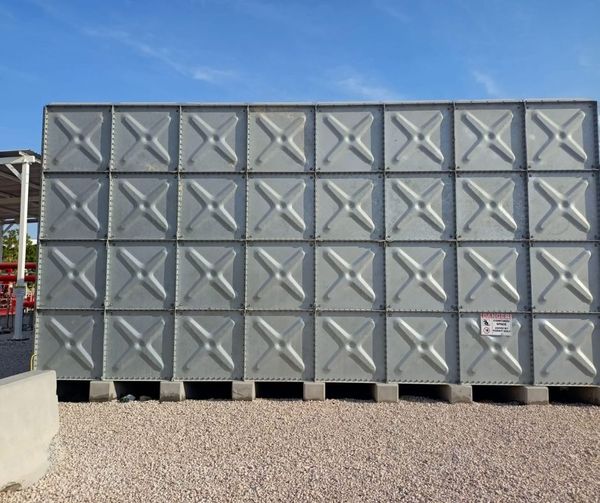
A stainless steel water tank is typically fabricated using materials such as SUS304 or SUS316 stainless steel. These materials offer high mechanical strength and good hygiene characteristics.
However, stainless steel tanks installed in coastal environments may face corrosion challenges due to chloride ions present in sea salt. When the protective chromium oxide layer on stainless steel surfaces is damaged, corrosion mechanisms such as pitting corrosion and crevice corrosion can develop.
Over time, these corrosion processes can lead to higher maintenance costs and reduced structural lifespan.
Corrosion resistance is one of the most important factors when selecting water tanks for coastal infrastructure projects.
Even high-grade stainless steel materials like SUS316 can experience corrosion under prolonged exposure to marine atmospheric conditions. The presence of chloride ions can lead to:
Salt spray combined with humidity accelerates these processes, particularly in environments such as ports, coastal industrial parks, and seaside residential developments.
Unlike metal materials, GRP composite materials do not undergo electrochemical corrosion. This means that GRP tanks remain stable even under constant exposure to marine atmospheric conditions.
Advantages include:
This makes GRP Square Shape Tanks particularly suitable for coastal infrastructure projects.
Stainless steel tanks often require heavy lifting equipment and on-site welding, particularly for large-capacity systems. These requirements increase installation time and labor costs.
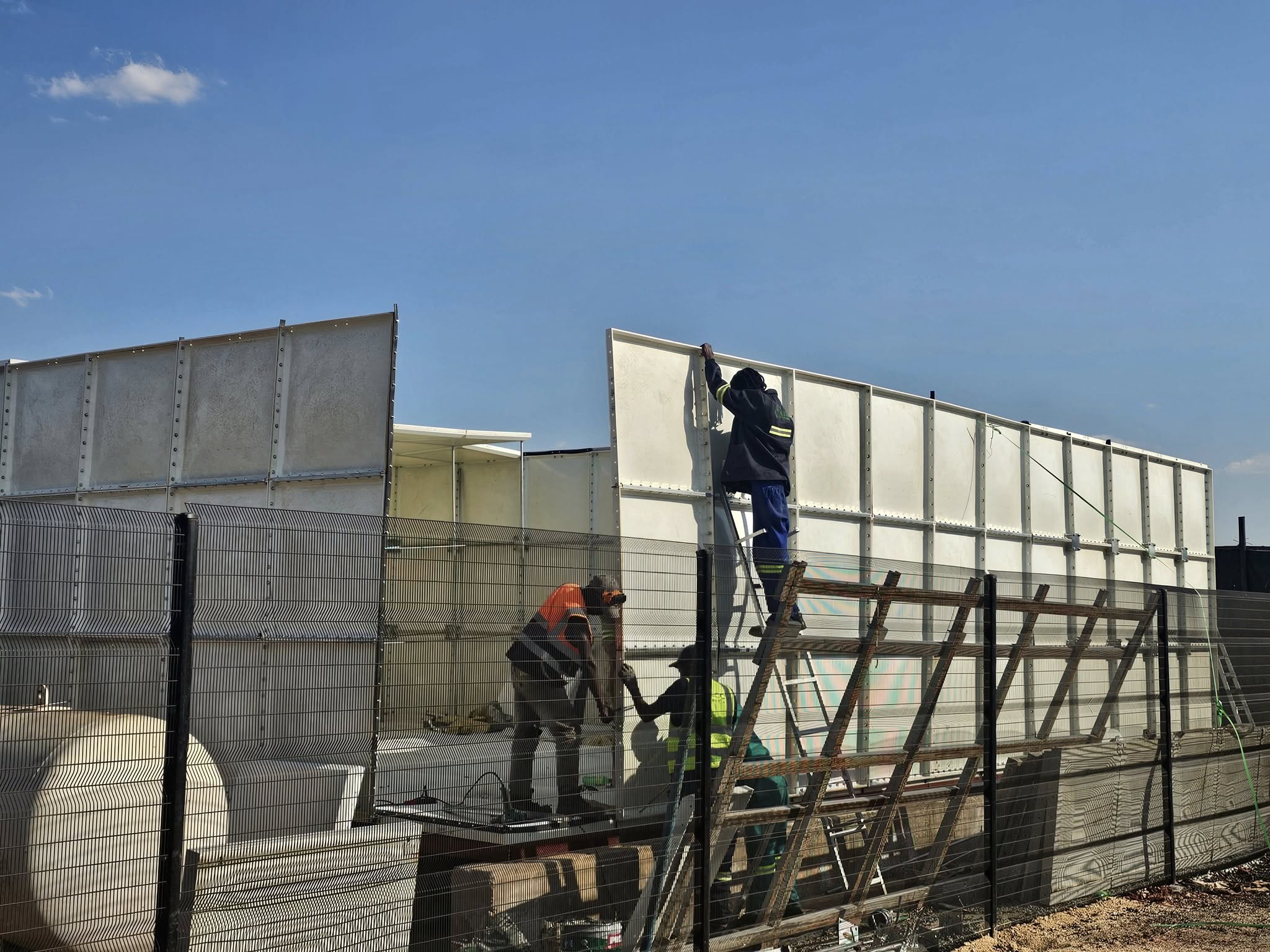
GRP tanks use a modular panel structure that allows for bolt assembly on-site. The lightweight panels simplify transportation and significantly reduce installation time.
In many projects, installation of a GRP tank can be completed 30%–40% faster than traditional welded tanks.
Maintenance costs play a major role in long-term operational expenses.
Because GRP materials do not corrode, long-term maintenance costs remain significantly lower.
| Comparison Factor | GRP Square Shape Tank | Stainless Steel Water Tank |
|---|---|---|
| Initial Cost | Moderate | Moderate to High |
| Installation Cost | Low (modular assembly) | High (welding and lifting) |
| Corrosion Resistance | Excellent | Moderate in coastal environments |
| Maintenance Cost | Low | High |
| Expected Service Life | 20+ years | 15–20 years |
| 20-Year TCO | 60–70% | 100% baseline |
Due to their corrosion resistance and modular design, GRP tanks are widely used in coastal infrastructure projects such as:
When evaluated over a 20-year Total Cost of Ownership lifecycle, the comparison clearly demonstrates that GRP Square Shape Tanks provide significant economic and technical advantages over traditional stainless steel water tanks in coastal environments.
While stainless steel tanks remain widely used, their susceptibility to chloride corrosion can lead to higher maintenance costs and increased operational risks.
In contrast, GRP Water Tanks offer corrosion-free performance, faster installation, and reduced lifecycle costs. For modern coastal infrastructure projects seeking durable and cost-efficient water storage solutions, GRP Square Shape Tanks are becoming the preferred industry standard.
Experience the brand Trusted by Renowned Companies across the GLOBE.
Pipeco stands at the forefront of the market, recognized as a premier manufacturer, supplier, and exporter specializing in top-tier GRP water tanks, stainless steel water tanks, and FRP Water Tank, Fiberglass Tank, SMC Water Tank committed to delivering unparalleled quality and excellence.
Get In Touch
Email: master@pipeco.cn
Tel: 0086-576-84616026
Address: No.2 Zhaofeng Road, Xinqian Street, Huangyan District, Taizhou City, Zhejiang Province, China