
Industrial water storage is not always an ambient-temperature application. Manufacturing plants, power stations, commercial processing facilities and other industrial operations may need to store water heated during production, equipment cleaning, heat exchange or other process operations.
For these applications, choosing an FRP water tank involves more than checking storage capacity and dimensions. Elevated temperatures can affect the resin matrix, fiberglass reinforcement, laminate stiffness, joints, seals and long-term structural performance. A fiberglass tank designed for ordinary water storage may not be suitable for continuous exposure to hot process water.
So, what is the maximum safe operating temperature of an FRP water tank? There is no single temperature limit that applies to every fiberglass tank. The actual service limit depends on the resin formulation, curing quality, laminate construction, water chemistry, exposure duration and structural design.
This guide explains the engineering factors that determine FRP tank temperature resistance and what industrial buyers should check before specifying a fiberglass tank for high-temperature process water storage.
FRP stands for fiber-reinforced plastic. In a typical fiberglass-reinforced plastic tank, glass fibers provide reinforcement while the polymer resin binds the fibers together and transfers loads through the laminate.
This composite structure offers several advantages for industrial water storage, including relatively low weight, corrosion resistance in suitable environments and flexibility in tank design. However, the resin matrix is sensitive to temperature.
As temperature rises, the resin's stiffness and mechanical properties may change. Depending on the resin chemistry and degree of cure, prolonged heat exposure can also accelerate aging and affect the interface between the resin and reinforcing fibers.
| Component or property | Potential temperature-related effect | Engineering concern |
|---|---|---|
| Resin matrix | Reduced stiffness and accelerated aging under certain conditions | Changes in long-term mechanical performance |
| Fiber-resin interface | Changes in interfacial behavior during prolonged exposure | Reduced load transfer between fibers and resin |
| FRP laminate | Changes in stiffness, dimensional stability and residual stress | Deformation or premature damage under loading |
| Joints and connections | Thermal expansion and changes in sealing performance | Leakage or additional connection stress |
| Gaskets and accessories | Temperature-related changes in elasticity and chemical compatibility | Seal degradation or premature replacement |
These effects do not mean that FRP tanks cannot be used for warm or hot water. They mean that the complete tank system must be designed and qualified for the actual operating conditions rather than selected solely by its general material description.
Unsaturated polyester resin is widely used in fiberglass-reinforced composite manufacturing. It offers a practical balance of processing characteristics, mechanical properties and cost, making it suitable for many FRP products.
However, not all unsaturated polyester resins have the same thermal performance. Resin chemistry, formulation, curing agents, post-curing conditions and the final degree of cure can all influence the thermal properties of the finished composite.
For industrial water storage, the resin system should be selected according to the actual operating environment. A general-purpose resin intended for ambient-temperature service should not automatically be considered suitable for continuously heated process water.
Certain resin formulations may provide improved thermal or chemical resistance. However, choosing a resin with better heat resistance does not independently establish the allowable temperature of a complete FRP water tank. The laminate, manufacturing process, joints and structural design must also be evaluated.
One common mistake when selecting a high-temperature fiberglass tank is treating the resin's heat deflection temperature as the maximum allowable operating temperature of the complete tank.
Heat deflection temperature is measured using a laboratory test in which a specimen is exposed to a specified mechanical stress while being heated. The result indicates the temperature at which the specimen reaches a defined deformation under those test conditions.
Glass transition temperature, or Tg, describes the temperature region in which the cured polymer changes from a relatively rigid glassy state toward a more flexible state. The measured value depends on the test method and material condition.
Neither property directly establishes the maximum service temperature of a finished fiberglass water tank.
| Term | What it describes | What it does not establish |
|---|---|---|
| Glass transition temperature (Tg) | Temperature-related transition in polymer behavior | Guaranteed continuous tank operating temperature |
| Heat deflection temperature (HDT) | Deformation behavior of a test specimen under specified load and test conditions | Maximum allowable temperature of the complete tank |
| Maximum service temperature | Allowable temperature under defined application conditions | A universal rating applicable to every resin or tank design |
A full-size tank operates under conditions that differ significantly from a small laboratory specimen. Its walls may experience hydrostatic loading, local stresses around nozzles, support reactions, environmental exposure and prolonged contact with water.
For this reason, the manufacturer's documented operating-temperature limit for the complete tank is more relevant than an isolated resin datasheet value.
The practical temperature limit of an FRP water tank is a system-level engineering question. Several factors must be considered together.
The resin system determines much of the polymer matrix's response to heat. A resin with a higher thermal rating may provide greater flexibility in application design, but its properties must be considered alongside curing quality, chemical compatibility and the intended service duration.
An FRP tank wall is a composite structure, not simply a layer of solid resin. Its performance depends on fiber type, fiber orientation, resin content, laminate sequence and thickness.
The structural design should account for the actual operating temperature because material properties used in a room-temperature design may not remain applicable under elevated-temperature conditions.
Temperature and chemical exposure can interact. Water containing dissolved salts, acids, alkalis, cleaning chemicals or process additives may create a more demanding environment than ordinary water at the same temperature.
A resin system that performs well with ordinary water may not provide the same resistance to a chemically treated process stream. Compatibility should therefore be assessed using the actual fluid composition, concentration and operating temperature.
There is an important difference between storing hot water for a short period and maintaining the same temperature continuously.
A tank exposed to a brief temperature increase may experience a different aging pattern from one operating at elevated temperature every day. The design review should distinguish normal operating temperature, peak temperature and the duration of each exposure.
Tank capacity, height, panel dimensions, support arrangement, connection positions and liquid level all influence structural loading.
For sectional tanks, panel joints, internal tie systems, external supports and sealing materials also require attention. A suitable resin alone cannot compensate for inadequate structural or connection design.
When evaluating an FRP water tank for industrial process water, providing a single temperature figure is not sufficient. Engineers need to understand how the water temperature changes during actual operation.
| Temperature condition | Meaning | What should be evaluated |
|---|---|---|
| Normal operating temperature | Temperature maintained during routine operation | Long-term material performance and structural suitability |
| Maximum operating temperature | Highest temperature expected during normal production | Allowable service conditions and design margins |
| Short-term temperature peak | Temporary increase during a process event | Peak exposure duration and recovery conditions |
| Cleaning temperature | Temperature reached during tank cleaning or sanitation | Compatibility with cleaning agents, seals and laminate |
| Thermal cycling | Repeated heating and cooling during operation | Thermal stress, joint behavior and temperature gradients |
For example, a process that operates at a moderate temperature for most of the day but introduces a hotter cleaning cycle may require a different tank specification from a process with a stable temperature.
The maximum temperature should never be considered independently of exposure time. A short-duration peak may be acceptable for one qualified design but unsuitable for another. This decision must be supported by the tank manufacturer's technical assessment.
For international engineering specifications, temperature data should ideally be stated in both Celsius (°C) and Fahrenheit (°F). This makes technical communication easier across North American, European and other international markets.
| Celsius (°C) | Fahrenheit (°F) | Conversion context |
|---|---|---|
| 40°C | 104°F | Temperature unit conversion only |
| 60°C | 140°F | Temperature unit conversion only |
| 80°C | 176°F | Temperature unit conversion only |
| 100°C | 212°F | Temperature unit conversion only |
These figures are mathematical conversions, not recommended operating temperatures or performance ratings for FRP tanks. The allowable temperature must be confirmed for the specific tank design.
Many industrial systems do not operate at a constant temperature. Water may be heated during production, cooled during shutdown and reheated when the next operating cycle begins.
These repeated temperature changes create thermal expansion and contraction. Because FRP is a composite material, its thermal response depends on fiber direction, resin properties and laminate construction.
The rate of heating and cooling also matters. Introducing hot water rapidly into a relatively cold tank may produce a different temperature distribution from gradual heating.
For applications involving frequent thermal cycling, these conditions should be reviewed before the tank is manufactured rather than treated as an operational detail after installation.
Not necessarily. A standard fiberglass water tank designed for ambient-temperature storage should not be assumed suitable for hot process water without reviewing its technical specification.
The difference is not simply whether the tank is made from fiberglass. Two FRP tanks can use glass-fiber reinforcement but have different resin systems, laminate designs, manufacturing processes and allowable operating conditions.
| Selection factor | Conventional water storage | High-temperature process water |
|---|---|---|
| Resin selection | Selected for the specified ambient service environment | Must be qualified for elevated temperature and fluid chemistry |
| Mechanical design | Based on normal operating conditions | Must account for temperature-dependent material properties |
| Joints and seals | Selected for standard service conditions | Must be checked for temperature and chemical compatibility |
| Operating profile | Often relatively stable | May include continuous heating, peak temperatures and cycling |
| Technical documentation | Standard tank specifications | Application-specific temperature and compatibility confirmation |
If the application involves elevated temperatures, buyers should request written confirmation of the tank's allowable operating conditions. If a proposed sectional tank has not been qualified for the required temperature range, a different tank design or storage material may be more appropriate.
A practical evaluation should begin with the process conditions rather than a general request for a heat-resistant fiberglass tank.
Record the normal operating temperature, maximum expected temperature, minimum temperature and duration of each condition. Include cleaning and shutdown cycles where relevant.
Provide the water composition, pH range, dissolved substances, treatment chemicals and any process additives. If the liquid is not ordinary water, identify the exact chemical components and concentrations.
Request the resin manufacturer, resin grade, relevant thermal data and chemical-resistance information. Confirm that the resin is intended for the specified operating environment.
Ask how the tank wall, reinforcement structure and connections are designed for elevated-temperature service. Material data should be consistent with the actual design temperature.
Review gaskets, sealants, bolts, flanges, nozzles and pipe connections. Their allowable temperatures and chemical compatibility should be consistent with the tank operating conditions.
The final technical specification should identify the permitted operating-temperature range, restrictions on peak exposure, and the conditions under which the tank warranty applies.
FRP is useful for many industrial water-storage applications, but it is not automatically the best choice for every high-temperature process.
If the required operating temperature exceeds the documented capability of the proposed FRP system, or if the stored liquid creates a difficult combination of heat and chemical exposure, alternative materials should be evaluated.
| Storage material | Potential advantages | Important considerations |
|---|---|---|
| FRP / Fiberglass | Low weight, corrosion resistance in suitable environments and flexible composite design | Resin-specific temperature limits and laminate qualification are essential |
| Stainless steel | Can be suitable for many elevated-temperature water applications | Grade selection, chloride exposure, corrosion conditions and fabrication quality matter |
| Carbon steel with lining | Can be engineered for demanding industrial storage conditions | Internal lining temperature and chemical compatibility must be checked |
| Specialty thermoplastic | Can provide chemical resistance in selected applications | Temperature-related softening and mechanical limits vary by polymer |
The correct comparison should consider the complete operating environment, including temperature, liquid chemistry, structural requirements, maintenance needs and lifecycle cost. Material selection based on temperature alone may overlook other important failure mechanisms.
For projects where FRP is not suitable for the required service conditions, buyers can also review PIPECO stainless steel water tank solutions as a potential alternative, subject to the actual temperature and corrosion requirements.
The term fiberglass tank describes a broad product category. It does not identify a specific resin formulation or establish a universal temperature limit.
HDT is a laboratory property measured under defined conditions. The allowable service temperature of a finished tank must be established through a broader engineering assessment.
A tank that can withstand a particular stable temperature may not automatically be suitable for repeated heating and cooling. Temperature cycles should be included in the original specification.
Gaskets, sealants, flanges and pipe connections may have different temperature limitations from the FRP laminate. These components must be checked as part of the complete system.
Industrial water may contain treatment chemicals, dissolved salts or process residues. Temperature can change the severity of chemical exposure, so compatibility should be assessed using the actual liquid composition.
For a manufacturer to assess whether an FRP water tank is suitable for an industrial hot-water application, buyers should provide sufficient technical information at the quotation stage.
| Information required | Details to provide |
|---|---|
| Tank application | Industrial process water, equipment cleaning, heat-exchange water or other use |
| Required capacity | Working volume and total storage capacity |
| Normal temperature | Typical operating water temperature |
| Maximum temperature | Highest expected temperature and exposure duration |
| Minimum temperature | Lowest operating or shutdown temperature |
| Thermal cycling | Heating and cooling frequency, rates and cycle duration |
| Water composition | pH, dissolved salts, treatment chemicals and other relevant constituents |
| Tank configuration | Sectional or other construction, dimensions and installation arrangement |
| Structural conditions | Liquid level, support arrangement, internal pressure or vacuum conditions |
| Site environment | Indoor or outdoor installation, ambient temperature and exposure conditions |
| Documentation | Required technical data, inspection records, testing and warranty conditions |
Providing these details helps the manufacturer distinguish between a conventional water-storage requirement and a high-temperature application that requires additional material and structural assessment.
Selecting an FRP water tank for industrial process water storage requires a clear understanding of the operating environment. Capacity, dimensions and material type are only part of the specification. Temperature, water chemistry, exposure duration and structural loading must also be considered.
PIPECO provides GRP water tank solutions for a range of water-storage applications. For projects involving heated process water, buyers should communicate the complete operating-temperature profile and water composition before confirming the tank specification.
Resin suitability, laminate performance, joint materials and structural requirements should be reviewed together. A standard GRP sectional tank should not be assumed suitable for high-temperature service unless its documented design limits support the application.
Learn more about PIPECO GRP water tank solutions, review the company's manufacturing background, or contact PIPECO to discuss your project requirements.
The maximum continuous operating temperature depends on the resin formulation, curing process, laminate construction, water chemistry and structural design. There is no universal temperature rating for all FRP water tanks. Buyers should request a documented continuous service-temperature limit for the complete tank.
The resin system determines much of the temperature-dependent behavior of an FRP laminate. Different unsaturated polyester and other thermosetting resin formulations have different thermal and chemical resistance properties. However, resin selection alone does not establish the allowable operating temperature of a finished fiberglass tank.
Whether an FRP water tank can handle 80°C (176°F) water depends on its specific resin system, laminate design, exposure duration, water chemistry and structural qualification. This temperature should not be assumed suitable for a standard FRP tank without written confirmation from the manufacturer.
Glass transition temperature (Tg), heat deflection temperature (HDT) and maximum service temperature describe different material or application characteristics. Tg and HDT are laboratory material properties measured under defined conditions, while the maximum service temperature must be established for the finished tank under its intended operating conditions.
Elevated temperatures can reduce resin stiffness and affect the mechanical performance of an FRP laminate. The actual effect depends on resin chemistry, exposure duration, water chemistry, curing quality and structural design.
Some FRP tank designs may be suitable for defined thermal cycling conditions, but repeated temperature changes can create thermal stresses and affect laminates, joints and connections. The expected temperature range, heating rate, cooling rate and number of cycles should be evaluated.
A standard fiberglass water tank should not automatically be considered suitable for hot process water. Its resin system, laminate design, joints, seals and supports must be checked against the actual operating conditions.
Provide the normal operating temperature, maximum temperature, exposure duration, minimum temperature, thermal cycling conditions, water chemistry, tank capacity, dimensions, installation conditions and operating pressure or vacuum requirements.
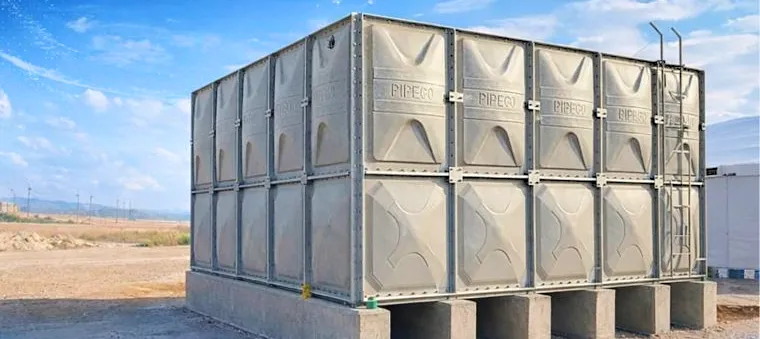
FRP water tanks can be considered for a variety of industrial water-storage applications, but high-temperature service requires a more detailed evaluation than conventional ambient-temperature storage.
The practical temperature limit is determined by the complete system: resin formulation, curing quality, laminate structure, water chemistry, exposure duration, thermal cycling, joints and structural loading. A resin's HDT or a general fiberglass material description cannot independently establish a safe operating temperature.
For industrial buyers, the most reliable approach is to define the actual process conditions first and then request a tank specification supported by relevant technical documentation. This helps ensure that the selected fiberglass tank is suitable for its intended service rather than relying on an assumed temperature capability.
Planning an industrial water storage project? Contact PIPECO with your temperature profile, water composition and storage requirements for an initial project assessment.
Experience the brand Trusted by Renowned Companies across the GLOBE.
Pipeco stands at the forefront of the market, recognized as a premier manufacturer, supplier, and exporter specializing in top-tier GRP water tanks, stainless steel water tanks, and FRP Water Tank, Fiberglass Tank, SMC Water Tank committed to delivering unparalleled quality and excellence.
Get In Touch
Email: master@pipeco.cn
Tel: 0086-576-84616026
Address: No.2 Zhaofeng Road, Xinqian Street, Huangyan District, Taizhou City, Zhejiang Province, China