
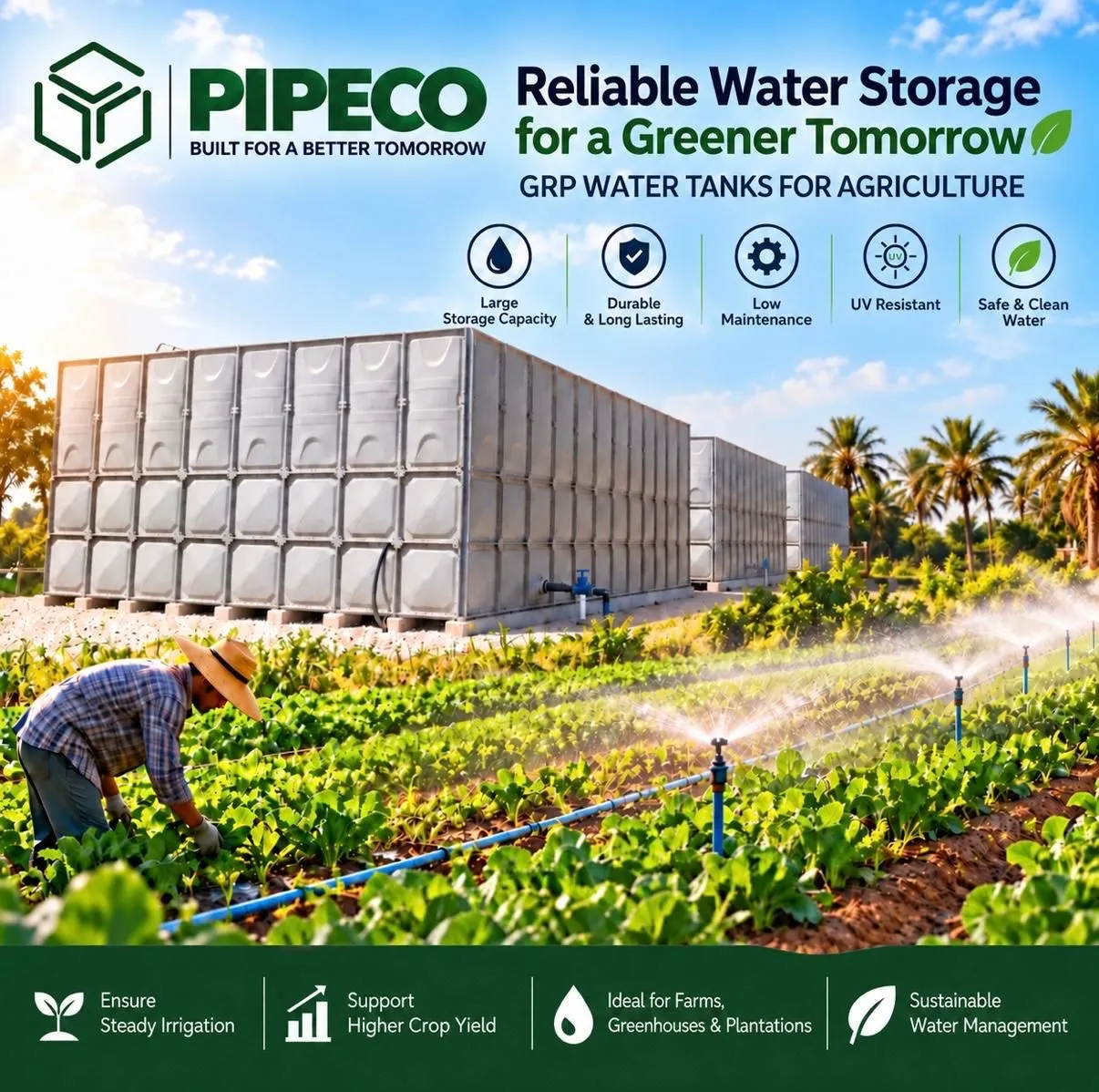
Reliable water storage is an important part of modern agricultural operations. Farms, greenhouses, plantations and irrigation projects need a dependable supply of water to manage changing weather conditions, coordinate irrigation schedules and maintain daily production activities.
A GRP water tank for agricultural irrigation can provide a practical storage option when its capacity, material specification and structural design match the project's requirements. GRP, or glass-reinforced plastic, combines glass reinforcement with a polymer resin matrix. In sectional tank systems, panels are assembled on site to form a storage tank with a capacity and layout selected for the application.
This guide explains how to evaluate GRP sectional tanks for agricultural water storage, including capacity planning, outdoor exposure, water quality, installation, maintenance and supplier selection. It is intended for farm owners, agricultural engineers, irrigation contractors, EPC companies and procurement teams looking for a technically appropriate storage solution.
Agricultural water demand can vary significantly throughout the year. Crop growth stages, weather, irrigation methods, soil conditions and the reliability of the local water supply all influence how much water a farm needs to store.
A dedicated storage tank can help separate the timing of water supply from the timing of irrigation. For example, a farm may collect or receive water at certain times but require controlled delivery throughout the day. Storage can also provide a buffer when a well, pump, pipeline or external supply is temporarily unavailable.
Open-field farms may require storage to support scheduled irrigation across different plots. The tank's required capacity depends on the irrigated area, crop water demand, irrigation method, supply schedule and available pumping capacity.
A tank should be designed as part of the overall irrigation system rather than selected by capacity alone. Inlet flow, outlet demand, pump performance, pipe sizing and available pressure can all affect how effectively stored water reaches the fields.
Greenhouses and other controlled-environment farms often use planned irrigation schedules, drip systems or fertigation equipment. Storage can provide a more predictable water supply and help operators coordinate water delivery with production cycles.
For these applications, engineers should consider water quality, sediment control, tank cleaning access and the compatibility of all wetted components with the intended water or nutrient solution.
Plantations and geographically distributed agricultural sites may have long distances between the water source and the point of use. A suitable storage arrangement can help manage local demand and reduce dependence on continuous water delivery.
Where multiple fields or irrigation zones share a tank, the design should account for peak demand, distribution losses, pump operation and the consequences of a temporary supply interruption.
In addition to crop irrigation, farms may require water for equipment cleaning, general site operations and other utility uses. Livestock water storage may also be considered, subject to the applicable water quality requirements and suitability of the complete tank system.
These uses should be identified separately during planning because the required water quality, demand pattern and storage arrangements may differ.
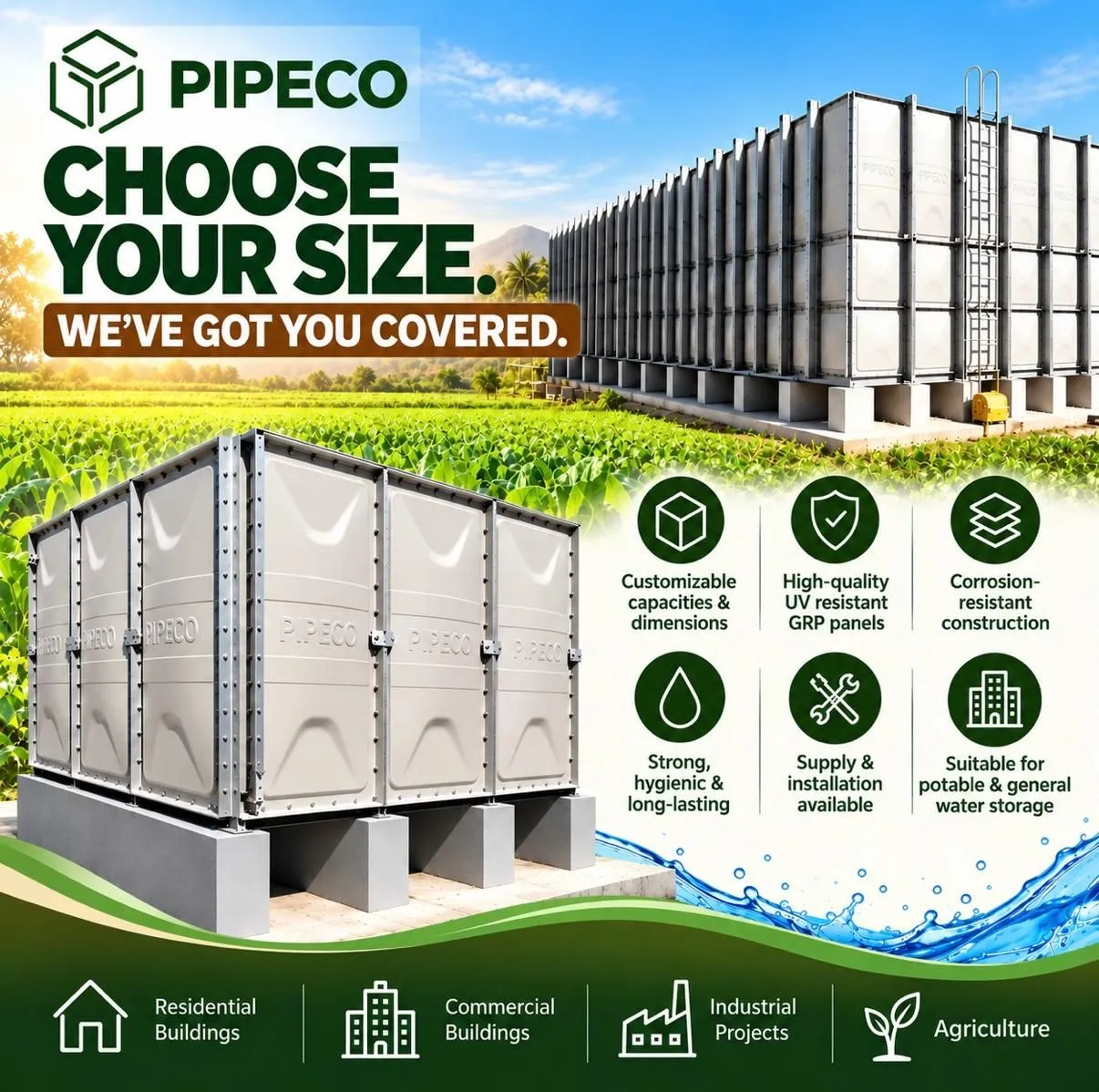
Agricultural projects differ in size, location and access conditions. A tank solution that works for a small greenhouse may not be appropriate for a large plantation or a remote irrigation project. GRP sectional tanks are worth evaluating when modular construction and a project-specific tank configuration are useful.
A GRP sectional tank is assembled from individual panels and associated structural components. The panel arrangement can be configured to meet specified capacity and dimensional requirements within the manufacturer's available design range.
This construction method can be useful when a large one-piece tank is difficult to transport through narrow roads, restricted site entrances or remote access routes. Panels may be transported separately and assembled at the installation location.
However, modular construction does not remove the need for a suitable foundation, appropriate lifting and handling procedures, correct joint assembly and a documented installation method.
GRP is a composite material rather than a metallic material. Its tank body does not rust through the same electrochemical mechanism as ordinary carbon steel. This can be useful in outdoor environments where moisture and atmospheric exposure are important considerations.
Nevertheless, the resin system and laminate construction must be suitable for the intended service. Any metal tie rods, fasteners, supports, ladders or other accessories also require appropriate material selection for the environment in which they will operate.
For remote farms, the practical challenge may be getting a tank to the site rather than finding a tank of sufficient nominal capacity. Road width, turning radius, bridge restrictions, vehicle access and available lifting equipment can influence the choice of tank design.
A sectional tank may simplify some transportation arrangements because its panels can be moved separately. The project team should still compare packaging dimensions, shipment volume, assembly labor, equipment requirements and the availability of installation personnel.
A suitable GRP water tank still requires inspection and maintenance. Panel joints, seals, structural supports, connections, access covers and the foundation should be included in the inspection plan.
When evaluating suppliers, ask for the recommended inspection procedures, approved repair methods and maintenance requirements for the specific tank model. These details are more useful than relying on a general claim that a tank is maintenance-free.
The following matrix connects common agricultural storage challenges with the engineering checks that should be included in a tank specification.
| Agricultural Challenge | Potential Risk | Engineering Consideration |
|---|---|---|
| Strong sunlight and UV exposure | Long-term exposure may affect materials that are not designed for outdoor service. | Confirm the tank's outdoor suitability, UV protection provisions, exposure limits and maintenance requirements with the manufacturer. |
| Algae growth in stored water | Light, nutrients and contamination can support algae growth and contribute to irrigation filter or emitter maintenance. | Consider opaque tank construction, protected openings, appropriate water source management, cleaning and inspection. |
| Large storage demand | Insufficient capacity can interrupt irrigation, while excessive capacity may increase capital and site costs. | Estimate demand, reserve days, inflow reliability, peak usage and available space before choosing the tank configuration. |
| Remote site access | Large deliveries may be difficult where roads, turning areas or lifting equipment are restricted. | Compare sectional delivery, packaging dimensions, assembly requirements and local installation resources. |
| Water quality management | Sediment, microorganisms or external contamination may affect stored water and downstream irrigation equipment. | Plan inlet protection, filtration where needed, tank access, cleaning and routine water quality monitoring. |
| Fertilizer or chemical exposure | Some agricultural chemicals may be incompatible with a standard water tank material. | Identify the exact chemical, concentration and temperature, then obtain written material compatibility confirmation. |
| Outdoor structural loads | Wind, foundation movement, temperature changes or other site conditions may affect the complete tank assembly. | Confirm design loads, foundation requirements, support arrangements and applicable local engineering requirements. |
The matrix is a preliminary selection aid. Final tank specifications should be based on the actual project conditions and the manufacturer's documented design.
Choosing the correct capacity is one of the most important steps in specifying a farm water storage tank. A tank that is too small may not cover irrigation demand during supply interruptions. A tank that is unnecessarily large can increase the cost of the tank, foundation, installation and associated infrastructure.
For a preliminary estimate, calculate the total daily demand of the agricultural operation. This may include irrigation, greenhouse operations and other site uses that draw from the same storage system.
For crop irrigation, demand depends on factors such as irrigated area, crop type, growth stage, weather, soil characteristics and irrigation efficiency. If reliable agronomic or irrigation-system calculations are available, use those figures instead of a generic consumption assumption.
A simplified preliminary calculation is:
Required storage volume = Daily water demand × Storage days + Operational reserve
This is a planning formula rather than a complete hydraulic design. The operational reserve should reflect the project's actual risks and operating requirements. Avoid adding reserve allowances twice if they are already included in the selected storage period or demand figure.
Consider a hypothetical farm with a calculated daily water demand of 60 m³ and a target of two days of storage. If the project adds a separately justified operational reserve of 10 m³, the preliminary required storage volume is:
60 m³/day × 2 days + 10 m³ = 130 m³
The result is an illustrative planning estimate, not a recommended capacity for every farm. The final tank size should account for usable rather than merely nominal volume, minimum operating level, overflow arrangement, inflow timing, peak demand and any project-specific reserve requirements.
Storage volume alone does not guarantee reliable irrigation. Engineers should check whether the tank can refill quickly enough to meet the next demand cycle and whether the outlet arrangement can supply the required flow rate.
Pump selection, pipe diameter, pressure requirements, filter losses, elevation changes and irrigation zoning should be assessed as part of the complete system.
For more complex projects, an irrigation engineer should confirm the storage calculation using local crop demand data, supply availability and the intended operating schedule.
Agricultural tanks are often installed in open fields, near greenhouses or in other locations with limited shelter. Their exposure conditions can differ considerably by region, especially in areas with strong sunlight, high daytime temperatures, seasonal rainfall or severe winds.
Long-term sunlight exposure should be included in the tank selection process. The outdoor performance of a GRP tank depends on its resin system, panel construction, exposed surfaces, protective measures and the manufacturer's design limits.
Ask the supplier whether the proposed tank is designed for continuous outdoor installation and whether any UV protection, inspection or maintenance provisions are required. If a specific UV stabilizer or protective treatment is claimed, request product documentation supporting that claim.
Temperature can influence material performance, stored-water conditions and the operation of associated equipment. Engineers should identify the expected ambient temperature range, water temperature and any short-duration temperature extremes.
Do not assume that a tank suitable for a mild climate will automatically meet the requirements of a very hot region. Confirm the operating limits of the specific panel system, seals, accessories and connections.
A tank installed outdoors must be assessed for the loads and support conditions applicable to its location. Depending on the project, this may include wind loads, seismic loads, foundation capacity, differential settlement and other locally specified requirements.
The foundation should provide the required support across the tank base. Poor leveling or uneven settlement can place additional stress on panels, joints and pipe connections, potentially leading to leakage or structural damage.
Outdoor durability should not be evaluated from the panel material alone. Bolts, tie rods, supports, gaskets, access covers, ladders and exposed pipework should also be suitable for the expected environment.
Before installation, review the manufacturer's drawings, foundation instructions, assembly procedures and site-specific structural requirements. These documents help ensure that the installed system reflects the design assumptions used during tank selection.
Water quality is important for agricultural irrigation, especially in systems that use filters, drip lines or small irrigation emitters. Algae and suspended material can increase cleaning requirements or contribute to blockages in downstream equipment.
Algae growth depends on several conditions, including light availability, nutrients, temperature, water source and the presence of organisms. Sunlight entering a tank can support photosynthesis when the other necessary conditions are present.
An opaque tank body can help limit light penetration. However, opacity alone does not guarantee algae-free water. Light may enter through openings, and nutrients or microorganisms may be introduced through the water source or contaminated equipment.
If a supplier specifies a numerical light-transmission value for tank panels, request the relevant test method, sample details and product documentation. Do not assume that every GRP panel has the same optical properties.
Similarly, claims such as zero algae growth should not be treated as a guaranteed outcome without evidence that considers the complete tank and operating system.
A tank is one component of a water management system. Source water quality, filtration, protected openings, cleaning and operating practices all contribute to maintaining suitable water for irrigation.
Agricultural operations may use fertilizers, nutrient solutions, cleaning agents and crop-protection chemicals. However, a GRP tank specified for ordinary water storage should not automatically be considered suitable for these substances.
Chemical compatibility depends on the specific substance, concentration, temperature, exposure duration and material formulation. A diluted nutrient solution may present different compatibility requirements from a concentrated chemical stored before dosing.
Before storing a fertilizer or chemical solution, provide the manufacturer with the product name, chemical composition, concentration, operating temperature and intended storage conditions. Request written confirmation that the proposed tank construction is suitable.
If a special resin, liner or corrosion barrier is required, it should be explicitly specified in the quotation and technical documentation.
Pumps, valves, seals, instruments and pipework must also be compatible with the stored substance. The project should identify any applicable safety, environmental, agricultural or regulatory requirements before equipment is selected.
For drinking water, livestock water or other uses with specific water quality requirements, confirm that the tank materials and any relevant approvals are appropriate for the intended application and destination market.
Installation quality has a direct influence on tank reliability. A well-specified tank can still experience problems if its foundation is uneven, connections are poorly supported or assembly instructions are not followed.
Assemble the tank according to the approved installation procedure. Panel alignment, joint preparation, fastener installation and seal placement should follow the manufacturer's instructions.
Avoid applying unapproved sealants, modifying structural components or changing connection locations without the appropriate technical review. Any required changes should be checked against the tank design.
Before placing the tank into normal service, complete the checks and tests specified for the project. These may include visual inspection, connection checks, verification of accessories and a controlled filling or leakage inspection in accordance with the manufacturer's procedure.
The acceptance criteria and test method should be defined before commissioning rather than improvised on site.
The maintenance plan should cover panel surfaces, joints, seals, supports, fasteners, pipe connections, access covers and the foundation. Inspection frequency should reflect the tank design, environmental conditions, water quality and operational risk.
Keep records of inspections, cleaning, repairs and any changes in operating conditions. These records can help identify developing problems and support more informed maintenance decisions.
For additional information, see Pipeco's water tank maintenance resource.
GRP sectional tanks are one of several possible water storage solutions. The appropriate choice depends on project capacity, site access, water quality, construction schedule, available space and long-term maintenance requirements.
| Storage Option | Potential Advantages | Key Considerations |
|---|---|---|
| GRP sectional tank | Panelized construction can support different layouts and may simplify transportation to sites with restricted access. | Check panel design, joint assembly, supports, foundation requirements, outdoor suitability and chemical compatibility. |
| One-piece plastic tank | May be convenient for smaller storage requirements where delivery and site access are straightforward. | Transport dimensions, available capacity, installation access and the manufacturer's operating limits may constrain the choice. |
| Steel tank | Can be appropriate for a range of capacities and structural requirements when correctly specified. | Review the steel type, corrosion protection, fabrication, coating maintenance and site exposure conditions. |
| Concrete reservoir | May suit projects where permanent civil construction is practical and compatible with the site layout. | Consider construction time, structural design, waterproofing, cracking control, access and future repair requirements. |
This comparison is not a universal ranking. Each option should be evaluated against equivalent storage capacity, operating requirements, installation scope and lifecycle assumptions.
To review Pipeco's GRP tank offering, visit the GRP water tank product page.
Selecting a tank supplier involves more than comparing prices. Buyers should confirm that the proposed system can meet the project's capacity, material, installation and documentation requirements.
Request the proposed tank dimensions, capacity, panel arrangement, support design, connection details and foundation requirements. The supplier's documents should make clear which components are included and which site works remain the buyer's responsibility.
Ask for the relevant material specifications and confirmation of suitability for the intended water and exposure conditions. Where the project requires particular approvals, test reports or quality documents, list them explicitly in the request for quotation.
Clarify whether installation guidance, commissioning support, maintenance instructions, spare parts and repair recommendations are available. For remote sites, lead times and the availability of qualified local installation resources may influence project risk.
Ensure that competing quotations use the same capacity, design conditions, connection scope, accessories and documentation requirements. A lower quotation may exclude important components or services that appear in another supplier's offer.
A consistent technical comparison makes it easier to evaluate the actual cost and suitability of each proposal.
Providing complete project information helps a supplier assess the application and prepare a more accurate quotation. The following checklist can be used by farm owners, irrigation contractors, consultants and EPC procurement teams.
| RFQ Item | Information to Provide |
|---|---|
| Application | Open-field irrigation, greenhouse, plantation, utility water or another specified agricultural use. |
| Required capacity | Target volume, daily demand, desired reserve period and expected operating levels. |
| Water characteristics | Water source, quality information, temperature and any known chemical constituents. |
| Site location | Country, region, indoor or outdoor location, environmental exposure and relevant local design conditions. |
| Space and access | Available footprint, maximum height, road access, unloading area and lifting restrictions. |
| Connections | Inlet, outlet, overflow, drain, level monitoring and any additional connection requirements. |
| Structural requirements | Foundation conditions, applicable loads, support requirements and relevant project specifications. |
| Water quality requirements | Any required approvals, material suitability evidence or project-specific water quality criteria. |
| Installation scope | Supply only, installation guidance, on-site assembly, commissioning or other required services. |
| Delivery schedule | Required delivery date, shipment destination and any site access or unloading constraints. |
| Documentation | Drawings, material information, installation instructions, inspection requirements and other specified documents. |
The more accurately the RFQ describes the application, the easier it is to identify the appropriate tank configuration and compare supplier proposals on a consistent basis.
Agricultural water storage projects require a solution that fits the required capacity, site layout, operating conditions and installation plan. A modular tank may be worth considering where transportation constraints or project-specific dimensions influence the storage design.
PIPECO provides water tank solutions for different storage requirements, including GRP water tanks. For an agricultural irrigation project, the specification should be developed around the actual water demand, site conditions, connection requirements and applicable project standards.
Before requesting a quotation, prepare the required capacity, installation location, water characteristics, available footprint and preferred delivery schedule. If the tank will be exposed to strong sunlight, high temperatures or other demanding outdoor conditions, include those details so the proposed configuration can be reviewed appropriately.
Visit the PIPECO GRP water tank page to learn more about the product range, or contact the team through the PIPECO contact page to discuss your project requirements.
A GRP water tank can store water for farm irrigation, greenhouse operations, livestock water systems where the material and water quality requirements are suitable, and agricultural utility applications. The required tank specification depends on the stored water, operating conditions and project design.
A GRP sectional tank uses assembled panels and can be configured for different project capacities and site layouts. Its modular construction may be useful where access or transportation limits the delivery of a large one-piece tank. The final design must meet the project's structural, water quality and installation requirements.
A preliminary estimate can be made by multiplying daily water demand by the required storage days and adding any justified operational reserve. The calculation should account for crop demand, irrigated area, irrigation efficiency, rainfall, supply reliability and other farm water uses.
GRP water tanks can be considered for outdoor agricultural applications when the tank materials, structural design, supports, seals, accessories and installation are suitable for the site's UV exposure, temperature, wind and other environmental conditions. Confirm the limits for the specific tank model with its manufacturer.
An opaque tank that limits light penetration can help reduce conditions that support algae growth, but it cannot guarantee algae-free water. Water quality also depends on the source, tank openings, contamination control, cleaning, circulation and operating practices.
Compatibility depends on the chemical composition, concentration, temperature, exposure duration and the tank's resin and laminate system. Do not assume a standard water storage tank is suitable for concentrated fertilizers, pesticides or chemical solutions without written compatibility confirmation from the manufacturer.
Provide the required capacity, stored water type, daily demand, desired storage period, installation location, site access, tank dimensions or height limits, environmental loads, connection requirements and any applicable water quality or project specifications.
Panelized construction may make transportation and access easier than moving a large one-piece tank, depending on the route and site conditions. However, the project still needs a suitable foundation, an assembly plan, qualified installation personnel and access for future maintenance.
The following pages provide additional information for agricultural buyers evaluating GRP tank products and project requirements.
Reliable agricultural water storage begins with an accurate understanding of demand, site conditions and operating requirements. A properly specified GRP sectional tank can be considered for farms, greenhouses, plantations and irrigation projects where its construction and material system suit the application.
Before selecting a tank, confirm the required storage volume, daily water demand, environmental exposure, foundation conditions and connection requirements. A clear specification helps reduce uncertainty during quotation, installation and long-term maintenance.
Looking for a GRP water tank for your agricultural irrigation project? Visit PIPECO's GRP water tank page or contact PIPECO to discuss the capacity and configuration required for your site.
Experience the brand Trusted by Renowned Companies across the GLOBE.
Pipeco stands at the forefront of the market, recognized as a premier manufacturer, supplier, and exporter specializing in top-tier GRP water tanks, stainless steel water tanks, and FRP Water Tank, Fiberglass Tank, SMC Water Tank committed to delivering unparalleled quality and excellence.
Get In Touch
Email: master@pipeco.cn
Tel: 0086-576-84616026
Address: No.2 Zhaofeng Road, Xinqian Street, Huangyan District, Taizhou City, Zhejiang Province, China