
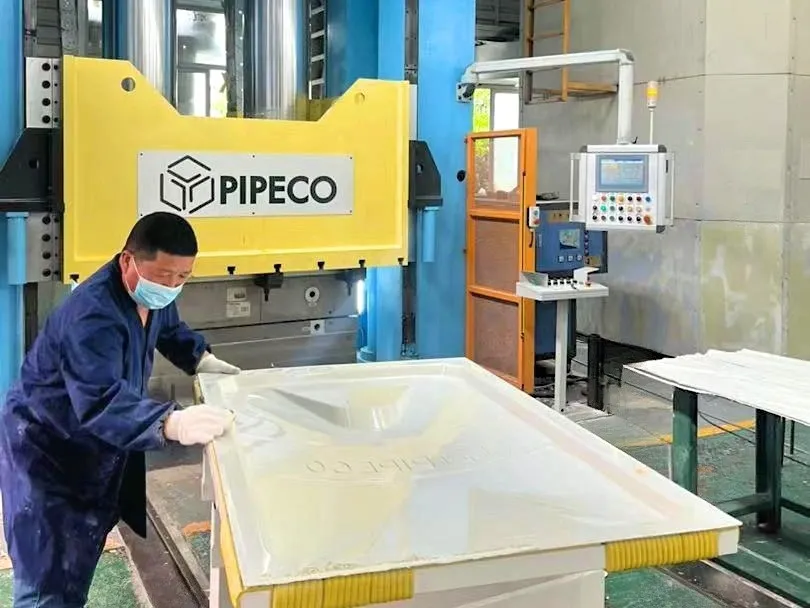
Coastal wastewater treatment plants face a combination of material challenges that can be more demanding than those at inland facilities. Salt-laden air, chloride-bearing water, high humidity, chemical dosing, wet-dry cycles and limited access for maintenance can all influence the long-term performance of storage tanks.
When engineers compare a GRP sectional tank with a stainless steel tank, the decision should not be based on purchase price or a general statement that one material is more corrosion-resistant. The correct choice depends on the stored liquid, the surrounding atmosphere, the tank structure, the installation details and the cost of maintaining the complete system over its service life.
This guide examines how fiberglass-reinforced plastic and stainless steel behave in coastal wastewater applications. It also provides a practical comparison framework for engineers, EPC contractors, facility operators and procurement teams evaluating a fiberglass tank for a marine or high-chloride environment.
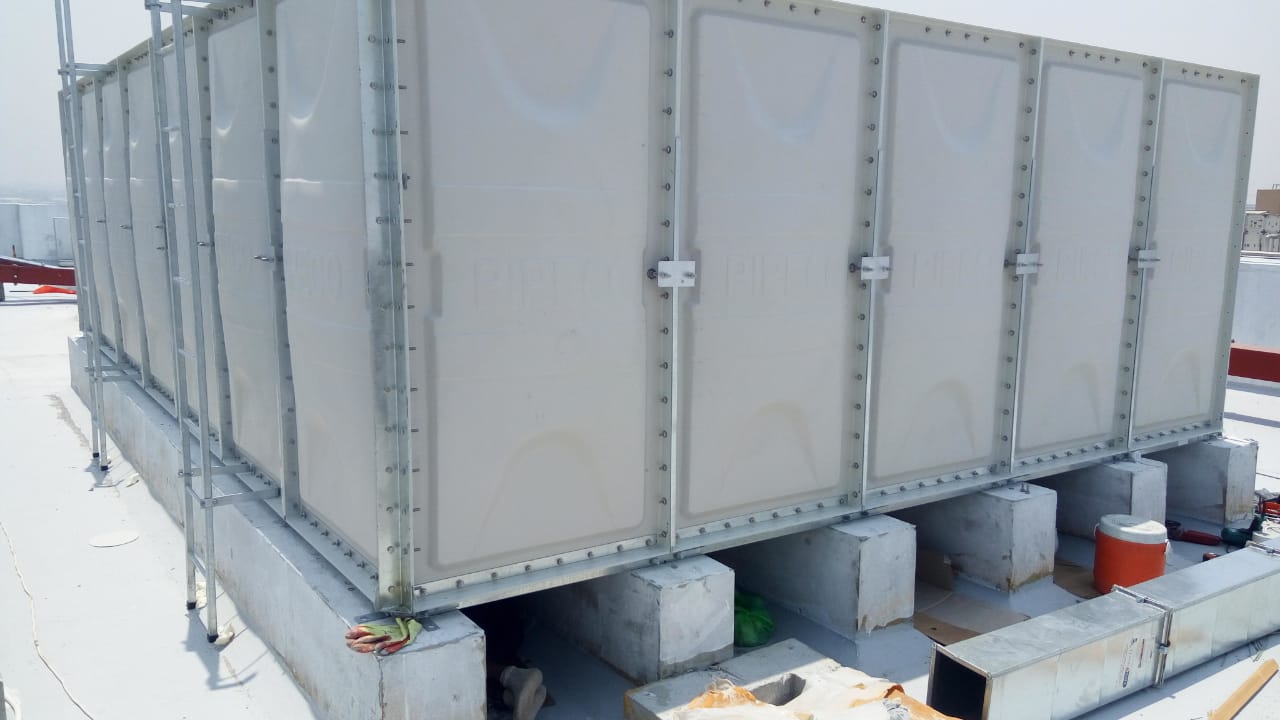
Wastewater infrastructure near the coast may be exposed to both atmospheric and process-related corrosion risks. These conditions should be evaluated separately because the liquid stored inside a tank may have different chemical characteristics from the atmosphere surrounding it.
Marine aerosols can deposit chlorides on exposed surfaces, including tank exteriors, support frames, fasteners, access platforms and pipework. In humid conditions, these deposits may remain wet for extended periods, creating a more aggressive environment for susceptible metals.
For stainless steel, the combination of chlorides, moisture, deposits and restricted oxygen access can contribute to localized corrosion, particularly at crevices, gasket interfaces, threaded connections and other locations where deposits accumulate.
A GRP tank body does not experience metallic rusting in the same way. However, exposed metal components in the tank assembly may still require suitable material selection, isolation, coating or inspection.
The wastewater itself may contain chlorides, dissolved salts, acids, alkalis, cleaning agents or treatment chemicals. Their concentrations can vary with industrial discharge, seawater intrusion, chemical dosing and the treatment process.
A material that performs well in a marine atmosphere may not automatically be suitable for continuous immersion in a chemically aggressive liquid. Engineers should therefore distinguish between:
Some coastal plants operate in locations where maintenance access, spare-part delivery or temporary storage arrangements are difficult. A repair that appears inexpensive on paper may cause significant disruption if the tank must be emptied, isolated or taken out of service.
Tank selection should therefore consider inspection access, the availability of replacement components, repair procedures and the consequences of downtime, not just the resistance of the primary material.
Glass-reinforced plastic, commonly abbreviated as GRP, is a composite material made from glass reinforcement embedded in a polymer resin matrix. It is also commonly described as fiberglass-reinforced plastic, or FRP.
Because GRP is non-metallic, its main structural body does not undergo electrochemical rusting like carbon steel. It also does not develop metallic chloride pitting in the same manner as stainless steel. This can make a properly specified GRP tank attractive for certain coastal and chloride-exposed applications.
Nevertheless, GRP is not universally resistant to every chemical. Its performance depends on factors such as:
Chemical compatibility should be confirmed for the proposed resin system and the actual service conditions. A general description such as "fiberglass" is not sufficient to establish compatibility with a specific wastewater stream.
Stainless steel relies on a passive surface film that helps protect the underlying metal. Its corrosion performance depends on the alloy composition, surface condition, fabrication quality and surrounding environment.
Grade 304 is commonly used in many general-purpose applications, while grade 316 contains molybdenum and generally offers improved resistance to chloride-related localized corrosion. However, grade 316 is not immune to pitting or crevice corrosion in every marine or wastewater condition.
Corrosion risk can increase when chlorides accumulate beneath deposits, gaskets or tight joints, especially where moisture remains trapped. Weld quality, heat tint, surface contamination, cleaning and passivation practices may also affect performance.
More highly alloyed stainless steels may be appropriate for some aggressive services, but the additional material cost should be justified by a documented assessment of the actual exposure.
The main panel or shell material is only one part of a storage system. A GRP sectional tank may include metallic tie rods, bolts, support members, access ladders, pipe connections and other accessories. A stainless steel tank may also incorporate gaskets, coated supports, dissimilar metals and connection hardware.
Engineers should check the corrosion resistance and compatibility of each component that is exposed to the atmosphere, stored liquid or condensation. Otherwise, a material advantage in the main tank body may be undermined by a vulnerable connection or support component.
The following table provides a preliminary comparison for coastal wastewater projects. Actual performance must be confirmed against the tank design, material specification, liquid composition and site conditions.
| Evaluation Factor | GRP Sectional Tank / Fiberglass Tank | Stainless Steel Tank | What Engineers Should Verify |
|---|---|---|---|
| Salt-laden coastal atmosphere | The GRP body does not undergo metallic atmospheric rusting. Exposed metal accessories may still require corrosion protection. | Performance depends on stainless steel grade, surface condition, deposits, crevices and exposure severity. | Salt exposure, humidity, wet-dry cycles, external hardware and maintenance access. |
| Chloride-bearing liquid | May offer an advantage where the specified resin and laminate are chemically compatible with the liquid. | Chloride resistance depends on the selected alloy and operating conditions. Localized corrosion remains possible. | Chloride concentration, temperature, exposure duration and chemical compatibility data. |
| Resistance to all chemicals | Not universal. Resin chemistry, temperature and exposure conditions determine suitability. | Not universal. Alloy selection and the process environment determine suitability. | Full wastewater composition, chemical dosing and abnormal operating conditions. |
| Initial purchase cost | Depends on tank capacity, panel design, resin system, accessories, engineering and project requirements. | Depends on alloy grade, plate thickness, fabrication, welding, finishing and project requirements. | Compare quotations with equivalent capacity, design loads, accessories and documentation. |
| Installation cost | Panelized construction may be practical where site access is restricted, but assembly, lifting, foundations and connections still require planning. | Installation requirements depend on whether the tank is fabricated on site, delivered in sections or installed as a complete unit. | Transport, crane access, labor, assembly time, foundation design and commissioning. |
| Routine maintenance | Inspection remains necessary for panels, joints, seals, accessories, supports and any exposed metal components. | Inspection may need to focus on localized corrosion, welds, surface condition, deposits, crevices and connections. | Inspection schedule, access requirements, cleaning procedures and repair availability. |
| Protective coatings | The main GRP body does not require metallic corrosion protection, but any coated or metallic components need their own specification. | Additional protective measures may be considered for particular services, although coatings do not replace suitable alloy selection and detailing. | Coating scope, surface preparation, inspection requirements and future recoating costs. |
| Structural performance | Depends on panel geometry, laminate design, joints, internal supports, tie rods and the overall structural arrangement. | Depends on alloy, thickness, stiffening, welds, supports and the overall structural arrangement. | Hydrostatic pressure, design loads, deflection limits, seismic or wind loads and support conditions. |
| Expected service life | Must be supported by the manufacturer's design basis, material specifications, environmental limits and maintenance requirements. | Must be supported by the selected grade, corrosion assessment, design details and maintenance requirements. | Use comparable project assumptions and documented service-life expectations rather than generic material claims. |
| Repair and replacement | Repair options depend on the damage type, laminate construction, access and approved repair procedure. | Repair options depend on damage severity, alloy, welding access, surface restoration and the applicable procedure. | Repair time, qualified labor, spare parts, isolation requirements and temporary storage needs. |
| Lifecycle cost | May be competitive where reduced metallic corrosion exposure, installation logistics or maintenance requirements provide a measurable project benefit. | May be competitive where the selected grade and design meet the service conditions with acceptable maintenance and installation costs. | Use a common analysis period, discount rate, maintenance plan and replacement assumptions. |
Note: This comparison is a screening tool, not a substitute for a project-specific corrosion assessment, structural design review or chemical compatibility confirmation.
Before comparing prices, engineers should establish whether each proposed tank material is suitable for the stored liquid. This is especially important for wastewater plants receiving industrial effluent or using chemical dosing systems.
The design basis should identify the principal chemical constituents and the range of concentrations expected during normal operation. Where relevant, it should also include pH, chlorides, oxidizing agents, cleaning chemicals and temperature variation.
Average values alone may not be sufficient. Short-duration cleaning cycles, dosing errors or process upsets can expose the tank to conditions that differ significantly from the normal wastewater stream.
For a proposed GRP sectional tank, request information about the resin system, laminate or panel construction, internal surface specification and the conditions for which the tank is designed. Where the wastewater is chemically aggressive, obtain written confirmation that the proposed construction is suitable for the documented service.
If a corrosion barrier or special internal liner is required, it should be included in the quotation and technical documentation rather than assumed to be part of a standard tank.
A stainless steel quotation should specify the actual grade used for the wetted components and relevant accessories. If different components use different grades, this should be clearly documented.
The assessment should also consider welds, surface finish, cleaning, passivation where applicable, crevice details and the potential accumulation of chloride-bearing deposits. Selecting a grade based on a generic description such as "marine stainless steel" is not enough for a demanding wastewater application.
Do not approve a tank material solely because it is described as corrosion-resistant. Record the actual chemical exposure, confirm the material specification and obtain supporting compatibility information before finalizing the design.
Corrosion resistance is only one part of tank reliability. Both GRP sectional tanks and stainless steel tanks must be designed for the required capacity, liquid head, support conditions and site-specific loads.
Liquid pressure increases with depth. For a liquid of approximately uniform density, the hydrostatic pressure at depth can be expressed as:
p = ρgh
Where p is hydrostatic pressure, ρ is liquid density, g is gravitational acceleration and h is the depth below the liquid surface.
This relationship is a basic starting point, not a complete tank design method. The final structural design must account for panel or plate behavior, joint forces, internal supports, deflection, local stress concentrations, load combinations and the applicable design standard.
A suitable foundation is essential for both tank types. Uneven support or differential settlement can cause distortion, leakage, excessive stress or damage to connections. GRP sectional tanks in particular rely on the correct arrangement of panels, joints and internal support components to achieve the intended structural performance.
Foundation flatness, level, load-bearing capacity, drainage and access for inspection should be addressed during project planning. The tank supplier's foundation and installation requirements should be incorporated into the civil design.
Pipe connections, access openings, overflow lines, drain fittings and level instruments should be designed for the tank material and service conditions. The connection arrangement should accommodate expected loads without transferring excessive forces into tank panels or shell sections.
In coastal environments, also review the corrosion resistance of fasteners, brackets, supports and other exposed metal parts. Where dissimilar metals are used together, the design should assess whether galvanic corrosion or other compatibility issues could arise under the actual exposure conditions.
Outdoor tanks near the coast may be exposed to ultraviolet radiation, wind, driving rain and, in some regions, seismic loads or extreme temperatures. The tank specification should define the relevant design conditions and identify any additional protection or support requirements.
For GRP tanks, verify that the selected material system and exposed accessories are suitable for the expected environment. For stainless steel tanks, consider the effects of deposits, crevices and persistent moisture on external surfaces and connections.
Maintenance requirements depend on tank design, exposure severity, operating conditions and the manufacturer's instructions. It is therefore more useful to compare the actual inspection and repair tasks than to assume that either material is maintenance-free.
The inspection schedule should reflect the tank manufacturer's instructions, the severity of the environment, the consequences of failure and the plant's operating requirements. A baseline inspection record can help the maintenance team compare later observations and identify changes before they become major problems.
For more practical guidance, review PIPECO's water tank maintenance resource and the company's information on GRP water tank systems.
Initial purchase price is only one part of the financial decision. A tank with a lower quotation may require more expensive installation, more frequent inspection, additional protective measures or greater operational disruption over the analysis period.
Conversely, a higher initial price may be justified if it provides a documented reduction in maintenance, replacement risk or downtime. These potential benefits should be quantified using project assumptions rather than treated as guaranteed outcomes.
A simplified discounted total cost of ownership model can be expressed as:
TCO = C0 + Σ [Ct / (1 + r)t] + Cend
Where:
The model should use the same analysis period for both tank options. If replacement is expected within that period, include the relevant replacement and removal costs. Avoid counting the same cost twice, and document whether downtime, energy, financing or residual value is included.
| Cost Category | Questions to Ask | Evidence to Collect |
|---|---|---|
| Purchase and engineering | Are the two quotations based on equivalent capacity, loads, accessories and documentation? | Itemized quotations, drawings, technical specifications and exclusions. |
| Delivery and installation | What are the transport, lifting, assembly, foundation and commissioning requirements? | Installation method statement, logistics plan and contractor estimates. |
| Inspection and maintenance | What routine inspections, cleaning and preventive tasks are required? | Manufacturer's maintenance instructions and site maintenance plan. |
| Repairs and spare parts | What damage scenarios are credible, and how quickly can repairs be completed? | Repair procedures, spare-part availability and labor estimates. |
| Downtime and temporary storage | Would tank isolation interrupt treatment or require temporary storage or bypass arrangements? | Operational impact assessment and contingency plan. |
| Replacement | Could the tank require major refurbishment or replacement during the analysis period? | Documented service-life assumptions and replacement scenarios. |
| End of life | What removal, transport, disposal or residual-value assumptions apply? | Local disposal requirements and credible cost estimates. |
When service-life or maintenance data are uncertain, prepare at least three scenarios: a base case, a lower-cost case and a higher-cost case. Vary assumptions such as inspection frequency, repair costs, replacement timing and downtime to understand which factors have the greatest impact on the decision.
A sensitivity analysis is especially useful when comparing a GRP sectional tank with a higher-grade stainless steel option. It can show whether the preferred material remains cost-effective if actual maintenance costs or replacement timing differ from the initial estimate.
Compare equivalent service requirements over an equivalent period. Do not assign an assumed service life, maintenance frequency or savings percentage to either material unless the figure is supported by relevant product data, project experience or a clearly documented engineering assumption.
A structured decision process helps engineering and procurement teams avoid selecting a tank based on a single material characteristic. The following steps can be used during concept design, technical bid evaluation and supplier clarification.
If both options satisfy the technical requirements, the final decision can be based on the project's risk tolerance, available maintenance resources, installation constraints and evaluated total cost of ownership.
A clear request for quotation (RFQ) makes technical bids easier to compare. It also reduces the risk of receiving quotations based on different assumptions about tank capacity, material construction or included accessories.
| RFQ Item | Information to Specify or Request |
|---|---|
| Tank duty | Stored liquid, required capacity, operating levels, filling and emptying conditions. |
| Site conditions | Coastal exposure, indoor or outdoor installation, ambient temperature, wind and other applicable site loads. |
| GRP material details | Resin system, panel or laminate construction, internal surface requirements and documented chemical compatibility. |
| Stainless steel details | Specified alloy grade for wetted and exposed components, material documentation, surface finish and fabrication requirements. |
| Structural design | Drawings, design loads, support arrangement, allowable deflection criteria and foundation requirements. |
| Accessories and connections | Inlet, outlet, overflow, drain, manhole, level instruments, ladders, supports, tie rods, bolts, seals and other required components. |
| Installation scope | Delivery, unloading, lifting, assembly, connection work, commissioning and any excluded site services. |
| Quality documentation | Material records, inspection and test requirements, drawings, installation instructions and other project-specified documents. |
| Maintenance requirements | Inspection intervals, cleaning instructions, approved repair methods and recommended spare parts. |
| Commercial terms | Delivery schedule, warranty scope, exclusions, spare-part lead times and responsibilities for installation or commissioning. |
Where the project specifies particular standards, certifications or third-party inspections, identify them explicitly in the RFQ. Requirements should be confirmed against the intended tank application and the contract specification rather than assumed to apply to every tank.
A GRP sectional tank may be worth evaluating when the project requires modular construction, access through restricted routes or a non-metallic tank body for a suitable chemical service. Its potential advantages are most relevant when the specified resin system is compatible with the stored liquid and the complete assembly is designed for the installation environment.
A GRP option should not be selected simply because the project is located near the sea. The engineer still needs to confirm structural performance, outdoor exposure limits, panel-joint design, supports, accessories and maintenance requirements.
For a project involving corrosive wastewater, a useful next step is to compare the proposed GRP tank specification against the liquid composition and site conditions before requesting a final commercial evaluation.
Learn more about PIPECO's GRP water tank solutions and review the company's stainless steel water tank options as part of the material selection process.
Choosing a tank for a coastal wastewater facility involves more than selecting a material. Capacity, panel or shell design, connections, site access, installation requirements and maintenance planning all influence the suitability of the final system.
PIPECO supplies water tank solutions for different project requirements, including GRP water tanks and stainless steel water tanks. Project teams can use the technical discussion and quotation process to clarify tank duty, site conditions, required accessories and applicable documentation before finalizing a specification.
To help assess a project, prepare the intended storage capacity, wastewater composition, operating temperature, installation location, design requirements and any mandatory standards or inspection documents. This information provides a more useful starting point than a material preference alone.
Contact PIPECO through the official contact page to discuss your project requirements.
A GRP sectional tank may offer advantages in coastal environments because its composite structure does not undergo electrochemical rusting like ordinary carbon steel. However, the best choice depends on wastewater chemistry, resin compatibility, operating temperature, structural requirements, installation conditions and total lifecycle cost. Stainless steel can also be appropriate when the selected grade and design suit the exposure.
Yes. Grade 316 generally offers improved resistance to chloride-related localized corrosion compared with grade 304, but it is not immune to pitting, crevice corrosion or other forms of attack. Risk depends on chloride concentration, temperature, deposits, crevices, surface condition and maintenance.
No. GRP chemical resistance depends on the resin system, reinforcement, internal surface construction, chemical concentration, temperature and exposure duration. The proposed material specification should be checked against the actual wastewater composition and operating conditions.
Yes. A GRP tank still requires inspections of panels, joints, seals, supports, connections and accessories. Any exposed metallic components should also be checked for corrosion or damage. Inspection frequency should follow the manufacturer's instructions and the project's operating and environmental conditions.
Neither material is always the lowest-cost option. A valid comparison includes purchase price, installation, foundations, protective systems, inspection, maintenance, downtime, repairs, replacement and end-of-life costs over the same analysis period.
No. Higher-alloy stainless steels may improve resistance in specific environments, but no grade should be assumed immune to every wastewater or marine exposure. Material selection should be based on the actual chemical and operating conditions, with appropriate attention to fabrication, surface condition and connection details.
Important inputs include wastewater composition, chemical concentrations, temperature range, design volume, operating level, installation location, design loads, access requirements, connection details, applicable project specifications and required inspection or certification documents.
A GRP sectional tank can be considered for outdoor coastal installation when its materials, structural design, support system, fasteners, seals, UV exposure and wind or seismic requirements are suitable for the site. The complete tank assembly should be reviewed, not just the panel material.
Yes, where a tank outage affects wastewater treatment, storage capacity, compliance or plant operations. Downtime, temporary storage, bypass arrangements, replacement lead time and operational disruption can materially affect the total cost of ownership.
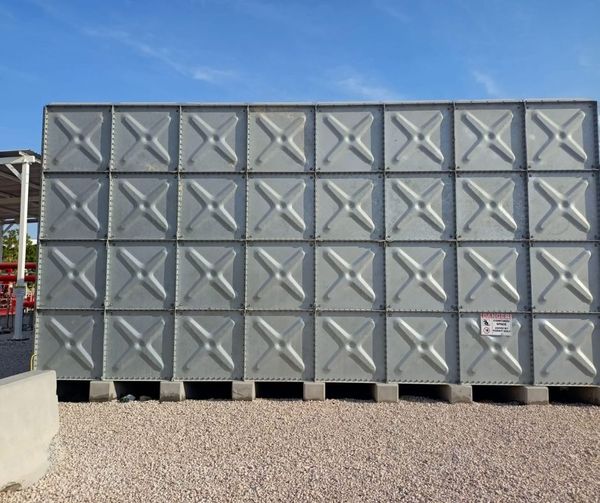
The following resources can help engineers evaluate tank construction, maintenance and project requirements:
For coastal wastewater plants, the comparison between a GRP sectional tank and a stainless steel tank should begin with the actual exposure conditions rather than a general material ranking. GRP avoids metallic rusting in its composite body, while stainless steel performance depends on alloy selection, fabrication and the local corrosion environment. Both options still require suitable structural design, installation controls and maintenance planning.
The most reliable selection process combines chemical compatibility verification, structural review, a realistic maintenance plan and a transparent lifecycle cost model. By documenting these factors before procurement, engineers and operators can choose a tank system that meets the project's technical requirements and long-term operational priorities.
For project-specific evaluation, visit PIPECO's contact page and prepare the required storage capacity, wastewater characteristics, site conditions and applicable project specifications.
Experience the brand Trusted by Renowned Companies across the GLOBE.
Pipeco stands at the forefront of the market, recognized as a premier manufacturer, supplier, and exporter specializing in top-tier GRP water tanks, stainless steel water tanks, and FRP Water Tank, Fiberglass Tank, SMC Water Tank committed to delivering unparalleled quality and excellence.
Get In Touch
Email: master@pipeco.cn
Tel: 0086-576-84616026
Address: No.2 Zhaofeng Road, Xinqian Street, Huangyan District, Taizhou City, Zhejiang Province, China