

Choosing the correct GRP water tank capacity is one of the first decisions that should be made when planning a water storage system. A tank that is too small may not provide sufficient reserve during periods of high demand, while an unnecessarily large tank can increase the footprint, structural requirements, transportation cost, and overall project investment.
For this reason, water tank sizing should not be based simply on the available tank models or a nominal capacity selected from a product catalogue. The required storage volume should be determined from the project's water demand, operating conditions, required storage duration, available installation space, and any additional reserve requirements.
For projects using a GRP sectional water tank, capacity selection also needs to consider the modular panel configuration. The final tank dimensions should provide the required effective storage volume while remaining compatible with the foundation, building structure, transportation route, pipework, and maintenance requirements.
This guide explains how to calculate the required water storage capacity, how nominal and usable capacity differ, which project factors influence tank sizing, and how to select a practical GRP water tank configuration.
The capacity of a water storage tank directly affects the reliability of the water supply system. The tank must contain enough water to satisfy the intended demand during the required operating period while maintaining an appropriate reserve.
The correct capacity depends on the purpose of the tank.
For example, a tank supplying a small commercial building may be sized according to daily water consumption, while a tank used for an industrial process may be sized according to production requirements, process interruption risk, and the required operating reserve.
Fire protection storage follows another design principle because the required volume may depend on the required fire flow and specified duration rather than normal daily consumption.
Therefore, there is no universal GRP water tank capacity that is suitable for every project.
A useful sizing process should begin with the question:
How much water must actually be available when the storage system is operating under the project's design conditions?
One of the most important concepts in water tank sizing is the difference between nominal capacity and usable capacity.
A tank may be described commercially as having a particular nominal volume, but the entire geometric volume should not automatically be treated as the amount of water available for every operating condition.
The practical storage volume can be affected by:
For engineering purposes, it is therefore useful to distinguish between the physical volume of the tank and the volume that can actually be used during normal operation.
Nominal capacity refers to the stated or calculated volume associated with the tank configuration.
For a simple rectangular tank, the basic geometric volume can be estimated using:
Volume = Length × Width × Height
For example, a rectangular tank measuring 5 m × 4 m × 5 m has a geometric volume of:
5 × 4 × 5 = 100 m3
This provides a basic 100 m3 geometric volume before considering practical operating limitations.
The usable capacity is the amount of water that can be practically utilized under the project's operating conditions.
For example, if the design does not use the full physical height of the tank because of freeboard and other operating requirements, the effective water volume will be lower than the simple external dimensions might suggest.
This distinction becomes particularly important when the required storage volume is close to the maximum capacity of the selected tank.
For a rectangular GRP water tank, the basic geometric calculation is straightforward:
Tank Volume (m3) = Length (m) × Width (m) × Water Depth (m)
Because one cubic metre of water corresponds to approximately 1,000 litres, the volume can also be converted as follows:
1 m3 = 1,000 litres
Therefore:
100 m3 = 100,000 litres
For a project requiring approximately 100,000 litres of geometric storage, a tank configuration providing approximately 100 m3 of volume would be the starting point for the sizing process.
However, this calculation only establishes the physical volume. It does not determine whether 100 m3 is actually sufficient for the project.
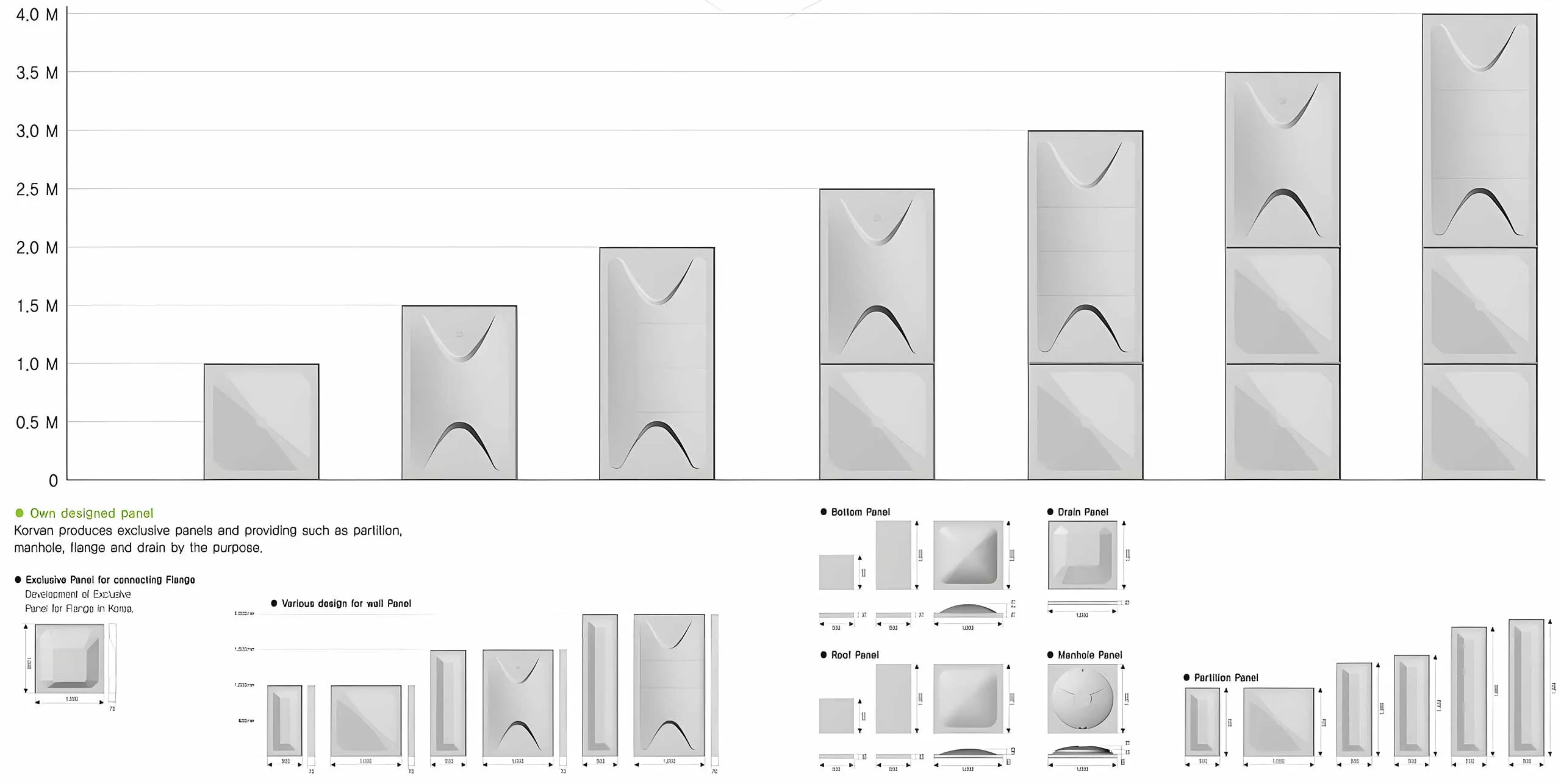
The required capacity should normally be determined from the project's expected water demand and required storage period.
A simplified sizing relationship can be expressed as:
Required Storage = Water Demand × Required Storage Duration
An additional reserve may then be considered where required by the application or project specification.
A simplified planning formula can therefore be written as:
Required Tank Capacity ≈ Daily Demand × Storage Days + Required Reserve
This is a conceptual sizing relationship rather than a universal design code formula. The final calculation should follow the requirements applicable to the specific project.
Suppose a facility has an estimated average daily water demand of 30 m3 and the project requires approximately two days of storage.
The basic storage requirement would be:
30 m3/day × 2 days = 60 m3
A tank of approximately 60 m3 would therefore provide the basic calculated storage volume before project-specific reserves and operating limitations are considered.
If the project requires additional reserve capacity, the selected tank may need to be larger than the basic 60 m3 calculation.
The required storage volume depends on much more than the number of people using the water system.
Important factors include:
The relative importance of these factors changes according to the application.
For residential and commercial applications, water storage requirements are often associated with the expected consumption of the occupants and the reliability of the municipal or incoming water supply.
The project team may consider:
A commercial building with a highly reliable continuous water supply may have different storage requirements from a remote facility where interruptions are frequent or difficult to predict.
This is why selecting a GRP water tank based only on building floor area can lead to inaccurate sizing.
Industrial water storage can be more complex because water demand may be directly related to production processes.
An industrial facility may require water for:
For these applications, average daily consumption may not be sufficient for determining the tank size.
The engineering team may also need to evaluate hourly consumption, production schedules, peak demand, minimum operating volume, and the consequences of water supply interruption.
A facility may consume a moderate amount of water on average but experience short periods of significantly higher demand.
If the incoming water supply cannot satisfy the peak demand directly, the storage tank may need to compensate for the difference.
For this reason, a tank sized purely from average daily consumption may not provide sufficient operating capacity in every application.
Fire protection storage should be treated separately from ordinary domestic or process water storage.
The required fire water volume can depend on the required flow rate and the specified duration of the fire protection system.
A simplified conceptual relationship is:
Fire Water Volume = Required Fire Flow × Required Duration
For example, if a project specification requires a particular flow to be maintained for a defined period, the required volume can be estimated from those two parameters.
However, actual fire water storage design should follow the applicable fire protection standard and project requirements rather than relying on a generic calculation.
For projects involving fire protection, the tank supplier should receive the relevant design criteria before the tank capacity is finalized.
Agricultural and irrigation applications can have highly variable water demand.
The required storage volume may depend on:
A storage tank may be used to bridge the difference between when water is available and when irrigation demand occurs.
In these applications, the tank capacity should therefore be evaluated together with the pumping and distribution system.
One of the simplest ways to understand tank sizing is to consider how long the stored water must support the system.
If daily demand remains constant, increasing the required storage duration will generally increase the required tank capacity.
| Daily Water Demand | Required Storage Duration | Basic Storage Requirement |
|---|---|---|
| 20 m3/day | 1 day | 20 m3 |
| 20 m3/day | 2 days | 40 m3 |
| 20 m3/day | 3 days | 60 m3 |
| 50 m3/day | 2 days | 100 m3 |
| 100 m3/day | 2 days | 200 m3 |
These values illustrate the basic relationship only. Actual tank sizing may require additional allowances, operating constraints, and application-specific requirements.
Two tanks can have approximately the same storage volume but very different dimensions.
For example, a project may require approximately 100 m3 of storage. A taller tank with a smaller footprint may provide this volume, while a shorter tank with a larger footprint may provide a similar capacity.
The preferred option depends on the installation site.
Important considerations include:
This is particularly important for GRP sectional water tanks, because the final tank configuration can be adapted through different combinations of modular panels.
One of the practical advantages of a sectional GRP water tank is that the tank can be assembled from individual panels at the final installation location.
This modular construction can be useful when the required capacity is large or when the site has restricted access.
Instead of transporting one large completed vessel, the individual panels and accessories can be transported separately and assembled on site.
However, modular construction does not eliminate the need for engineering consideration.
The selected configuration should still satisfy:
Increasing the height of a water tank can provide more storage volume without increasing the footprint, but greater water depth also increases hydrostatic pressure at the lower portions of the tank.
The basic hydrostatic relationship is:
P = ρgh
where:
This relationship explains why water depth is an important engineering parameter when configuring a sectional GRP tank.
A higher tank may reduce the required footprint, but the structural design must account for the corresponding increase in water pressure.
Tank sizing can therefore be viewed as a balance between storage volume and physical dimensions.
| Configuration | Potential Advantage | Potential Consideration |
|---|---|---|
| Taller and narrower | Reduced floor area | Greater water depth and height |
| Lower and wider | Lower water depth | Greater floor area |
| Intermediate configuration | Balanced footprint and height | Requires site-specific optimization |
There is therefore no single “best” tank dimension for a given capacity. The appropriate configuration depends on the actual project constraints.
A water tank is not always operated at its absolute geometric maximum.
The tank design may include an upper freeboard area or other operating allowance depending on the tank configuration and project requirements.
This means that the required nominal tank capacity should be evaluated against the required usable storage volume.
For example, if a project requires 100 m3 of usable water but the tank is not intended to operate at its complete geometric maximum, simply selecting a tank with exactly 100 m3 of geometric volume may not provide an adequate operating margin.
The final specification should therefore distinguish between:
The exact relationship should be confirmed with the tank manufacturer and the project engineer.
Average daily consumption is useful for preliminary planning, but it does not always represent the actual operating condition of a water storage system.
Water demand can fluctuate considerably throughout the day. A building may experience relatively low consumption during the night but significantly higher demand in the morning or during working hours.
If the incoming water supply cannot immediately satisfy these short-term demand peaks, the storage tank may need to provide the difference.
A simplified way to understand this relationship is:
Tank Contribution During Peak Demand = Peak Demand − Available Incoming Supply
The larger the difference between peak demand and available supply, the more important the storage volume becomes.
| Parameter | Average Demand | Peak Demand |
|---|---|---|
| Purpose | Represents normal consumption | Represents high-demand operating periods |
| Typical use | Daily storage estimation | Short-term system sizing |
| Variation | Usually smoother | Can change significantly over short periods |
| Importance | Defines baseline demand | Helps determine required reserve and supply capability |
For this reason, a reliable water storage design should consider both normal consumption and the expected peak operating condition.
The reliability of the incoming water supply is another important factor in determining the required GRP water tank capacity.
A facility supplied by a highly reliable continuous network may require less storage than a remote facility where interruptions are frequent or difficult to predict.
The project team should therefore consider:
For critical infrastructure, the cost of insufficient storage may be much greater than the additional investment required for a larger tank.
This does not mean that every project should use an oversized tank. Instead, the storage duration should be established from the actual reliability and risk requirements of the facility.
Reserve capacity can provide additional operational flexibility, but the appropriate reserve depends on the application.
Potential reasons for additional storage include:
However, reserve volume should not simply be added as an arbitrary percentage to every project.
The required reserve should be based on the project's risk profile, operating strategy, applicable requirements, and the consequences of water shortage.
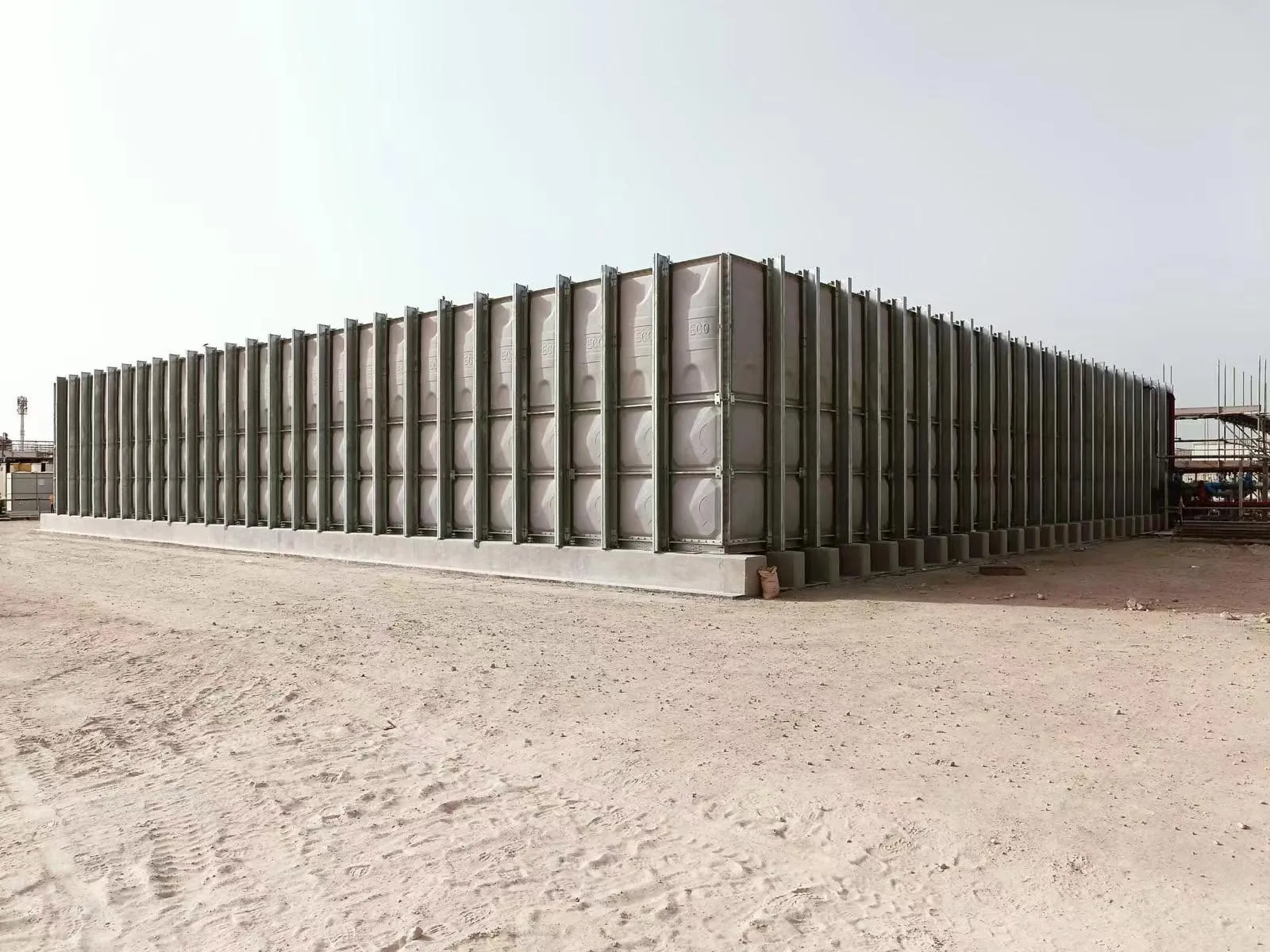
A large water storage requirement does not always have to be satisfied by a single tank.
Depending on the project, multiple sectional GRP tanks can potentially be used as part of one water storage system.
For example, a project requiring a large total storage volume may consider:
The appropriate arrangement depends on site constraints and system requirements.
Multiple tanks can provide several potential operational advantages.
For example, if one tank can be isolated while another remains in operation, maintenance may be easier than with a single-tank system.
However, multiple tanks also introduce additional pipework, valves, controls, foundations, and coordination requirements. The overall system should therefore be evaluated rather than assuming that more tanks automatically provide a better solution.
In some facilities, different types of water should not necessarily be stored in the same tank.
A project may require separate storage for:
Separating these functions can simplify system management and allow each tank to be designed according to its specific operating requirements.
For example, fire water storage should normally be evaluated according to the applicable fire protection requirements rather than being sized from ordinary daily consumption.
Rooftop water storage introduces an additional relationship between tank capacity and building structure.
As tank capacity increases, the weight of the stored water also increases significantly.
A useful preliminary relationship is:
Water Mass ≈ Water Volume × Water Density
Because water has a density of approximately 1,000 kg/m3 under ordinary conditions, 100 m3 of water represents roughly 100,000 kg of water mass, before considering the tank structure and accessories.
This illustrates why rooftop tank capacity should never be selected solely according to available roof space.
The structural engineer should evaluate the building structure and load-transfer arrangement before the final tank configuration is approved.
Remote infrastructure projects can have very different storage requirements from urban buildings.
Examples include:
In these locations, the required tank capacity may be influenced by transportation schedules and the availability of replacement water.
If water deliveries are infrequent, a larger storage volume may be required to bridge the period between deliveries.
The tank should therefore be sized together with the site's complete water supply strategy.
Consider a remote facility that receives water by tanker.
If water is delivered every day, the required storage volume may be relatively modest. If deliveries occur only once every several days, the storage requirement may increase significantly.
A simplified planning relationship is:
Required Storage ≈ Daily Demand × Delivery Interval
For example, if a facility consumes 15 m3 per day and water is delivered every four days:
15 × 4 = 60 m3
Approximately 60 m3 would be the basic storage requirement before considering reserve capacity and other project-specific factors.
This example demonstrates that tank capacity is closely related to the complete water supply logistics rather than the tank itself.
Sometimes the required storage volume is known, but the available installation space limits the possible tank dimensions.
This situation is common in:
For a sectional GRP water tank, the available space should be measured in three dimensions:
In addition, access clearance must be considered because the tank needs to be assembled and maintained.
A useful preliminary comparison is to consider how much storage volume can be achieved within a given footprint.
| Tank Configuration | Approximate Footprint | Approximate Height | General Consideration |
|---|---|---|---|
| Compact and tall | Smaller | Higher | Useful where floor area is restricted |
| Medium configuration | Moderate | Moderate | Balanced option for many sites |
| Wide and low | Larger | Lower | Useful where floor area is available |
These descriptions are conceptual rather than standardized tank configurations. The actual dimensions should be determined from the manufacturer's available panel system and the project's engineering requirements.
The physical footprint of the tank is not necessarily the same as the space required for the complete installation.
Additional space may be needed for:
A tank that technically fits into a room may therefore still be unsuitable if there is insufficient clearance for assembly or maintenance.
This is especially important for indoor sectional tank installations where the available working space can be more restrictive than the final tank footprint.
Daily consumption provides a useful starting point, but peak demand, storage duration, supply reliability, and reserve requirements may also affect the final capacity.
The stated tank volume should not automatically be assumed to equal the practical operating volume. Freeboard, outlet elevation, operating levels, and reserve requirements should be reviewed.
A tank with the correct volume may still be unsuitable if its height exceeds the building or installation constraints.
Increasing tank capacity also increases the total water load. The supporting structure must be considered before the tank size is finalized.
A larger tank is not automatically better. Excessive storage can increase project cost, footprint, structural requirements, and potentially water residence time.
Tank capacity should be evaluated together with incoming supply, pumping, distribution, and delivery schedules.
A theoretical tank capacity may not correspond to a practical tank configuration once the available footprint, access route, foundation, and maximum height are considered.
No. The optimal tank capacity is the one that satisfies the required operating conditions without creating unnecessary cost or engineering complications.
An oversized tank may require:
In some water systems, excessive storage may also increase the time that water remains inside the tank. Depending on the application, water turnover and water quality management may therefore need to be considered.
The objective should be appropriate capacity, not maximum capacity.
A practical capacity-selection process can be summarized as follows:
Consider a commercial facility with the following preliminary requirements:
The basic storage requirement is:
40 m3/day × 2 days = 80 m3
The preliminary target is therefore approximately 80 m3 of storage before project-specific reserve and operating allowances are applied.
The next step is not simply to order an “80 m3 tank.”
The engineering team should determine which sectional configuration can provide the required usable volume while fitting within the available footprint and satisfying the required height, foundation, connections, and access conditions.
This illustrates the difference between capacity calculation and tank selection. The first determines how much water is needed; the second determines how that volume can be physically and safely provided.
A common procurement mistake is to select a standard tank configuration first and then attempt to justify its capacity afterward.
A better approach is to work in the opposite direction:
Water Requirement → Required Storage → Usable Capacity → Tank Dimensions → Structural Check → Final Configuration
This sequence allows the tank to be selected according to the project instead of forcing the project to adapt to an arbitrary tank size.
A supplier's technical input can be particularly useful when the project has unusual constraints.
Technical consultation may be appropriate when:
The manufacturer can then review the required volume together with the physical and operational constraints and propose a practical sectional tank configuration.
Do not select a GRP water tank by capacity alone. First calculate the required storage volume, then determine the usable capacity, available footprint, tank height, foundation requirements, operating conditions, and connection arrangement. The final tank configuration should satisfy the complete project rather than a single numerical capacity.
GRP sectional water tanks are commonly specified according to their nominal storage volume. However, a capacity number by itself does not describe the complete tank configuration.
A requirement such as 50 m3, 100 m3, or 500 m3 should be treated as the starting point for engineering and procurement rather than as a complete product specification.
The final tank dimensions may vary depending on:
A 50 m3 tank provides approximately 50,000 litres of geometric water volume.
This capacity may be considered for smaller commercial buildings, utility facilities, residential developments, irrigation systems, or other applications where the required storage volume is relatively moderate.
The actual suitability depends on the project's daily consumption and required storage duration.
A 100 m3 GRP water tank corresponds to approximately 100,000 litres of geometric volume.
This capacity is often relevant to commercial, institutional, industrial, infrastructure, and other medium-scale water storage applications.
For example, a project consuming approximately 50 m3 per day may require around two days of basic storage to reach approximately 100 m3, before considering reserve and other project-specific requirements.
A 200 m3 tank provides approximately 200,000 litres of geometric storage.
At this scale, the relationship between tank capacity, footprint, structural support, installation access, and piping becomes increasingly important.
A sectional configuration can be particularly useful when transporting a large completed tank to the final installation site would be difficult.
A 500 m3 storage requirement represents approximately 500,000 litres of geometric volume.
At this scale, the project should be evaluated as a complete engineered storage system rather than simply as a large tank.
The project team may need to coordinate:
Not by itself.
A given storage volume can be achieved using different combinations of length, width, and water depth.
For a simplified rectangular geometry:
Volume = L × W × H
Therefore, a nominal 100 m3 volume could theoretically be represented by many different dimensional combinations.
| Example | Length | Width | Water Depth | Geometric Volume |
|---|---|---|---|---|
| A | 5 m | 5 m | 4 m | 100 m3 |
| B | 10 m | 5 m | 2 m | 100 m3 |
| C | 8 m | 5 m | 2.5 m | 100 m3 |
These examples are mathematical illustrations rather than recommended tank designs.
The actual configuration must account for structural requirements, available panel systems, installation conditions, operating water level, and other engineering considerations.
When the required storage volume is fixed, the tank's dimensions can sometimes be optimized according to the available site.
A taller tank may be useful when floor area is limited, while a wider and lower configuration may be more suitable when there is sufficient ground space but height is restricted.
The choice can affect:
Therefore, tank capacity and tank geometry should be considered together.
For a large storage requirement, the project team may need to decide whether the required capacity should be provided by one large tank or several smaller tanks.
| Approach | Potential Advantages | Potential Considerations |
|---|---|---|
| Single large tank | Simple overall storage arrangement | Requires suitable space and foundation |
| Two tanks | Potential redundancy and maintenance flexibility | Additional pipework and equipment |
| Multiple tanks | Flexible layout and staged capacity | More complex system coordination |
The best arrangement depends on the project's operational priorities.
A single tank can be practical when:
Multiple tanks may be considered when:
The use of multiple tanks should be evaluated at the system level because additional tanks also require additional valves, pipework, foundations, and controls.
For sectional GRP water tanks, transportation is one of the reasons modular construction can be useful for large-capacity projects.
Instead of shipping a complete large-volume vessel, the tank can be supplied as individual panels and associated components for assembly at the destination.
This can be particularly useful when the final installation site has:
However, the total shipment still includes panels, reinforcement components, fasteners, sealing materials, accessories, and other required equipment.
Therefore, logistics should be considered during the early design stage rather than after the tank configuration has already been finalized.
As storage capacity increases, installation planning becomes increasingly important.
A large GRP sectional water tank may require:
This does not mean that a large sectional tank is inherently difficult to install. Rather, the installation should be planned according to the tank configuration and site conditions.
For large projects, a clear assembly sequence and appropriate installation procedures can help reduce avoidable delays.
The filled weight of the tank is dominated by the stored water.
As a preliminary relationship:
Water Load ≈ Tank Volume × 9.81 kN/m3
This means that approximately:
| Water Volume | Approximate Water Weight |
|---|---|
| 50 m3 | Approximately 491 kN |
| 100 m3 | Approximately 981 kN |
| 200 m3 | Approximately 1,962 kN |
| 500 m3 | Approximately 4,905 kN |
These figures represent the approximate gravitational load of the water only and do not constitute a foundation design.
The actual structural assessment should consider the tank, water, support system, foundation, local soil conditions, seismic requirements where applicable, and other project-specific loads.
It may appear that increasing tank capacity simply increases the quantity of materials proportionally. In practice, the relationship between capacity and total project cost can be more complicated.
A larger tank may require:
At the same time, selecting an unnecessarily small tank can create operational problems and may require future expansion.
The objective should therefore be to select a capacity that satisfies the actual design requirement while avoiding unnecessary oversizing.
The initial purchase price is only one part of a water tank project's total cost.
A broader evaluation can include:
For this reason, the cheapest tank quotation is not necessarily the lowest-cost water storage solution over the entire project lifecycle.
A clear RFQ helps suppliers understand the actual requirement and reduces the possibility of receiving quotations based on different assumptions.
Instead of writing:
“Please quote a GRP water tank.”
a more useful request might state:
For example:
Example RFQ Requirement:
“Supply a sectional GRP water tank with approximately 100 m3 required storage capacity for commercial water storage. The available installation area is approximately 6 m × 5 m, with a maximum allowable tank height of 4.5 m. The tank will be installed at ground level on a prepared concrete foundation. Please provide the proposed tank dimensions, panel configuration, accessories, connection details, installation requirements, and technical documentation.”
This type of RFQ gives the supplier enough information to evaluate the capacity together with the physical installation constraints.
Before finalizing the tank size, buyers and project engineers can review the following checklist.
| Question | Why It Matters |
|---|---|
| What is the required storage volume? | Defines the basic capacity target |
| What is the average daily demand? | Establishes baseline consumption |
| What is the peak demand? | Identifies short-term storage requirements |
| How many days of storage are required? | Determines storage duration |
| Is reserve capacity required? | Provides additional operational margin |
| What is the available footprint? | Limits tank length and width |
| What is the maximum allowable height? | Limits tank depth and configuration |
| Can the foundation support the filled tank? | Confirms structural feasibility |
| How will the tank reach the installation location? | Confirms transportation and assembly feasibility |
| Where are the pipe connections located? | Allows proper system coordination |
| Is redundancy required? | May affect single- vs. multiple-tank selection |
| What standards apply? | Ensures compliance with project requirements |
The process of selecting a water storage tank can be summarized into several engineering stages.
The capacity of a GRP water tank should not be considered independently from the rest of the water supply system.
The tank interacts with:
Changing the tank capacity can therefore affect other parts of the system.
For example, increasing storage capacity may allow longer operation during supply interruptions, but it may also increase structural loading and require a larger installation footprint.
Good tank selection is therefore an exercise in balancing competing requirements rather than maximizing a single parameter.
The correct GRP water tank capacity is not simply the largest volume that fits the site. It is the capacity that provides the required usable storage for the intended operating conditions while remaining compatible with demand, storage duration, peak usage, reserve requirements, site dimensions, foundation, transportation, installation, and system connections.
The appropriate storage capacity varies considerably according to the application. The same tank volume may be sufficient for one project but inadequate for another because water demand, operating schedules, supply reliability, and reserve requirements can be very different.
| Application | Main Capacity Consideration | Additional Factors |
|---|---|---|
| Residential buildings | Occupancy and daily consumption | Peak usage and supply reliability |
| Commercial buildings | Daily and peak demand | Operating hours and occupancy |
| Industrial facilities | Process and utility consumption | Production schedule and interruption risk |
| Fire protection | Required fire flow and duration | Applicable fire protection requirements |
| Irrigation | Irrigation demand and schedule | Water availability and seasonal conditions |
| Remote infrastructure | Demand and supply interval | Delivery logistics and emergency reserve |
| Construction camps | Population and daily consumption | Water delivery frequency |
| Process water | Production requirements | Water quality and process continuity |
Before approving a final tank configuration, the project team can use the following checklist to verify that the main capacity-related requirements have been addressed.
A structured request for quotation can make it easier for manufacturers to understand the project and prepare comparable proposals.
The following template can be adapted for commercial, industrial, infrastructure, or other water storage projects.
| Application | ____________________________ |
| Required storage capacity | ________________ m3 |
| Average water demand | ________________ m3/day |
| Peak demand | ________________ m3/day or __________________ |
| Required storage duration | ________________ days / hours |
| Required reserve | ________________ |
| Installation location | Ground / Rooftop / Indoor / Outdoor / Other |
| Available footprint | Length ______ m × Width ______ m |
| Maximum allowable height | ________________ m |
| Water type | Potable / Process / Fire / Irrigation / Other |
| Foundation | Existing / New / To be designed |
| Pipe connections | Inlet / Outlet / Drain / Overflow / Other |
| Environmental conditions | ____________________________ |
| Applicable standards | ____________________________ |
| Project location | ____________________________ |
A complete RFQ does more than help a supplier calculate a price. It gives the manufacturer an opportunity to identify potential technical constraints before production begins.
For example, a buyer may initially request a 200 m3 tank, but the available installation area may only allow a relatively low tank configuration. The supplier may then need to consider a different length-to-width-to-height combination or discuss the possibility of multiple tanks.
Similarly, a rooftop installation may require additional structural coordination before the tank capacity can be confirmed.
Providing these details at the beginning of procurement can reduce:
A water tank catalogue may list capacities such as 50 m3, 100 m3, 200 m3, or 500 m3, but these numbers should not be interpreted independently of the application.
The same nominal capacity can have different engineering implications depending on tank dimensions, water depth, foundation, installation location, and operating conditions.
For this reason, a professional tank selection process normally progresses from the water requirement toward the physical tank configuration.
The basic sequence is:
Water Demand → Storage Duration → Peak Demand → Reserve → Required Capacity → Usable Capacity → Tank Dimensions → Site Verification → Final GRP Tank Configuration
This approach allows the tank to be selected according to the project instead of selecting a tank first and attempting to adapt the project to it.
A basic preliminary calculation can be made by multiplying the expected water demand by the required storage duration. For example, a facility using 40 m3 of water per day and requiring two days of basic storage would need approximately 80 m3 of storage before considering reserve capacity and other project-specific requirements. Final sizing should account for actual operating conditions and applicable engineering requirements.
Nominal capacity generally describes the stated or geometric tank volume, while usable capacity refers to the amount of water that can practically be used under the project's operating conditions. Freeboard, operating water level, outlet elevation, reserve requirements, and other design considerations can make usable capacity different from the total geometric volume.
A 100 m3 tank represents approximately 100,000 litres of geometric water volume. The actual usable operating volume may be lower depending on the tank design, operating level, freeboard, and project requirements.
A 200 m3 GRP sectional tank can be suitable for many industrial water storage applications when its capacity, material specification, dimensions, structural support, water conditions, and connection arrangement are appropriate for the project. The actual suitability should be evaluated from the industrial facility's water demand and operating requirements.
The decision depends on available space, redundancy requirements, maintenance strategy, water services, foundation conditions, and system complexity. One tank can provide a simpler storage arrangement, while multiple tanks can provide greater operational flexibility and may allow one tank to be isolated for maintenance.
No. Oversizing can increase the tank footprint, foundation requirements, structural load, transportation, installation, and overall project cost. The objective should be to select sufficient usable storage for the actual application rather than simply choosing the largest available capacity.
GRP sectional tanks can often be configured using different combinations of modular panels, allowing the overall dimensions to be adapted to project requirements. However, the available configuration must still satisfy structural, operating, installation, and foundation requirements.
Increasing tank height can provide more storage volume without increasing the footprint, but greater water depth also increases hydrostatic pressure. Tank height must therefore be evaluated together with structural requirements, foundation conditions, building clearance, maintenance access, and the available tank panel system.
There is no universal rooftop tank capacity. The appropriate size depends on water demand and storage requirements, but the building's structural capacity is equally important. The weight of the stored water can be substantial, so the supporting structure should be evaluated before the final tank volume and configuration are approved.
Useful information includes the required capacity, average and peak water demand, storage duration, application, installation location, available footprint, maximum height, foundation conditions, water type, pipe connection requirements, environmental conditions, applicable standards, and project location. Complete information helps the supplier recommend a practical tank configuration and prepare a more accurate quotation.
Selecting the right GRP water tank capacity starts with understanding the water requirement rather than choosing a tank from a standard capacity list.
The basic calculation begins with water demand and required storage duration, but a complete engineering assessment may also need to consider peak demand, incoming supply reliability, emergency reserve, usable operating volume, installation dimensions, foundation conditions, transportation access, and pipework.
For sectional GRP tanks, capacity and geometry should be evaluated together. A tank may provide the required nominal volume but still be unsuitable if its height, footprint, access requirements, or structural loading does not match the project.
Large-capacity applications may also benefit from evaluating whether one tank or multiple tanks provide the better overall solution. The correct choice depends on redundancy, maintenance, site conditions, water services, and lifecycle cost.
The most reliable approach is therefore to follow a structured process:
By following this process, project owners and engineers can avoid both under-sizing and unnecessary oversizing while developing a water storage system that is better matched to the actual application.
PIPECO provides GRP water storage solutions for commercial, industrial, infrastructure, irrigation, and other project applications. For sectional tank projects, the required capacity can be evaluated together with installation dimensions, water application, foundation conditions, environmental requirements, and connection requirements.
When requesting a quotation, customers can provide the required storage volume, water demand, available installation space, maximum allowable height, application, project location, and other relevant technical information.
This allows the proposed tank configuration to be considered as part of the complete water storage system rather than as an isolated product.
If you are planning a new water storage project, contact PIPECO with your required capacity and project conditions to discuss a suitable GRP water tank configuration.
Experience the brand Trusted by Renowned Companies across the GLOBE.
Pipeco stands at the forefront of the market, recognized as a premier manufacturer, supplier, and exporter specializing in top-tier GRP water tanks, stainless steel water tanks, and FRP Water Tank, Fiberglass Tank, SMC Water Tank committed to delivering unparalleled quality and excellence.
Get In Touch
Email: master@pipeco.cn
Tel: 0086-576-84616026
Address: No.2 Zhaofeng Road, Xinqian Street, Huangyan District, Taizhou City, Zhejiang Province, China