
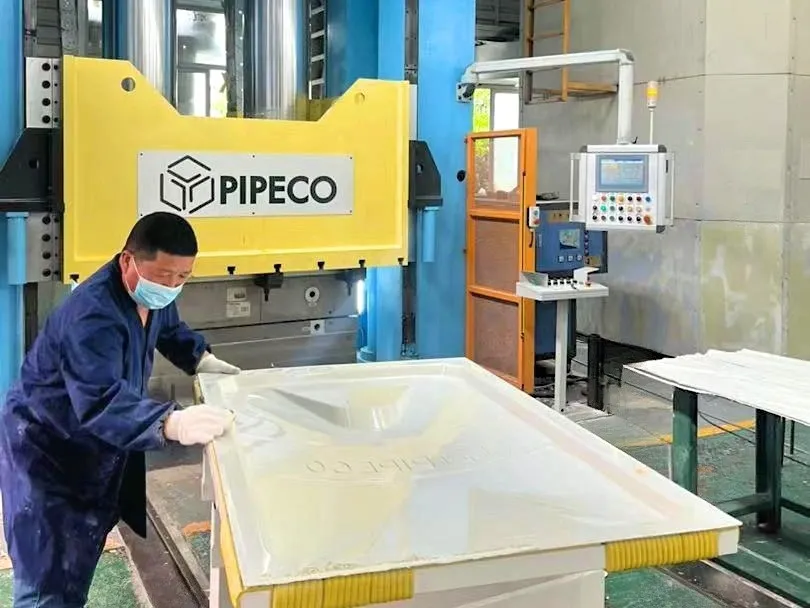
Selecting a water storage tank should begin with a simple question: what type of water will be stored?
Although many water storage projects appear similar from the outside, the conditions inside the tank can be very different. Potable water, irrigation water, industrial water, treated water, and process water may have different requirements for hygiene, chemical compatibility, temperature resistance, internal components, and long-term operation.
For this reason, a GRP water tank should not be selected only according to storage capacity or external dimensions. The characteristics of the stored water should also be included in the technical specification.
For sectional tank projects, this principle is particularly important because the final storage system consists of more than GRP panels alone. Panel construction, sealing components, flanges, fasteners, internal accessories, pipe connections, and other water-contact components may all need to be considered according to the intended application.
This guide explains how different water types can affect GRP water tank selection and what buyers should consider before placing an order.
A water tank is not simply an empty container. It is a storage system whose materials and components remain exposed to the stored water throughout its operating life.
The characteristics of that water can influence:
This means that two tanks with exactly the same nominal capacity may require different specifications when they are designed for different water services.
For example, a tank intended for potable water should be evaluated differently from a tank intended for industrial process water. The former places particular emphasis on water-contact hygiene and regulatory requirements, while the latter may require greater attention to chemical composition, temperature, or process-specific compatibility.
The terms GRP, FRP, and SMC are related, but they should not automatically be treated as interchangeable product descriptions.
GRP generally refers to Glass Reinforced Plastic, while FRP refers to Fiber Reinforced Plastic. Both terms describe composite materials reinforced with fibers, but the exact manufacturing process, resin system, reinforcement structure, and application can vary.
SMC, or Sheet Molding Compound, refers to a specific composite molding material and processing route. SMC typically consists of resin, reinforcement fibers, mineral fillers, additives, and other components formulated for compression molding.
In the context of sectional water tanks, the important point is not simply which abbreviation appears in a product description. The project team should identify:
Therefore, buyers should avoid assuming that every product described as FRP, GRP, fiberglass, or SMC has identical properties.
Potable water storage is one of the most important applications for sectional GRP water tanks.
When a tank is intended to store drinking water, the primary consideration is not only whether the structure can physically contain the water. The materials and components that contact the stored water may also need to satisfy the relevant requirements for potable water use.
Important considerations can include:
The exact certification or regulatory requirements depend on the destination market and project specification.
For international projects, buyers should therefore communicate the intended potable-water application to the tank manufacturer before quotation rather than selecting a general-purpose tank and assuming that it automatically meets drinking-water requirements.
A tank can be structurally watertight without automatically being suitable for every water-contact application.
For potable water, the engineering assessment should consider both:
Structural containment
and
Water-contact suitability.
Structural containment addresses whether the tank can safely store the required volume without unacceptable deformation or leakage.
Water-contact suitability addresses whether the materials and components used in contact with the water are appropriate for the intended service and applicable requirements.
These are related but different engineering questions.
Municipal and building water storage applications can have relatively straightforward water chemistry, but the tank still needs to be specified according to the actual project.
Typical applications may include:
For these applications, the project specification may focus on potable-water suitability, required capacity, installation environment, access, cleaning, and integration with the building water supply system.
Irrigation water is generally subject to different requirements from drinking water.
The water may come from municipal supplies, wells, reservoirs, rivers, recycled sources, or other systems. Its quality can therefore vary significantly from one project to another.
A GRP sectional tank used for irrigation may need to be evaluated according to:
For agricultural or landscape irrigation, the tank may also be installed outdoors, making environmental exposure another consideration.
The appropriate specification should therefore be based on the actual irrigation water source rather than the word "irrigation" alone.
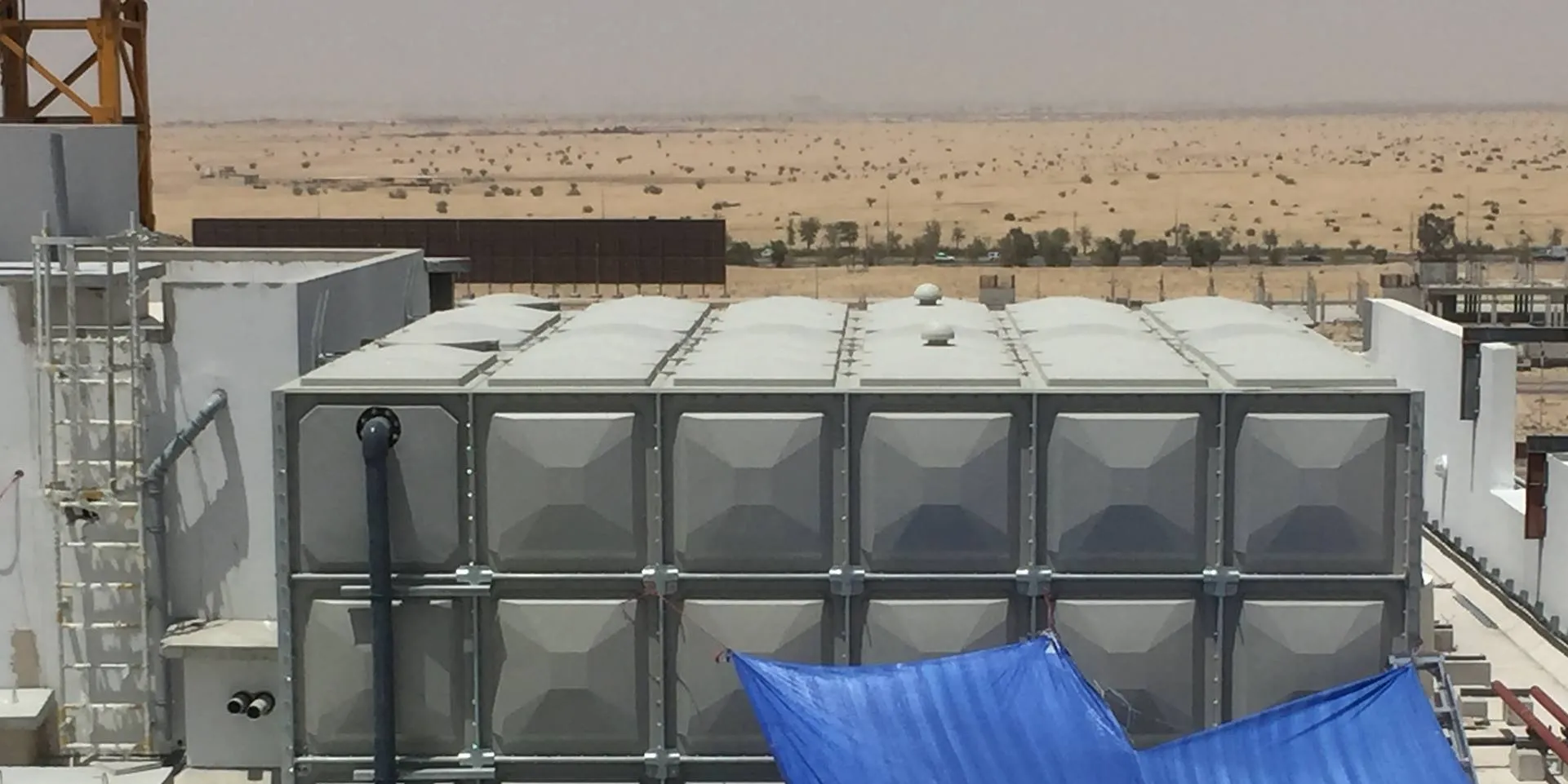
Industrial water is a broad category rather than a single type of water.
Industrial facilities may use water for:
The water chemistry can vary considerably between facilities.
For this reason, an industrial GRP water tank should not be selected solely according to the word "industrial." The manufacturer should understand what the stored water actually contains and how the tank will operate.
Industrial water can contain dissolved minerals, treatment chemicals, additives, suspended solids, or other substances that may affect material selection.
The relevant information may include:
The importance of each parameter depends on the actual application.
For a standard water storage application, a detailed chemical compatibility analysis may not be necessary. For a process-water application, however, the same assumption should not be made without reviewing the water chemistry.
Process water is water used as part of a manufacturing or industrial process.
Unlike ordinary utility water, process water may have controlled chemical properties or may be exposed to specific additives during operation.
Examples can include water used for:
For these applications, tank selection should be based on the actual process conditions.
A manufacturer may need information about the water composition, temperature, concentration of additives, operating cycle, and expected exposure duration before confirming material suitability.
One of the most important principles in composite tank selection is that chemical resistance should be evaluated against the actual chemical environment.
It is not sufficient to say that GRP is "corrosion resistant" and therefore suitable for every chemical service.
Different resin systems, reinforcement structures, concentrations, temperatures, and exposure conditions can produce different results.
For water storage projects involving unusual or chemically aggressive liquids, the following information can help the manufacturer evaluate the application:
For ordinary water storage, the chemical environment may be relatively mild. For treated or process water, however, these details can become important.
pH can be an important indicator of the chemical environment of stored water.
Water with a pH close to neutral may present a different material environment from strongly acidic or strongly alkaline water.
However, pH should not be considered in isolation.
Two water sources with similar pH values may still have very different chemical compositions.
Therefore, for applications outside conventional water storage, the tank specification should consider the complete water chemistry where necessary rather than relying on pH alone.
Water temperature can influence both material behavior and the thermal environment around the tank.
A tank operating with relatively cool water may experience condensation in a warm humid environment, while a tank containing warmer water may experience a different thermal condition.
Temperature can also influence the compatibility of materials with particular chemical environments.
For this reason, buyers should provide the expected operating water temperature when the application falls outside normal ambient water storage conditions.
Water treatment processes can change the characteristics of the water entering a storage tank.
Depending on the treatment system, the stored water may have been exposed to:
The final water chemistry should therefore be considered when the treated water is stored for extended periods.
The tank manufacturer should be informed about any treatment chemicals that remain in the stored water at meaningful concentrations.
GRP composite tanks can be considered for certain wastewater-related applications, but suitability depends strongly on the wastewater composition and the specific tank construction.
Wastewater is not a single standardized liquid. Its composition can vary according to:
Therefore, a GRP tank intended for ordinary water storage should not automatically be specified for aggressive wastewater.
Where wastewater contains chemicals or other aggressive substances, a specific compatibility assessment should be carried out before finalizing the tank material and configuration.
The tank panel is not the only component exposed to the stored water.
In a sectional GRP water tank, water may also contact:
This means that water quality evaluation should extend beyond the GRP panel itself.
A chemically compatible panel combined with an unsuitable sealing material would not represent a complete material-selection solution.
Gaskets are critical sealing components in sectional tank construction.
Their function is to maintain sealing performance at the panel joints and other relevant connections.
The suitability of a gasket can depend on:
For potable water applications, the gasket material may also need to satisfy the relevant requirements for contact with drinking water.
Therefore, gasket selection should be considered as part of the complete tank specification rather than treated as an insignificant accessory.
Other internal components may also need to be evaluated according to the stored water.
For example, metallic components can have different corrosion behavior depending on the water environment.
The specification may therefore need to address:
This is particularly important when a project involves high humidity, saline water, chemically treated water, or other potentially aggressive environments.
A useful way to approach tank selection is to start with the intended water service and work toward the final technical specification.
The process can be summarized as:
Water Type → Water Characteristics → Material Compatibility → Component Selection → Tank Configuration → Applicable Requirements
This approach is more reliable than selecting a standard tank first and attempting to determine its suitability afterward.
| Water Application | Main Considerations | Information to Provide |
|---|---|---|
| Potable Water | Hygiene and water-contact requirements | Application, standards, water conditions |
| Municipal Water | Storage and distribution requirements | Capacity, location, water source |
| Irrigation Water | Water quality and environmental exposure | Source, salinity, temperature |
| Industrial Water | Chemical and operating conditions | Water chemistry, temperature, additives |
| Process Water | Specific process compatibility | Composition, concentration, temperature |
| Treated Water | Residual treatment chemicals | Treatment process and final water chemistry |
| Wastewater | Variable chemical and biological conditions | Source, composition, treatment stage |
| Fire Water | Storage requirements and system standards | Required volume, application, project standard |
A GRP water tank should be specified according to the water it will store, not simply according to the volume it can contain.
For conventional water storage, the requirements may be relatively straightforward. For potable, treated, industrial, process, or chemically affected water, the water chemistry and water-contact components should be considered before the final tank specification is approved.
pH is one of the first water-quality parameters that should be reviewed when a GRP water tank is intended for anything beyond conventional water storage.
The pH value indicates whether water is acidic, neutral, or alkaline, but it should not be used as the only criterion for material compatibility. The same pH value can occur in water with very different dissolved chemicals and operating conditions.
For a standard municipal or potable-water application, the water chemistry is generally well defined. For industrial and process applications, however, the project specification should provide sufficient information for the tank manufacturer to assess the actual service environment.
A useful engineering approach is therefore:
pH + Chemical Composition + Concentration + Temperature + Exposure Time
rather than evaluating pH in isolation.
Terms such as "industrial water" or "treated water" describe an application, but they do not fully define the chemical environment inside the tank.
For example, treated water may contain residual chemicals at concentrations that are very different from those found in untreated source water.
When chemical exposure is relevant, the manufacturer may need to know:
This information allows material compatibility to be considered as an actual engineering requirement rather than a generic claim about corrosion resistance.
Salinity can be an important consideration for water stored in coastal, agricultural, industrial, or other environments where dissolved salts are elevated.
High-salinity water can also affect metallic components associated with a tank system.
Therefore, a project involving saline water should consider not only the GRP panel but also:
The appropriate specification depends on the actual water chemistry and environmental exposure. In coastal installations, atmospheric salt exposure may also need to be considered separately from the salinity of the stored water.
Some water sources contain relatively high concentrations of dissolved minerals.
Hardness and mineral content do not automatically make a water source unsuitable for GRP storage, but they can influence the broader water-management system.
Depending on the application, mineral-rich water may contribute to deposits on internal surfaces, pipework, valves, or other components.
For this reason, the tank specification should be considered together with the water treatment and distribution system rather than as an isolated component.
Chlorination and other disinfection processes are common in water-treatment systems.
For tanks used to store treated water, the relevant question is not simply whether the water has been chlorinated, but what the expected operating conditions are.
The project specification should identify, where relevant:
The tank manufacturer can then assess the suitability of the proposed materials and components for the specified service.
Fire-water storage is another important application where the water itself may appear relatively straightforward, but the overall tank specification can be highly project-specific.
The design focus may include:
The fact that the stored liquid is "water" does not mean that the tank can be specified independently from the fire protection system.
For fire-water applications, the tank should be coordinated with the relevant project engineering requirements and applicable standards.
/upload/b8d7464f6f09d17e059d48ae7ef713ed.jpg" title="GRP Sectional Tank" alt="GRP Sectional Tank" />Water treatment plants often contain several different water streams rather than one uniform water source.
A single facility may have:
These streams should not automatically be assumed to have identical material requirements.
A better approach is to identify each storage duty separately and specify the tank according to the characteristics of the liquid being stored.
Not necessarily.
Raw water can contain naturally occurring minerals, suspended solids, microorganisms, or other substances depending on its source.
Treated water has undergone one or more treatment processes and may have a different chemical composition.
The appropriate tank specification should therefore follow the actual water quality at the point where the tank is installed.
This distinction is particularly useful when multiple storage tanks are installed within the same treatment facility.
Agricultural water-storage projects can have highly variable water sources and operating environments.
A tank may be used for:
For ordinary irrigation water, the primary considerations may be storage conditions, water quality, environmental exposure, and system configuration.
If fertilizers or other chemicals are introduced into the water stream, however, the application should be evaluated as a potentially different chemical service rather than being treated as ordinary irrigation storage.
Rainwater collection systems can also use GRP sectional tanks for storage.
Compared with potable-water systems, rainwater may have different characteristics because it can collect contaminants from:
The tank itself should therefore be considered as one part of the complete rainwater harvesting system.
Where collected rainwater is later intended for potable use, the requirements become different from those for non-potable irrigation or utility applications.
One of the most effective ways for a buyer to avoid material-selection problems is to include water-service information in the initial request for quotation.
Instead of providing only:
"GRP sectional water tank, 500 m³"
the RFQ can provide additional information such as:
This gives the supplier a much clearer technical basis for recommending the appropriate tank configuration.
Before selecting a GRP water tank, the following questions can help define the application:
A structured selection process can reduce uncertainty and prevent the tank from being specified only by volume.
Determine whether the application involves potable water, municipal water, irrigation water, industrial water, process water, treated water, fire water, rainwater, or wastewater.
Where relevant, identify pH, temperature, salinity, chemical additives, concentration, and other available water-quality data.
Determine whether the tank is intended for drinking water or another regulated application requiring specific water-contact materials.
Review not only the GRP panels but also gaskets, flanges, fasteners, supports, pipe connections, and other components exposed to the stored water.
The final specification should be checked against the applicable project standards, local regulations, and end-user requirements.
For a straightforward water-storage project, basic information such as capacity, dimensions, installation location, and intended use may be sufficient to begin the quotation process.
For more specialized applications, buyers should provide as much of the following information as available:
| Parameter | Example Information | Why It Matters |
|---|---|---|
| Water Type | Potable, irrigation, industrial, process | Defines the service application |
| Water Source | Municipal, well, river, treated | Helps identify expected water characteristics |
| Temperature | Minimum / normal / maximum | Important for material and operating assessment |
| pH | Expected operating range | Indicates acidity or alkalinity |
| Chemicals | Name and concentration | Supports compatibility evaluation |
| Salinity | Available test data | Relevant to certain water environments |
| Potable Status | Potable / non-potable | Determines water-contact requirements |
| Installation | Indoor / outdoor / rooftop | Defines environmental conditions |
Standardization can simplify procurement, but the assumption that one tank specification is suitable for every water application can create unnecessary risk.
A tank designed for conventional water storage may not have been specified for a process liquid with unusual chemistry.
Likewise, a tank intended for non-potable industrial service should not automatically be assumed to meet the requirements of a drinking-water application.
The most reliable approach is to standardize where the service conditions are genuinely comparable and customize the specification where the water environment requires it.
For sectional GRP water tank projects, PIPECO can evaluate the tank requirement from the perspective of the complete storage system rather than capacity alone.
Project discussions can consider factors such as:
For projects involving unusual water chemistry, providing the available water-quality information at the quotation stage allows the tank configuration to be evaluated more accurately.
The best GRP water tank is not simply the tank with the correct capacity. It is the tank whose materials, components, configuration, and applicable requirements match the actual water and operating environment.
For conventional potable or utility water, the specification may be relatively straightforward. For industrial, treated, process, saline, or wastewater applications, water chemistry and operating conditions should be reviewed before the final tank configuration is confirmed.
Different water-storage applications place different priorities on the tank system. The table below provides a practical starting point for matching common water types with the main technical considerations.
| Application | Primary Selection Focus | Additional Considerations |
|---|---|---|
| Drinking Water | Water-contact suitability and hygiene | Applicable potable-water requirements, cleaning access, internal components |
| Municipal Water | Reliable storage and distribution | Capacity, installation environment, connections |
| Irrigation Water | Water source and environmental conditions | Salinity, outdoor exposure, temperature |
| Industrial Utility Water | Operating conditions | Water chemistry, temperature, treatment additives |
| Process Water | Specific material compatibility | Chemical composition, concentration, temperature, exposure duration |
| Treated Water | Final treated-water chemistry | Residual treatment chemicals and operating conditions |
| Fire Water | Required volume and system requirements | Applicable fire protection standards and connections |
| Rainwater | Collection and storage conditions | Collection surface, intended reuse, water quality |
| Wastewater | Liquid composition and compatibility | pH, chemicals, temperature, solids and treatment stage |
The most important difference is not necessarily the physical appearance of the tank. It is the service requirement.
For potable water, the primary concern is whether the water-contact materials and complete storage system are appropriate for drinking-water service and applicable regulations.
For industrial water, the emphasis may shift toward chemical compatibility, temperature, operating conditions, and the specific process in which the water is used.
This distinction illustrates why a GRP water tank should be specified according to its intended duty rather than selected solely from a standard product category.
GRP is a composite material rather than a single universal formulation.
Its performance depends on the combination of resin, glass reinforcement, additives, manufacturing process, panel construction, and operating environment.
Consequently, statements such as "GRP is corrosion resistant" should be interpreted in the context of the specific material system and service condition.
For ordinary water storage, a standard GRP construction may provide an appropriate solution. Where the stored liquid contains aggressive chemicals or unusual concentrations, however, the material system should be reviewed against the actual application.
The resin system forms an important part of a GRP composite and can influence how the material performs in different environments.
For water-storage applications, the resin selection may need to consider:
The exact resin formulation should therefore be determined according to the manufacturer's engineering specification and the requirements of the application.
For specialized industrial applications, buyers should provide the relevant chemical and operating information before the material specification is finalized.
Fiberglass reinforcement provides the structural reinforcement within the composite material.
The final performance of a GRP panel depends on more than the presence of glass fiber alone. Fiber architecture, resin distribution, panel thickness, molding conditions, surface construction, and structural design all contribute to the resulting panel characteristics.
This is one reason why two products both described generally as "fiberglass tanks" should not automatically be assumed to have identical engineering performance.
The inside surface of a tank is the direct interface between the storage system and the water.
For potable-water applications, this interface becomes particularly important because the water may eventually be consumed.
For industrial applications, the same surface may instead be exposed to process conditions or treated water.
The project specification should therefore identify the intended water-contact service before the tank is manufactured.
Water type does not normally determine the tank's dimensions by itself, but it can influence the overall configuration.
Depending on the project, considerations may include:
For example, a tank used in a water treatment facility may require a different connection and accessory arrangement from a simple building water-storage tank.
Yes, but the relationship depends on the application.
Potable-water systems may have defined hygiene and cleaning procedures, while industrial or process-water tanks may require cleaning according to the process and the characteristics of the stored liquid.
A tank used for rainwater or irrigation may have different cleaning considerations from a tank storing treated municipal water.
Therefore, cleaning should be treated as part of the complete operating procedure rather than as a universal schedule that applies identically to every tank.
The stored water is only one part of the operating environment.
The surrounding environment can also influence the tank system through:
For example, an irrigation tank installed outdoors in a hot climate may face a very different external environment from a potable-water tank installed inside a controlled building.
Consequently, water quality and installation environment should be considered together during project specification.
If the supplier receives only the tank capacity and dimensions, important application information may be missing.
This can make it difficult to determine whether a standard configuration is appropriate for the intended service.
A more complete specification reduces ambiguity by identifying:
Providing this information at the beginning of the project can make technical communication between the buyer, consultant, contractor, and tank manufacturer more efficient.
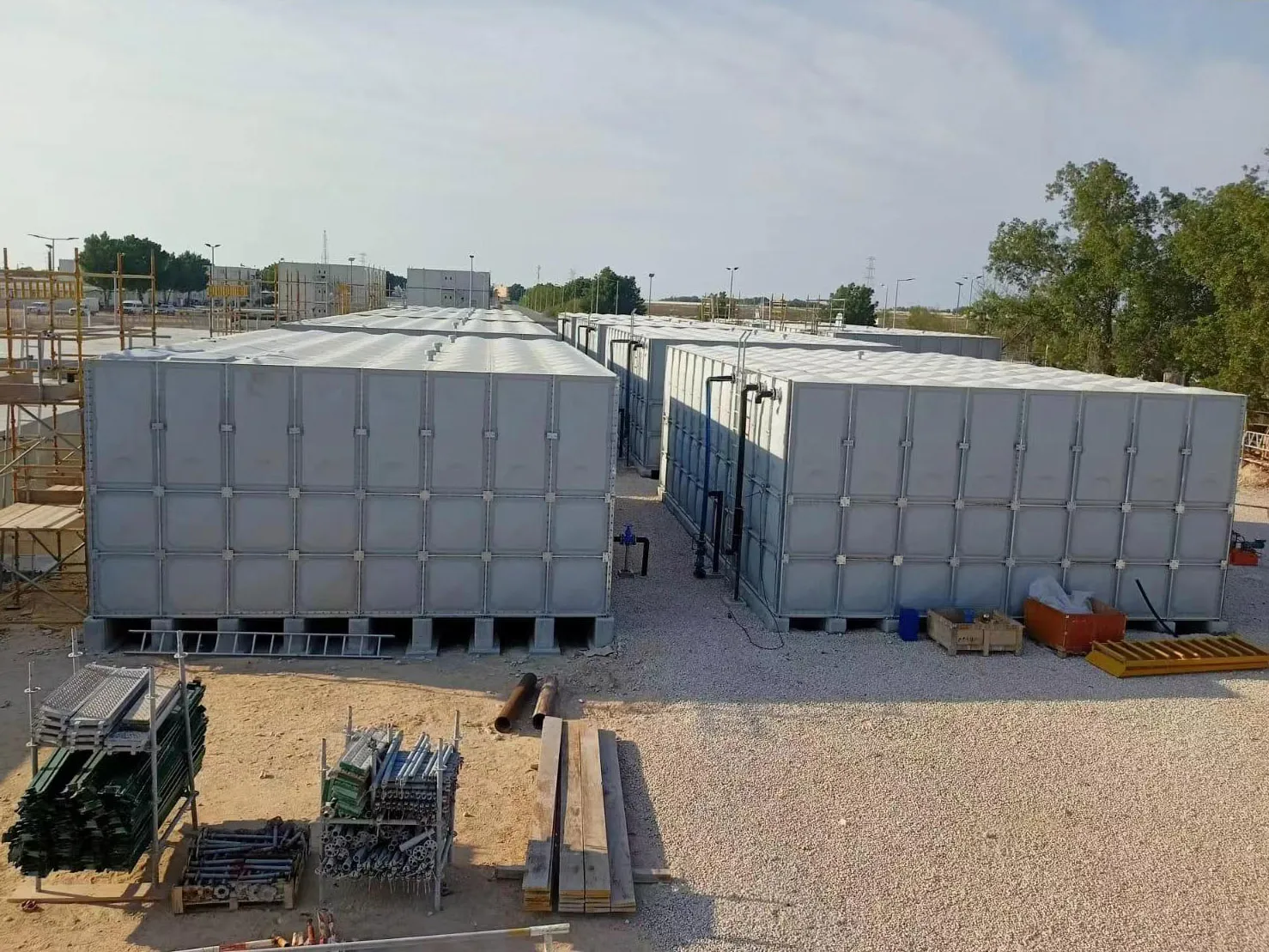
Several mistakes can occur when buyers specify a composite water tank.
A statement such as "300 m³ GRP tank" describes the volume but does not define the water service.
Municipal, irrigation, industrial, and process water can have very different characteristics.
Gaskets, flanges, fasteners, supports, and other water-contact components may also require evaluation.
Composite materials can offer strong resistance to many environments, but compatibility still depends on the actual material system and exposure conditions.
Temperature can affect both material behavior and the chemical environment.
A tank should not be assumed to meet drinking-water requirements simply because it is manufactured from GRP.
When comparing quotations from different suppliers, price and capacity should not be the only criteria.
Buyers can compare:
This provides a more meaningful technical comparison than simply comparing the total quotation price.
For an international GRP sectional tank project, the following checklist can help establish a clear technical basis before manufacturing begins.
| Item | Required Information |
|---|---|
| Tank Application | Potable, irrigation, industrial, process, fire, etc. |
| Storage Capacity | Required effective and nominal volume |
| Water Source | Municipal, groundwater, rainwater, treated water, etc. |
| Water Temperature | Normal and maximum expected values |
| pH | Expected range where relevant |
| Chemical Exposure | Chemicals and concentrations where applicable |
| Potable Requirement | Yes / No and applicable requirements |
| Installation Location | Indoor, outdoor, rooftop, plant room, etc. |
| Environmental Conditions | Temperature, humidity, coastal exposure, UV exposure |
| Connection Requirements | Inlet, outlet, drain, overflow and other connections |
| Applicable Standards | Project, local and regulatory requirements |
GRP sectional tanks can be used in potable-water applications when the complete tank system and water-contact materials meet the requirements applicable to the project and destination market. The potable-water application should be stated clearly during specification.
The physical tank configuration may be similar, but the requirements for the water-contact system can differ. Potable-water applications should be evaluated against the applicable drinking-water requirements rather than assuming that a non-potable specification is automatically suitable.
GRP tanks can be used for many industrial water-storage applications, but suitability depends on the actual water chemistry, temperature, additives, and operating conditions.
Potentially, but the treatment chemicals, concentration, temperature, and exposure conditions should be provided so that the proposed materials and components can be evaluated for compatibility.
They can be considered for certain wastewater applications, but wastewater composition varies substantially. A specific compatibility assessment may be required when the wastewater contains aggressive chemicals, unusual temperatures, or other challenging conditions.
No. pH is useful but should normally be considered together with chemical composition, concentration, temperature, and exposure conditions when material compatibility is important.
Yes. Temperature can influence material performance, chemical compatibility, and the thermal environment surrounding the tank. The expected operating temperature should be provided for applications outside conventional ambient water storage.
Yes. Gaskets form part of the tank's sealing system and may be exposed directly to the stored water. Their material suitability should therefore be considered together with the panel and other water-contact components.
At minimum, provide the intended application, tank capacity, installation environment, and stored water type. For specialized applications, also provide water temperature, pH, chemical composition, concentration, salinity, and applicable project requirements where available.
No. GRP is a broad category of composite material systems, and suitability depends on the specific construction and operating environment. The actual water service should be considered before the final material and tank configuration are approved.
Choosing a GRP water tank begins with more than determining how many cubic meters of water need to be stored.
The type and characteristics of the stored water can influence material selection, water-contact requirements, sealing components, internal accessories, operating conditions, and the overall tank specification.
For potable water, hygiene and applicable water-contact requirements should be clearly defined. For irrigation and municipal water, the source and operating environment remain important. For industrial and process water, chemical composition, concentration, and temperature may require closer evaluation. For treated water and wastewater, the actual liquid characteristics should be considered rather than relying on a broad application label.
The fundamental engineering principle is simple:
Water Type → Water Characteristics → Material Compatibility → Component Selection → Tank Configuration → Project Requirements
Following this sequence allows buyers, engineers, contractors, and tank manufacturers to establish a clearer technical basis for the project and reduce the risk of selecting a tank that is appropriate in size but unsuitable for its actual service.
If you are planning a GRP sectional water tank project, PIPECO can work from your actual project requirements rather than capacity alone.
When requesting a quotation, providing the following information can help us understand the application:
With these details, the tank configuration can be evaluated according to the actual storage conditions and project requirements.
For GRP water tank projects, contact PIPECO with your capacity, water type, installation environment, and technical requirements for a project-specific solution.
Experience the brand Trusted by Renowned Companies across the GLOBE.
Pipeco stands at the forefront of the market, recognized as a premier manufacturer, supplier, and exporter specializing in top-tier GRP water tanks, stainless steel water tanks, and FRP Water Tank, Fiberglass Tank, SMC Water Tank committed to delivering unparalleled quality and excellence.
Get In Touch
Email: master@pipeco.cn
Tel: 0086-576-84616026
Address: No.2 Zhaofeng Road, Xinqian Street, Huangyan District, Taizhou City, Zhejiang Province, China