
Algae growth is a common concern in water storage systems exposed to sunlight. For building owners, facility managers and engineering contractors, the issue is not simply whether a water tank is made from fiberglass or another material. The more important questions are how much light can enter the tank, how the panels perform under outdoor exposure, and how the complete storage system is designed and maintained.
A properly specified SMC water tank can help reduce the conditions that support algae growth when its panels provide effective light blocking and the tank is designed to limit unwanted light entry. UV stabilization serves a different but equally important purpose: helping protect exposed composite panels against long-term ultraviolet radiation.
These functions should not be confused. A panel that resists UV degradation does not automatically block visible light, and an opaque tank does not sterilize stored water. Effective water storage design combines suitable panel materials, controlled light transmission, sound structural engineering, hygienic installation and appropriate maintenance.
This guide explains the physical mechanisms behind algae growth, the material engineering principles of SMC panels, the relationship between UV stabilization and outdoor durability, and the specifications engineers should consider when selecting a fiberglass water tank.
Algae are photosynthetic organisms that use light as an energy source. When sufficient light reaches water containing suitable nutrients, certain algae can grow and reproduce. The speed and extent of growth depend on several interacting conditions rather than on tank material alone.
In a water storage system, the main factors influencing algae growth include:
A fiberglass tank should therefore be evaluated as part of a complete water storage system. The material itself does not create algae, but panel light transmission, openings, installation conditions and maintenance practices can influence whether the internal environment supports biological growth.
The relationship between light and algae growth begins when incident sunlight reaches the exterior surface of a tank panel. Depending on the panel formulation, thickness, pigmentation, surface condition and internal structure, some of that light may be reflected, absorbed or transmitted through the material.
If transmitted light enters the stored water at a level and wavelength distribution that supports photosynthesis, it can contribute to algae growth. Reducing the amount of suitable light entering the tank can therefore remove an important growth-supporting condition.
Light transmission is not the same as visual transparency. A panel may appear opaque to the human eye while still transmitting a measurable amount of radiation at particular wavelengths. Conversely, a material's appearance alone cannot establish its optical performance under standardized test conditions.
Engineers should distinguish between visible-light transmittance and the transmission of radiation across a wider wavelength range. Photosynthetic activity is especially associated with photosynthetically active radiation, conventionally defined as approximately 400–700 nanometers. A meaningful specification should identify which wavelength range is being measured instead of using the term "light blocking" without a defined test method.
| Factor | Technical meaning | Relevance to algae prevention |
|---|---|---|
| Incident sunlight | Radiation reaching the outside of the tank | Provides the initial light source for potential transmission through panels and openings. |
| Panel reflectance | Proportion of incident radiation reflected from a surface | Can reduce the amount of radiation entering the material. |
| Panel absorption | Proportion of radiation absorbed within the material | Can reduce the energy transmitted through the panel. |
| Panel transmittance | Proportion of incident radiation transmitted through the panel | Helps quantify how much light may reach the stored water through the panel itself. |
| Uncontrolled openings | Light entering through covers, vents, access points or gaps | May undermine the benefit of otherwise opaque panels. |
| Nutrients and temperature | Additional environmental conditions affecting biological growth | Help determine whether available light leads to significant algae development. |
This is why selecting a fiberglass water tank for algae control should involve both material selection and a review of the complete tank configuration. Panel performance matters, but it cannot compensate for every poorly sealed opening or unsuitable maintenance practice.
Sheet Molding Compound (SMC) is a composite molding material commonly formulated from resin, glass-fiber reinforcement, mineral fillers and selected additives. Depending on the application, the formulation may also incorporate pigments and other ingredients that influence surface appearance, processing behavior, mechanical properties and optical performance.
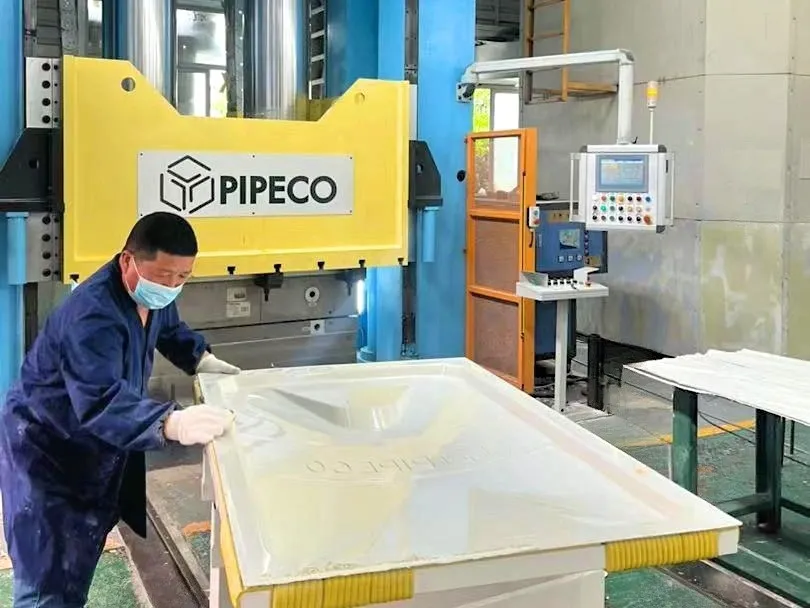
During compression molding, the prepared SMC charge is placed in a heated mold and consolidated under controlled pressure. Heat and pressure allow the compound to flow into the cavity and cure into the required panel geometry. The final panel properties depend on the formulation, mold design, processing conditions and quality control.
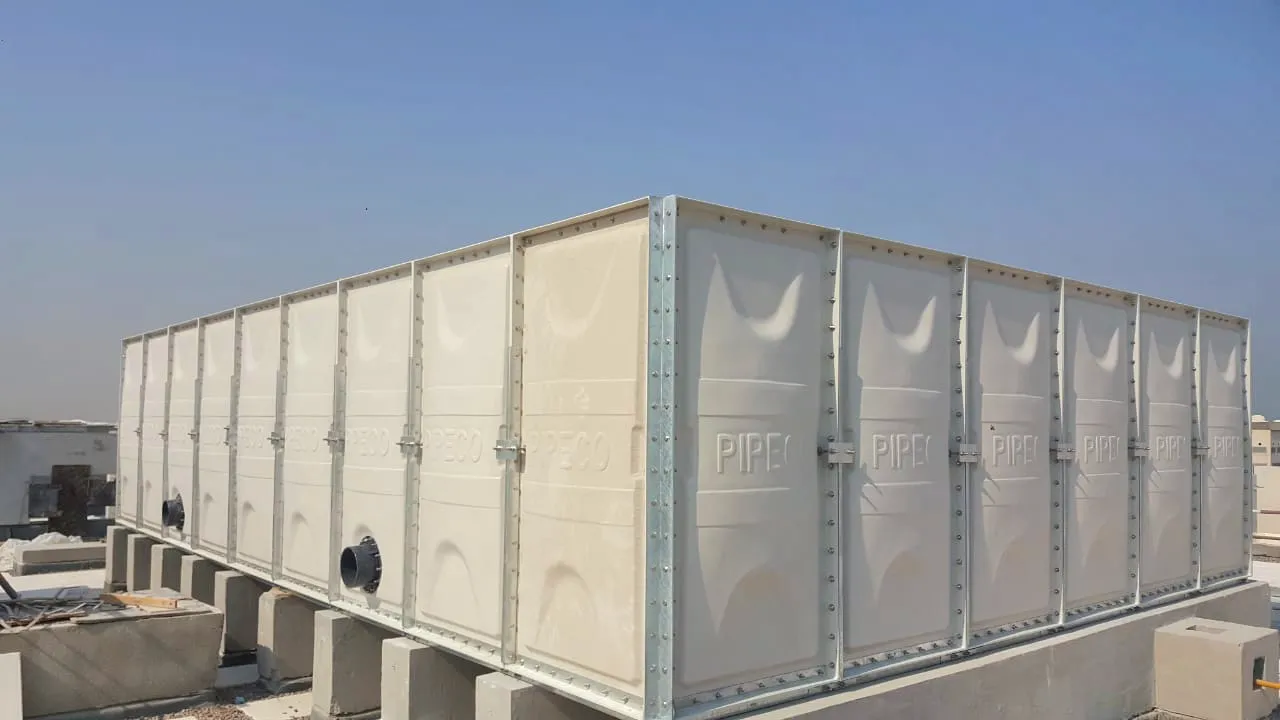
For water tank applications, a suitably formulated and manufactured SMC panel can provide an opaque barrier that limits light transmission. The actual performance depends on the specific compound and finished panel; it should not be assumed that every SMC panel has identical light-blocking characteristics.
Several material and manufacturing factors may influence optical performance:
Effective light blocking should therefore be treated as a measurable panel property rather than a benefit inferred solely from the words "fiberglass," "GRP" or "SMC."
Light blocking and UV stabilization address different engineering problems. They may be designed into the same tank panel, but one property should not be used as evidence of the other.
| Comparison | Light blocking | UV stabilization |
|---|---|---|
| Primary objective | Reduce radiation transmitted through the panel into the tank. | Reduce the adverse effects of ultraviolet exposure on the material. |
| Main engineering concern | Optical transmission through the finished panel and unwanted light entry into the tank. | Weathering, resin degradation, surface changes and retention of relevant material properties. |
| Typical design considerations | Pigmentation, fillers, panel construction, thickness and openings. | Resin selection, stabilizing additives, protective surface systems and exposure conditions. |
| Relevant verification | Optical transmittance measurement under defined test conditions. | Material data, exposure testing and evaluation of property retention where required. |
| What it does not prove | Does not establish UV durability, structural strength or water potability. | Does not establish low visible-light transmittance, sterilization or potable-water compliance. |
A tank intended for outdoor water storage may need both properties. Low light transmission can help reduce conditions that support algae growth, while UV stabilization can help preserve the exposed panels during long-term service.
For more information about the material and manufacturing process, see Pipeco's related resources on SMC water tank construction and SMC tank panel molding.
Outdoor composite panels are exposed to more than direct sunlight. Depending on the installation environment, they may also experience temperature fluctuations, moisture, rain, pollutants and repeated wetting and drying. Ultraviolet radiation can contribute to the degradation of susceptible polymer systems over time.
The effects of UV exposure depend on the resin chemistry, formulation, protective surface system, exposure intensity, temperature and duration. Possible changes in insufficiently protected materials include fading, chalking, surface deterioration and changes in selected mechanical properties. The extent of these effects cannot be predicted from panel color alone.
UV stabilization may involve the use of suitable resin systems, stabilizing additives, protective surface layers or other measures selected for the intended service environment. These measures should be considered together with the overall SMC formulation and manufacturing process.
When specifying a fiberglass tank for an outdoor installation, procurement teams should clarify:
UV stabilization should not be described as a guarantee of a particular service life unless that claim is supported by relevant product data, test evidence and clearly defined operating conditions. It is one part of a broader durability strategy that also includes structural design, correct installation and maintenance.
No. An opaque fiberglass tank can help reduce light availability and thereby limit one factor that supports algae growth, but opacity alone does not prevent all bacterial growth.
Many bacteria do not depend on photosynthesis. Their survival and growth may be influenced by water temperature, nutrient availability, disinfectant residual, stagnation, incoming contamination and the condition of surfaces in contact with water.
Some microorganisms may also persist in deposits or surface-associated communities even when direct sunlight is excluded. A tank with effective light blocking can therefore still experience water quality problems if the source water, tank configuration, maintenance or operating conditions are unsuitable.
For potable-water applications, tank material and system design should be evaluated alongside the quality of the incoming water, the treatment regime, hygienic access arrangements and the requirements of the relevant jurisdiction.
A biofilm is a community of microorganisms attached to a surface and embedded in a self-produced matrix. Biofilms can develop on many types of water-contact surfaces when environmental conditions allow microorganisms to attach and persist.
In a water storage tank, biofilm development may be affected by several conditions:
A suitable tank design should support inspection, cleaning and maintenance while limiting contamination pathways. Internal surfaces, access openings, overflow arrangements, vents and connections should be considered as part of the complete water storage system.
The objective is not to claim that a particular composite material eliminates biofilm. Instead, the engineering objective is to provide a suitable water-contact material and a tank configuration that can be operated and maintained in accordance with the water quality requirements.
A fiberglass tank intended for potable water must meet the material and system requirements applicable to its intended use and market. Optical performance and UV resistance are not substitutes for evidence that water-contact materials are suitable for drinking-water applications.
Buyers should distinguish between the structural performance of a panel, its resistance to environmental exposure and its suitability for contact with potable water. These are separate assessment areas and may require different documentation.
Depending on the destination market and project specification, the compliance review may need to consider:
NSF/ANSI/CAN 61 and WRAS-related requirements may be relevant in particular markets or projects, but they should not be treated as interchangeable or universally mandatory. The exact requirement depends on the jurisdiction, application and specified product scope.
Buyers should verify whether the specific tank, material or component is covered by the relevant approval and whether the evidence applies to the actual product being supplied. A manufacturer's general statement or a certificate for a different component does not automatically demonstrate compliance of the complete tank system.
If algae prevention is a defined project objective, light-blocking performance should be included in the technical specification rather than left as a general marketing expectation.
A specification should identify the required optical property, the measurement method and the acceptance criteria. Without these details, two suppliers may use the same description while providing panels with different measured performance.
The following information can help make a light-transmission requirement more useful for procurement and quality control:
| Specification item | What should be defined | Why it matters |
|---|---|---|
| Measured property | Total transmittance, spectral transmittance or another clearly defined optical parameter. | Prevents ambiguity about what the reported value represents. |
| Wavelength range | The relevant wavelength interval, including visible or photosynthetically active radiation where appropriate. | Different materials can transmit different proportions of radiation at different wavelengths. |
| Test method | The applicable recognized method or agreed laboratory procedure. | Supports repeatable measurements and comparable results. |
| Test specimen | Representative finished panel, thickness, surface condition and sampling location. | Ensures that the test represents the supplied product. |
| Instrument and conditions | Measurement equipment, calibration status and relevant test conditions. | Helps establish the reliability and repeatability of the result. |
| Acceptance criterion | A numerical limit or clearly defined pass/fail requirement agreed by the parties. | Creates a basis for supplier verification and incoming quality inspection. |
| Documentation | Test report, product identification, date and traceability to the supplied panel. | Connects the result to the actual product and project record. |
Where a project requires very low light transmission, the acceptance limit should be selected according to the application's needs and the capability of the chosen measurement method. A claim such as "zero light transmission" should not be used unless the test method, instrument detection limit and supporting results justify that wording.
Optical testing of a representative panel also does not automatically demonstrate that the complete installed tank excludes light. Covers, vents, inspection openings, seals and other potential entry points should be considered separately.
Panel thickness can influence optical transmission, but it should not be considered the only controlling factor. The resin system, pigment, filler content, internal material structure and manufacturing consistency can all affect the measured result.
Increasing thickness may reduce transmission for some material systems, but the relationship is formulation-dependent. A thicker panel is not automatically better in every optical or structural respect, and thickness should not be used as a substitute for measured performance.
Panel thickness also has a structural role. A water tank panel must resist the loads imposed by the stored water, its own weight, support conditions and other project-specific actions. Panel geometry, reinforcement, connections and the tank's overall bracing arrangement influence how these loads are carried.
For this reason, optical and structural requirements should be reviewed together but verified independently:
For more information about panel composition and quality considerations, see how GRP water tank panels are manufactured.
Light-blocking performance does not determine whether a tank panel is structurally adequate. The design must also account for the pressure exerted by the stored water.
For a static liquid, the hydrostatic gauge pressure at a depth below the free surface can be expressed as:
P = ρgh
Where:
For water of approximately 1,000 kg/m³ density, the pressure increase is about 9.81 kPa for every meter of depth. Actual design must use the appropriate liquid properties and applicable engineering requirements.
Because hydrostatic pressure increases with depth, the lower regions of a filled tank generally experience greater water pressure than the upper regions. Panel design must account for this pressure distribution and the way loads are transferred through the tank structure.
The structural load path may involve:
A reliable design must evaluate the tank as an integrated structure. Panel material, panel thickness, reinforcement spacing, joint details and support conditions must work together to control deformation, leakage and structural risk.
The relevant design standard and project specification should govern the structural verification. Optical performance, UV stabilization and water-contact compliance should be documented separately rather than used as indirect evidence of structural safety.
A modular SMC water tank is a complete assembly, not simply a collection of composite panels. Its performance depends on the interaction between the panels, structural connections, sealing materials, support system and accessories.
During supplier evaluation, buyers should review the entire tank configuration and confirm that the proposed system is suitable for its intended capacity, installation environment and water storage application.
Depending on the tank design, the main components may include:
The design should also address access for inspection, cleaning and maintenance. A tank may have well-performing panels but still present operational difficulties if the access openings, drainage arrangements or internal configuration are unsuitable.
When the tank is installed outdoors, the review should include exposed hardware, seals, protective systems and openings as well as the SMC panels. Environmental durability is a system-level consideration.
To compare tank options, begin with the required capacity, operating conditions, installation constraints and applicable standards. Pipeco's GRP water tank solutions provide a starting point for reviewing modular tank configurations and project requirements.
A clear request for quotation (RFQ) helps suppliers understand the required tank configuration and provide comparable technical proposals. If algae prevention is an important project objective, it should be stated explicitly alongside structural, operational and compliance requirements.
The following checklist can be adapted for engineering specifications and supplier inquiries.
| RFQ item | Information to provide or request | Purpose |
|---|---|---|
| Application | Potable water, domestic water, process water, fire water or another defined use. | Establishes the intended service and relevant material requirements. |
| Tank capacity | Required usable volume and nominal storage volume, where both are relevant. | Helps determine the tank configuration and dimensions. |
| Dimensions and layout | Available installation space, tank height, access restrictions and connection locations. | Supports a practical modular layout and site coordination. |
| Panel material | Proposed SMC formulation or product designation, panel configuration and applicable material data. | Clarifies the proposed panel system rather than relying on a generic material name. |
| Light-blocking requirement | Required optical property, wavelength range, test method and acceptance limit. | Defines measurable performance relevant to reducing light entry. |
| UV protection | Intended exposure conditions, protective measures and available weathering evidence. | Addresses long-term outdoor exposure. |
| Mechanical performance | Required structural design basis, relevant material properties and verification documents. | Supports engineering review of the tank's load-bearing performance. |
| Reinforcement system | Proposed reinforcement arrangement, connections and relevant material specifications. | Clarifies how structural loads are transferred through the tank. |
| Hardware and fasteners | Material grades, corrosion protection and suitability for the operating environment. | Reduces uncertainty about exposed and structural components. |
| Gaskets and seals | Material, water-contact suitability where applicable and installation requirements. | Supports joint integrity and the intended water-contact requirements. |
| Potable-water compliance | Applicable standards, approvals or test evidence required by the project. | Establishes the documentation needed for the destination market. |
| Inspection and testing | Required inspections, leakage tests, optical tests or other agreed verification procedures. | Defines how conformance will be checked before acceptance. |
| Technical documentation | Drawings, installation instructions, material data, test reports and maintenance guidance. | Supports procurement, installation, commissioning and long-term operation. |
Not every project requires the same tests or documentation. The specification should distinguish mandatory requirements from optional preferences and identify the party responsible for providing each item of evidence.
Material selection is only one part of algae prevention and water hygiene. Even an opaque tank can experience contamination or microbial growth if the system is poorly operated or maintained.
A practical maintenance strategy should consider the following areas:
Cleaning and disinfection procedures should be selected according to the application and applicable water safety requirements. For potable-water systems, the procedure should avoid introducing unsuitable chemicals or leaving the system in a condition that compromises water quality.
A tank should not be cleaned or entered without following the relevant safety procedures. Confined-space hazards, electrical risks, working at height and the handling of cleaning chemicals may require specific controls and qualified personnel.
Regular inspection does not replace sound initial design. Instead, design and maintenance should support one another: a well-designed tank makes it easier to inspect, clean and operate the system, while consistent maintenance helps identify problems before they become more serious.
See Pipeco's water tank maintenance guide for additional considerations when planning long-term tank operation.
Selecting a tank supplier involves more than comparing nominal capacity or panel material. Buyers need to understand the proposed tank configuration, the information available for engineering review, and the support provided for installation and project coordination.
When evaluating Pipeco or any prospective supplier, project teams should confirm the following points against the actual quotation and technical documentation:
For projects where algae control is a key objective, specify the required light-blocking performance directly rather than relying on a generic statement that the tank is made from SMC or fiberglass. Separately define outdoor UV durability, structural requirements and potable-water compliance where applicable.
Pipeco's team can be contacted to discuss tank configuration and project-specific requirements. Provide the intended application, storage capacity, installation environment and relevant technical specifications so that the proposed solution can be evaluated against the project's needs.
A fiberglass water tank can help reduce algae growth when its panels and enclosure limit the light available for photosynthesis. The result also depends on nutrients, temperature, contamination pathways, water residence time and maintenance. Fiberglass construction alone does not guarantee that algae will never develop.
Light transmittance indicates how much incident radiation passes through a panel under defined measurement conditions. Lower transmission in wavelengths relevant to photosynthesis can help reduce one of the conditions that support algae growth. For projects with specific performance targets, the required optical property and test method should be included in the specification.
Light blocking reduces the radiation transmitted through a panel into the tank. UV stabilization helps protect susceptible composite materials from degradation associated with ultraviolet exposure. The properties address different engineering concerns and should be verified separately.
No. Opacity can reduce light availability, which is relevant to algae, but many bacteria do not depend on photosynthesis. Water temperature, nutrients, disinfectant residual, stagnation, contamination and biofilm can all affect microbial conditions. Suitable water management and maintenance remain necessary.
Not necessarily. Thickness can influence light transmission, but performance also depends on resin chemistry, pigmentation, fillers and material structure. Optical performance should be confirmed using representative panel measurements rather than inferred from thickness alone.
Buyers should request a defined optical property, wavelength range, test method, representative specimen details and an agreed acceptance criterion. The supporting report should identify the tested material and panel thickness so that the result can be related to the supplied product.
No. UV stabilization addresses material durability under ultraviolet exposure; it does not establish suitability for drinking-water contact. Potable-water projects should verify the applicable requirements and supporting evidence for the specific materials and components used in the tank.
Include the intended application, required capacity, dimensions, installation environment, panel material, light-transmission requirement, UV exposure conditions, structural design requirements, hardware, seals, applicable water-contact requirements, inspection and testing procedures, and required documentation. Clear acceptance criteria help suppliers prepare comparable proposals.
The following resources can help engineers and procurement teams evaluate composite tank materials, manufacturing, capacity and maintenance:
Engineering note: The appropriate panel specification, optical acceptance criteria, structural design and water-contact requirements depend on the project and destination market. Confirm product-specific claims and supporting test documentation with the supplier before procurement.
Experience the brand Trusted by Renowned Companies across the GLOBE.
Pipeco stands at the forefront of the market, recognized as a premier manufacturer, supplier, and exporter specializing in top-tier GRP water tanks, stainless steel water tanks, and FRP Water Tank, Fiberglass Tank, SMC Water Tank committed to delivering unparalleled quality and excellence.
Get In Touch
Email: master@pipeco.cn
Tel: 0086-576-84616026
Address: No.2 Zhaofeng Road, Xinqian Street, Huangyan District, Taizhou City, Zhejiang Province, China