
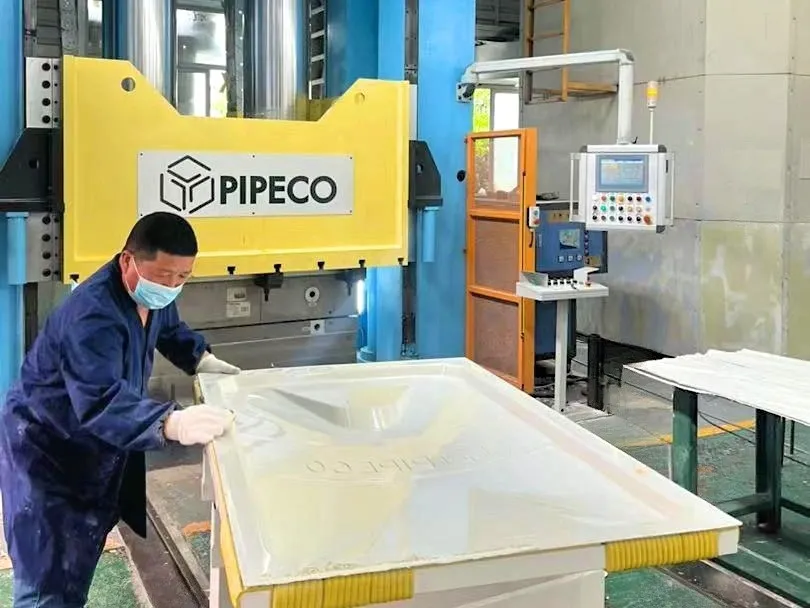
Southeast Asia is one of the world's fastest-growing regions for urban development, infrastructure construction, industrial expansion, and commercial real estate investment. As cities continue to grow and water demand increases, reliable water storage systems have become an essential component of residential, commercial, industrial, and municipal projects.
Among the various storage solutions available today, GRP water tanks have become increasingly popular throughout Singapore, Malaysia, Indonesia, Thailand, Vietnam, the Philippines, and other Southeast Asian markets. Their corrosion resistance, lightweight construction, modular design, long service life, and suitability for potable water storage make them particularly well suited to the region's tropical climate and infrastructure requirements.
For project developers, consultants, contractors, and facility owners, GRP tanks offer a combination of performance and cost efficiency that is difficult for traditional steel or concrete storage systems to match.
One of the biggest challenges facing water storage systems in Southeast Asia is environmental exposure. High humidity, frequent rainfall, elevated temperatures, and coastal salt-laden air create aggressive conditions that can accelerate material degradation.
Traditional metal tanks rely heavily on protective coatings to prevent corrosion. Once these coatings become damaged or deteriorate over time, electrochemical corrosion can begin to affect the structure, especially in coastal regions exposed to high-salinity marine environments.
A GRP water tank, however, is manufactured from glass reinforced plastic materials that are inherently resistant to rust and corrosion. Unlike steel tanks, GRP structures do not require sacrificial corrosion protection and maintain their structural integrity even after years of exposure to tropical weather conditions.
These characteristics have made GRP tanks a preferred choice for hotels, hospitals, schools, industrial facilities, and municipal water storage projects throughout Southeast Asia.
In tropical regions, solar heat gain can significantly affect water storage performance. Metal tanks rapidly transfer heat from direct sunlight into stored water, often causing undesirable increases in water temperature during daytime operation.
GRP materials provide naturally lower thermal conductivity than steel, helping reduce heat transfer and maintain more stable water temperatures. This thermal insulation capability contributes to improved water quality management while reducing temperature fluctuations inside the storage system.
For commercial buildings, hotels, residential developments, and drinking water applications, maintaining stable storage conditions is an important advantage that further supports the growing adoption of GRP sectional tanks.
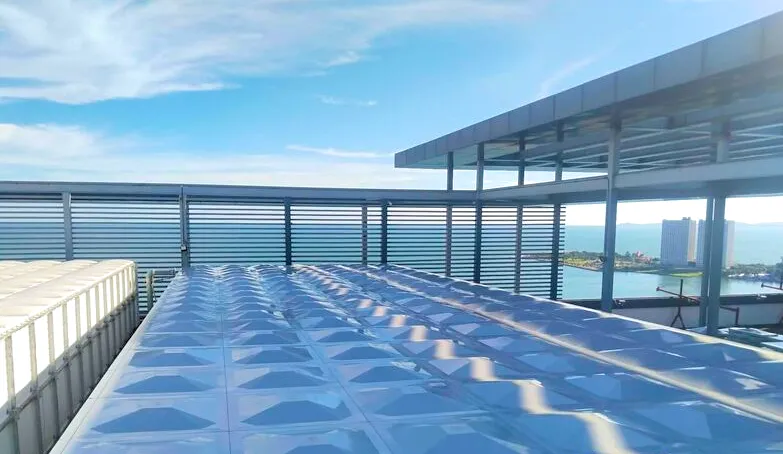
Many construction projects across Southeast Asia face logistical challenges due to dense urban environments, limited site access, rooftop installations, or remote island locations.
Unlike large welded tanks that require significant transportation and lifting resources, GRP sectional tanks are manufactured as modular panels that can be transported efficiently and assembled directly at the installation site.
This modular approach offers numerous benefits:
Because of these advantages, GRP sectional tanks are widely specified for commercial buildings, residential developments, hospitals, universities, airports, and industrial facilities throughout the region.
While initial purchase cost is important, many project owners increasingly evaluate water storage solutions based on total life-cycle cost rather than installation cost alone.
A properly designed and maintained GRP water tank can typically provide more than 25 years of reliable service under normal operating conditions. The combination of corrosion resistance, moisture resistance, and UV-resistant panel technology helps extend operational lifespan while minimizing maintenance requirements.
Modern GRP panels are engineered to withstand prolonged exposure to intense sunlight and high UV-index conditions commonly experienced throughout Southeast Asia.
Key contributors to long service life include:
The result is a water storage solution that delivers long-term value while reducing maintenance and replacement costs over the life of the project.
Rapid urbanization continues to drive demand for scalable water infrastructure throughout Southeast Asia. Cities require water storage systems that can be installed efficiently, expanded easily, and adapted to changing demand patterns.
The modular nature of GRP tanks allows engineers and developers to customize storage capacities for projects ranging from small residential buildings to large industrial facilities and municipal water networks.
This flexibility makes GRP systems highly attractive for growing urban centers where future expansion may be required without major structural modifications.
For many Southeast Asian applications, GRP tanks offer significant advantages over traditional steel tanks.
In coastal cities such as Singapore, Jakarta, Manila, and Bangkok, high-salinity airborne particles can accelerate corrosion when protective coatings on metal tanks begin to deteriorate. Once corrosion starts, maintenance requirements and repair costs often increase significantly.
By contrast, GRP panels are naturally resistant to corrosion and do not rust. This makes them particularly suitable for humid and marine environments where long-term durability is essential.
Another important consideration is thermal performance. Steel tanks rapidly absorb and transfer solar heat into stored water. GRP materials provide superior insulation properties, helping minimize water temperature spikes caused by direct sunlight exposure.
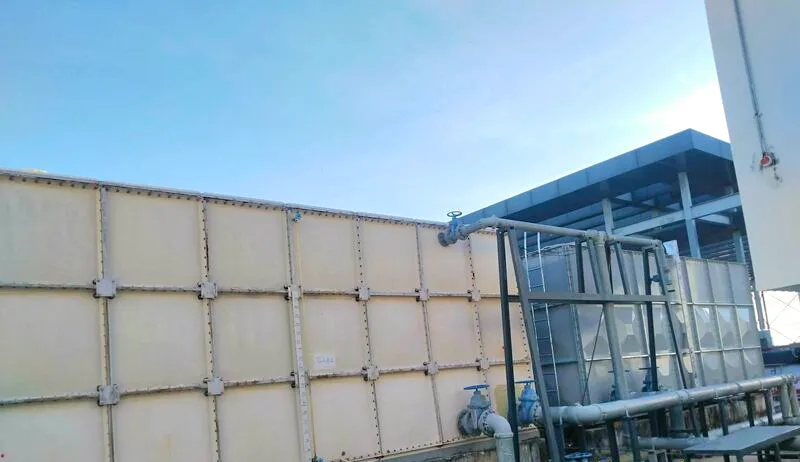
One of the most frequently asked questions by project owners is the expected lifespan of a GRP water tank.
Under normal operating conditions, a high-quality GRP water tank can typically achieve a service life exceeding 25 years. This long lifespan is supported by corrosion-resistant composite construction and advanced UV-resistant material formulations.
Unlike metal tanks that may require periodic corrosion treatment, GRP panels maintain their structural performance without rust-related degradation. UV-resistant technologies help minimize weathering effects associated with continuous exposure to strong sunlight and tropical climates.
When properly installed and maintained, GRP tanks provide reliable long-term performance with relatively low maintenance requirements.
Commercial developments often require water storage systems that can be installed quickly while maximizing available space.
The modular structure of GRP sectional tanks allows panels to be transported through restricted access areas and assembled directly on rooftops, basements, plant rooms, or mechanical service floors.
This installation flexibility is especially valuable for:
In addition, modular construction allows future capacity increases without replacing the entire storage system.
Yes. Modern GRP water tanks are widely used for potable water storage applications around the world.
High-quality GRP tank systems are manufactured using materials suitable for drinking water contact and are designed to meet relevant international quality requirements for potable water storage.
An important advantage of GRP construction is its opaque, light-blocking structure. By preventing sunlight penetration, GRP panels help reduce conditions that encourage algae growth and biological contamination inside the tank.
This provides several key benefits:
For drinking water projects, selecting a professionally manufactured GRP tank with appropriate compliance documentation helps ensure safe, clean, and reliable water storage throughout its operational life.
Pipeco specializes in supplying high-quality GRP water tanks, FRP water tanks, and GRP sectional tank systems for commercial, industrial, municipal, and residential applications worldwide.
Through advanced manufacturing technology, strict quality control procedures, and extensive project experience, Pipeco delivers reliable water storage solutions designed to meet the demanding environmental conditions found throughout Southeast Asia and other global markets.
The growing popularity of GRP tanks in Southeast Asia is driven by a combination of technical and economic advantages. Corrosion resistance, thermal insulation performance, modular installation, long service life, potable water suitability, and low life-cycle costs make GRP tanks an increasingly preferred solution for modern water infrastructure projects.
As urbanization, industrial development, and water infrastructure investment continue across the region, GRP water tanks are expected to remain one of the most trusted and widely specified water storage solutions for decades to come.
Experience the brand Trusted by Renowned Companies across the GLOBE.
Pipeco stands at the forefront of the market, recognized as a premier manufacturer, supplier, and exporter specializing in top-tier GRP water tanks, stainless steel water tanks, and FRP Water Tank, Fiberglass Tank, SMC Water Tank committed to delivering unparalleled quality and excellence.
Get In Touch
Email: master@pipeco.cn
Tel: 0086-576-84616026
Address: No.2 Zhaofeng Road, Xinqian Street, Huangyan District, Taizhou City, Zhejiang Province, China