
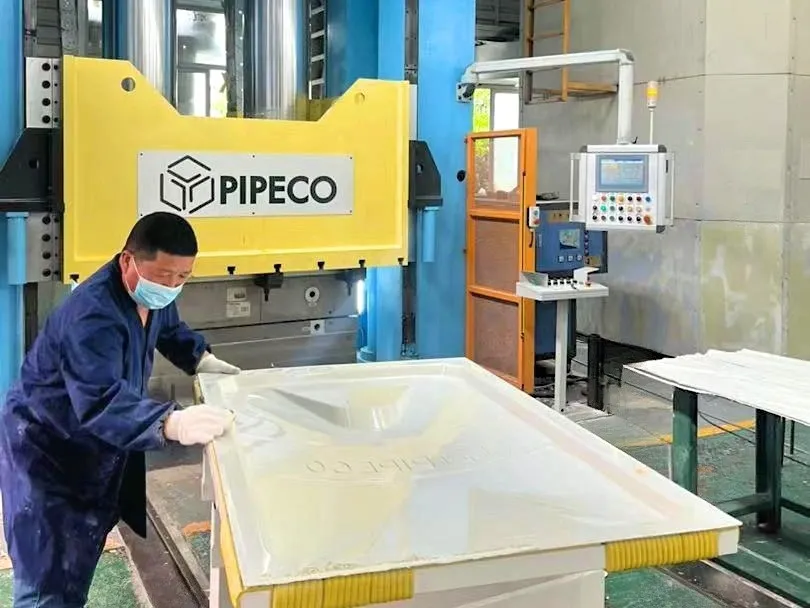
As demand for reliable water storage infrastructure continues to grow worldwide, GRP sectional water tanks have become a preferred solution for commercial buildings, industrial facilities, municipal water systems, hospitals, schools, and residential developments.
Thanks to their modular construction, corrosion resistance, hygienic performance, and long service life, modern GRP water tank panels offer significant advantages over traditional concrete and steel tanks. However, even the highest-quality tank panels can experience leakage, deformation, or premature failure if the installation process is not executed correctly.
Industry experience shows that most water tank failures are not caused by manufacturing defects but by installation errors that occur during water tank panel assembly. Understanding these mistakes and implementing proper engineering practices can significantly improve long-term performance and reduce maintenance costs.
A GRP sectional water tank functions as an integrated structural system. Every panel connection, gasket joint, bolt assembly, support member, and base frame contributes to the tank's ability to withstand hydrostatic pressure over decades of service.
Even minor installation deviations can create stress concentrations that gradually develop into leakage paths, structural distortion, or panel damage under continuous water loading.
Proper GRP water tank installation ensures:
One of the most common installation mistakes occurs when bolts are tightened sequentially around the tank flange rather than using a balanced tightening pattern.
Many installers simply tighten bolts in a circular direction around the joint. While this approach appears efficient, it often creates uneven compression across the sealing gasket and generates localized stress within the GRP water tank panels.
Professional installers should use a diagonal or star-pattern tightening sequence.
Bolts should be tightened gradually in multiple stages:
| Tightening Stage | Recommended Torque Level |
|---|---|
| Initial Seating | 30% |
| Intermediate Tightening | 60% |
| Final Torque | 100% |
A calibrated torque wrench should always be used to ensure consistent loading throughout the assembly.
The sealing strip serves as the primary hydraulic barrier between adjacent tank panels. Most FRP water tank assembly systems use EPDM rubber gaskets because of their excellent durability, elasticity, and water resistance.
However, gasket performance depends heavily on correct installation.
When a stretched gasket relaxes after installation, microscopic gaps can develop between panel joints. Under hydrostatic pressure, these gaps often become leakage paths.
Even small leaks can eventually lead to:
Install sealing strips without tension and ensure all flange surfaces are clean and dry before assembly.
At corner joints, maintain adequate overlap according to the tank manufacturer's specifications to ensure continuous sealing performance.
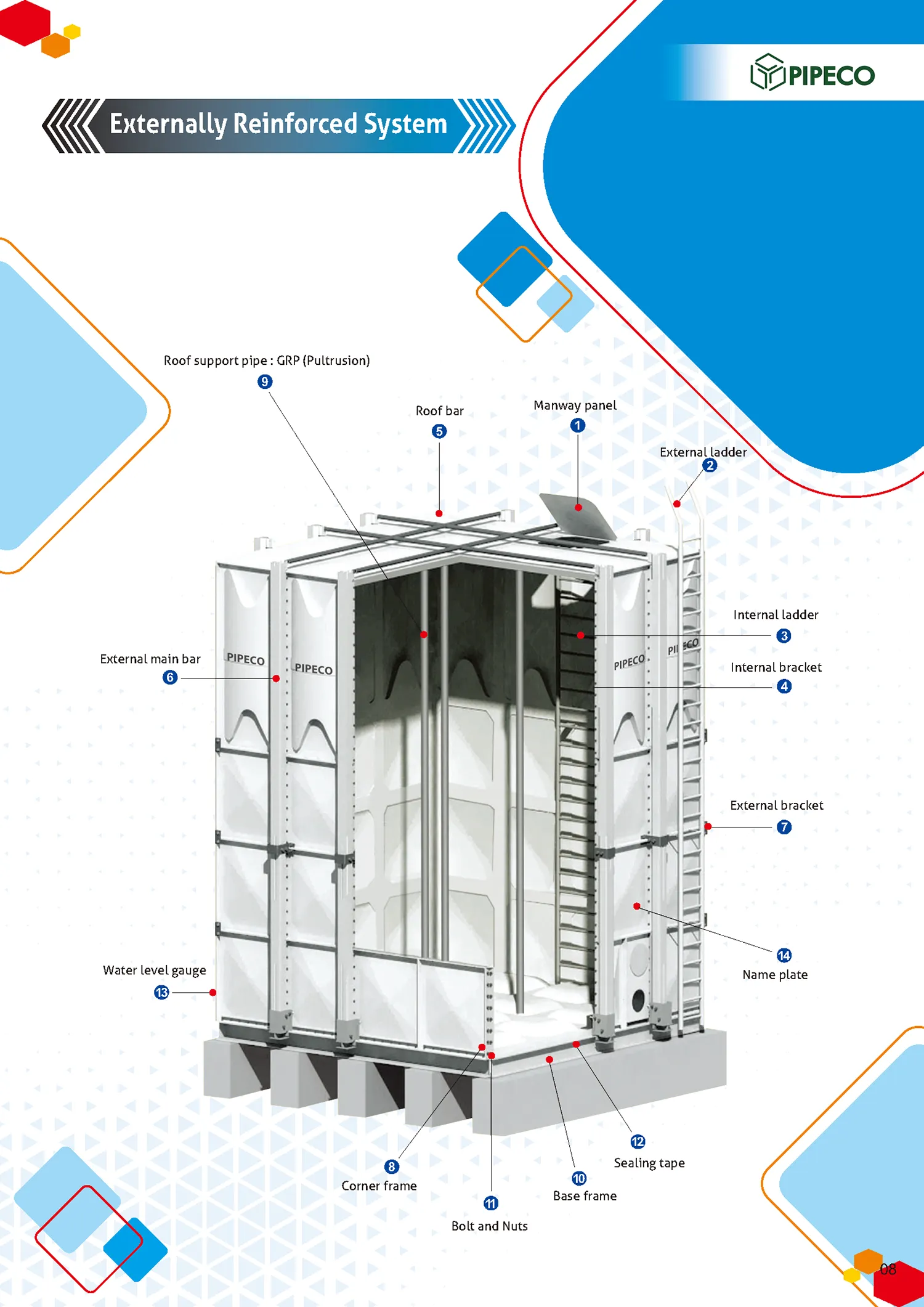
A sectional water tank can weigh hundreds of tons when fully loaded. The entire load is transferred through the tank base to the supporting steel frame or concrete foundation.
If the support structure is not level, significant structural stresses may develop once the tank is filled.
Before assembly begins, installers should verify:
Laser level measurements are strongly recommended for large-capacity tanks.
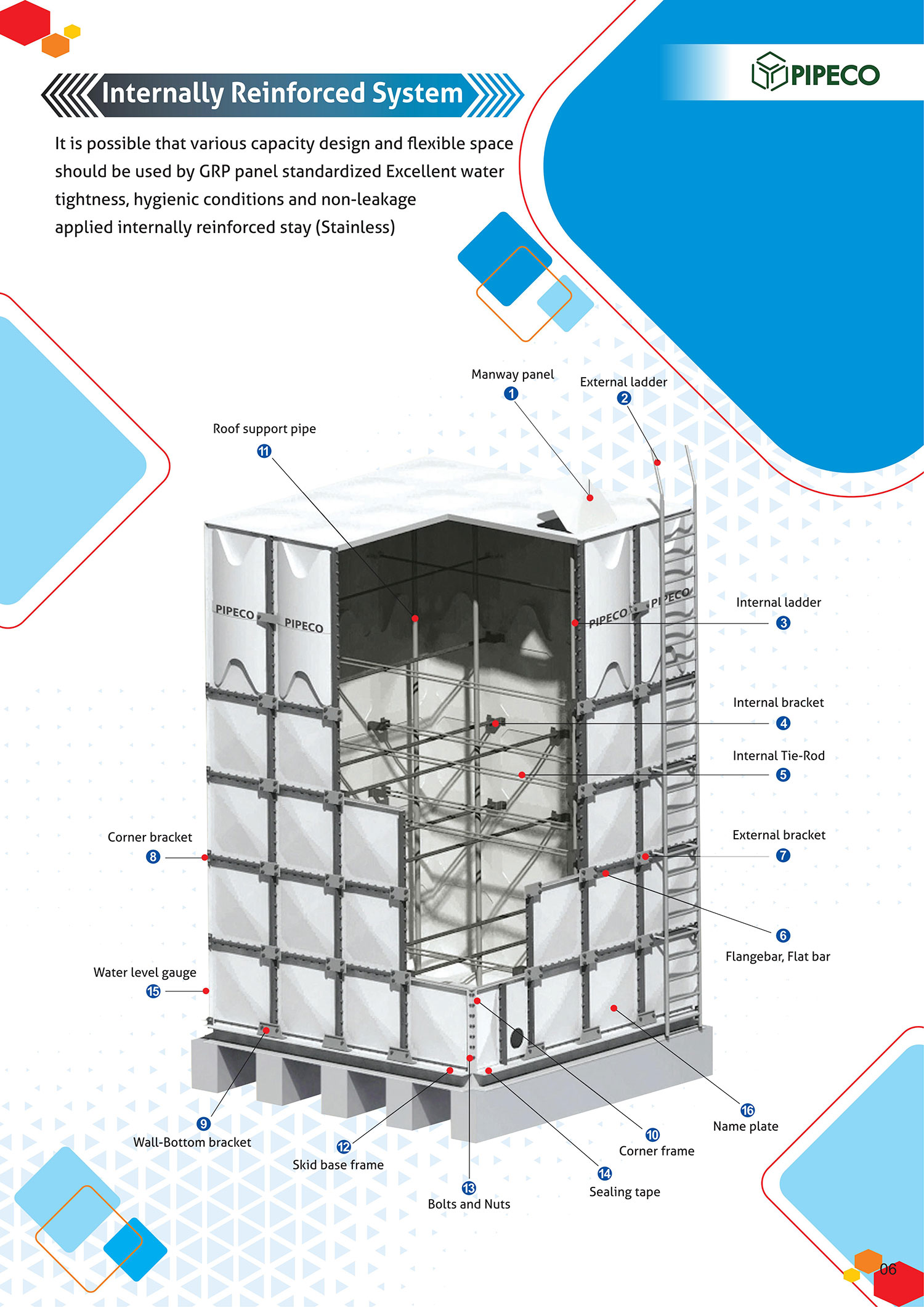
Internal tie rods and reinforcement systems play a critical role in resisting hydrostatic pressure acting on sidewall panels.
As water depth increases, the lateral force applied to tank walls rises significantly. Internal supports help distribute these loads safely throughout the structure.
Always follow the manufacturer's structural drawings and verify every reinforcement component before filling the tank.
Many installation teams complete assembly and immediately fill the tank to full capacity. While this may appear to save time, it eliminates opportunities to identify installation issues before full loading occurs.
| Stage | Water Level | Inspection Requirement |
|---|---|---|
| Stage 1 | 25% | Check panel joints and supports |
| Stage 2 | 50% | Inspect for leakage and deformation |
| Stage 3 | 75% | Verify structural stability |
| Stage 4 | 100% | Final commissioning inspection |
This staged filling approach allows corrective actions before the tank reaches maximum operating load.
Another common issue occurs when external pipe loads are transferred directly to tank panels.
Large inlet, outlet, overflow, and drain pipes can introduce significant mechanical forces if they are not independently supported.
External pipework should always be independently supported and flexible connections should be used where necessary to accommodate movement and thermal expansion.
Successful sectional water tank assembly requires attention to every installation detail.
Most failures in water tank panel assembly can be traced back to installation practices rather than product quality. Uneven bolt torque, gasket installation errors, poor foundation preparation, improper bracing, and rushed commissioning procedures are among the most common causes of leakage and structural problems.
By applying sound engineering principles and following proven installation procedures, contractors and project owners can maximize the reliability, safety, and service life of their GRP sectional water tank systems while minimizing long-term maintenance costs.
Improper gasket installation and uneven bolt tightening are among the leading causes of leakage in sectional water tanks.
Consistent bolt torque ensures uniform gasket compression and prevents localized stress concentrations that may lead to leakage or panel damage.
Yes. Staged filling allows installers to identify leaks, structural issues, and support problems before the tank reaches full operating capacity.
Proper installation, regular inspections, correct structural support, and adherence to manufacturer guidelines are essential for achieving maximum service life.
Experience the brand Trusted by Renowned Companies across the GLOBE.
Pipeco stands at the forefront of the market, recognized as a premier manufacturer, supplier, and exporter specializing in top-tier GRP water tanks, stainless steel water tanks, and FRP Water Tank, Fiberglass Tank, SMC Water Tank committed to delivering unparalleled quality and excellence.
Get In Touch
Email: master@pipeco.cn
Tel: 0086-576-84616026
Address: No.2 Zhaofeng Road, Xinqian Street, Huangyan District, Taizhou City, Zhejiang Province, China