
As infrastructure projects worldwide face increasing pressure to shorten construction cycles, control costs, and improve sustainability, GRP WATER TANK systems are rapidly replacing traditional cast-in-place concrete reservoirs. Modular GRP water tanks represent a fundamental shift in construction methodology—transforming water storage projects from labor-intensive, time-consuming civil works into efficient, factory-engineered installations.
This report provides a professional comparison of modular GRP water tank rapid assembly technology and traditional on-site concrete water tank construction, focusing on construction duration, workflow efficiency, risk control, and overall project performance.
In municipal water supply, industrial water storage, and commercial infrastructure projects, construction time directly affects capital turnover, operational readiness, and overall project profitability. Traditional concrete tanks often require long curing periods, complex formwork, and weather-dependent schedules, which can significantly delay commissioning.
In contrast, GRP WATER TANK systems are designed around industrialized manufacturing and modular assembly concepts, allowing water storage capacity to be deployed rapidly with predictable timelines and reduced on-site uncertainty.
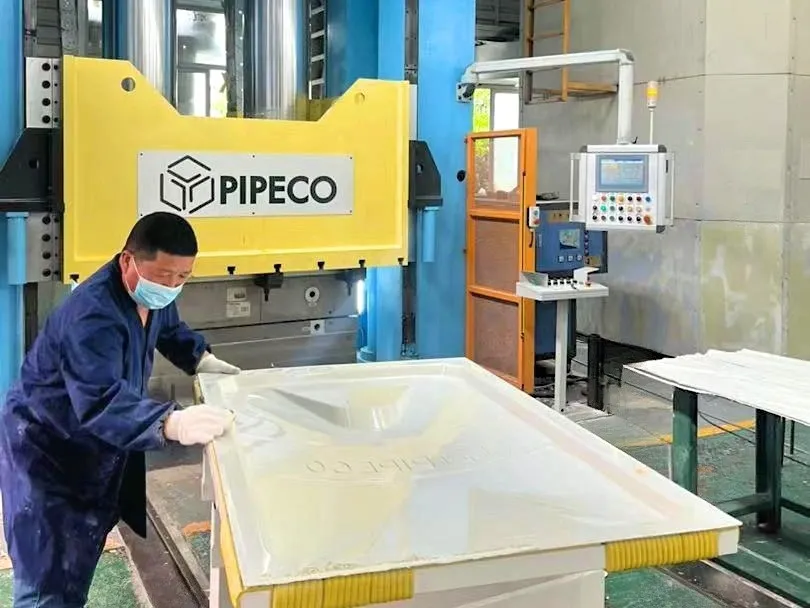
Modular GRP water tanks are manufactured as standardized or customized panels in controlled factory environments. These panels are transported to site and assembled using bolted connections and sealing systems.
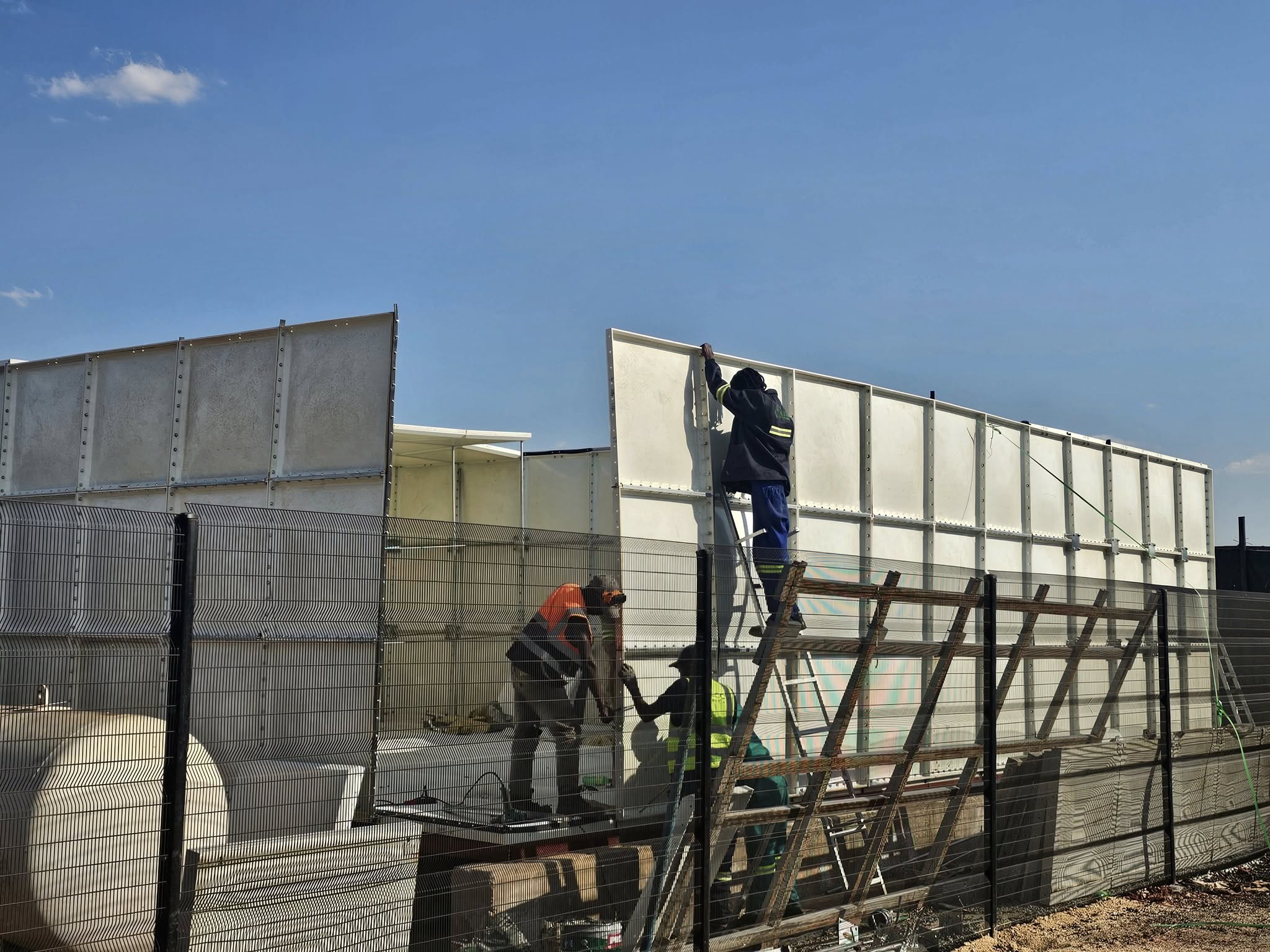
Typical installation time for a medium-capacity modular GRP water tank ranges from 3 to 7 days, depending on volume and site conditions.
Cast-in-place concrete water tanks rely heavily on civil engineering processes, including excavation, reinforcement placement, formwork installation, concrete pouring, curing, waterproofing, and internal coating.
Even under ideal conditions, construction cycles for concrete tanks often exceed 30–60 days, with additional delays common in adverse environments.
| Comparison Item | Modular GRP Water Tank | Cast-in-Place Concrete Tank |
|---|---|---|
| Manufacturing | Factory prefabrication (parallel to site prep) | On-site construction only |
| On-Site Assembly Time | 3–7 days | 30–60 days |
| Curing / Drying | Not required | 14–28 days |
| Weather Impact | Low | High |
| Commissioning Speed | Immediate after installation | Delayed |
While initial material costs may appear comparable, overall project economics strongly favor GRP WATER TANK systems when labor, schedule risk, and lifecycle costs are considered.
Faster deployment also enables earlier revenue generation or operational use, delivering tangible financial benefits for project owners.
Beyond construction efficiency, modular GRP water tanks offer superior long-term performance compared to concrete alternatives.
These advantages significantly reduce maintenance downtime and extend service life, particularly in aggressive or humid environments.
Modular GRP WATER TANK systems are widely adopted in:
The comparison clearly demonstrates that modular GRP water tank rapid assembly technology delivers a decisive construction efficiency advantage over traditional cast-in-place concrete methods.
With dramatically shorter installation cycles, lower on-site risk, and superior lifecycle performance, FRP water tanks are redefining how modern water storage infrastructure is planned and delivered.
For project owners seeking speed, reliability, and long-term value, modular GRP water tanks represent not just an alternative—but a construction efficiency revolution.
Experience the brand Trusted by Renowned Companies across the GLOBE.
Pipeco stands at the forefront of the market, recognized as a premier manufacturer, supplier, and exporter specializing in top-tier GRP water tanks, stainless steel water tanks, and FRP Water Tank, Fiberglass Tank, SMC Water Tank committed to delivering unparalleled quality and excellence.
Get In Touch
Email: master@pipeco.cn
Tel: 0086-576-84616026
Address: No.2 Zhaofeng Road, Xinqian Street, Huangyan District, Taizhou City, Zhejiang Province, China