
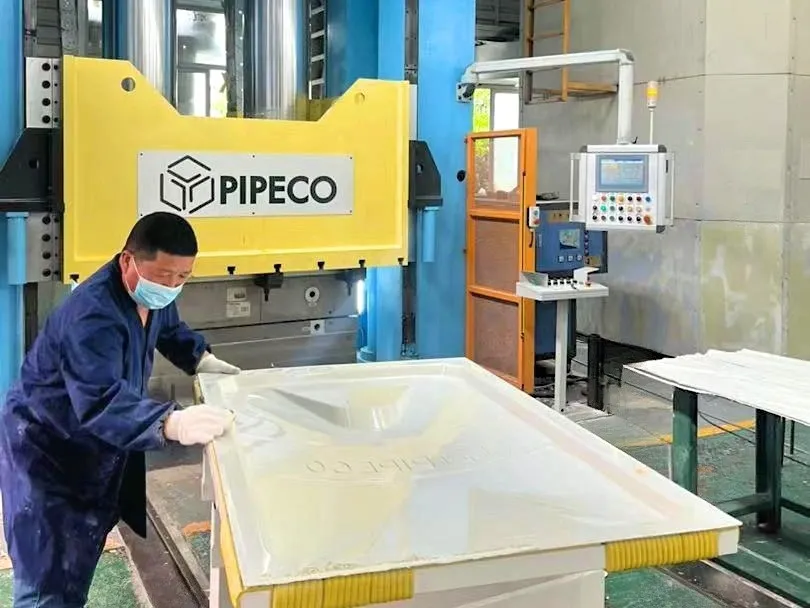
As urban buildings continue to grow taller and more compact, rooftop water storage systems have become a standard solution for residential, commercial, and industrial projects. Among these systems, the GRP square shape tank is widely adopted due to its modular design, corrosion resistance, and long service life.
A GRP (Glass Reinforced Plastic) square shape tank is typically assembled from modular panels and supported by a steel base frame or reinforced concrete foundation. Although GRP tanks are relatively lightweight compared to concrete tanks, the weight of stored water represents a significant structural load.
For rooftop installations, proper consideration of structural support conditions and foundation bearing capacity is essential to prevent long-term deformation, leakage, or structural damage.
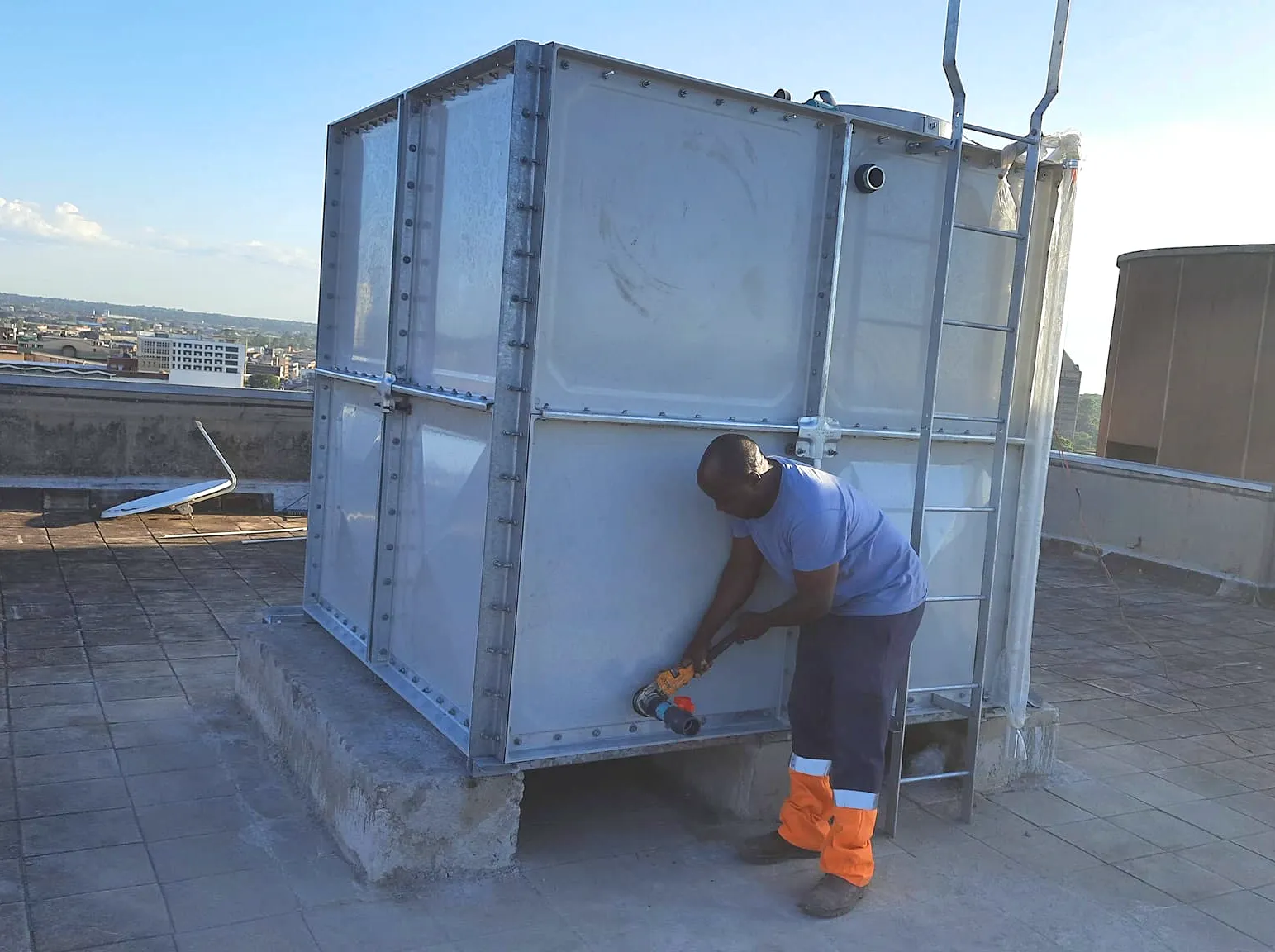
The total load introduced by a rooftop GRP square shape tank can be divided into several components:
Among these, the water load usually accounts for more than 90% of the total vertical load and must be treated as a uniformly distributed load acting on the supporting structure.
A GRP square shape tank must be fully supported over its entire base area. Partial or point support can result in uneven stress distribution, panel deformation, and joint leakage.
The load transfer path should be clearly defined as:
GRP Tank → Foundation or Support Frame → Roof Slab → Beams → Columns → Building Foundation
Prior to installation, the roof slab load capacity must be verified by a qualified structural engineer to ensure compliance with design limits.
Two common foundation solutions are used for rooftop GRP tank installations:
Regardless of the solution selected, the foundation surface must be flat, level, and capable of distributing loads evenly to the roof structure.
The calculated bearing pressure under the GRP square shape tank must be lower than the allowable bearing capacity of the roof slab and supporting structural elements.
GRP tanks are sensitive to differential settlement. Even small uneven deformations can affect panel alignment and sealing performance. Therefore, strict installation tolerances and long-term settlement control are essential.
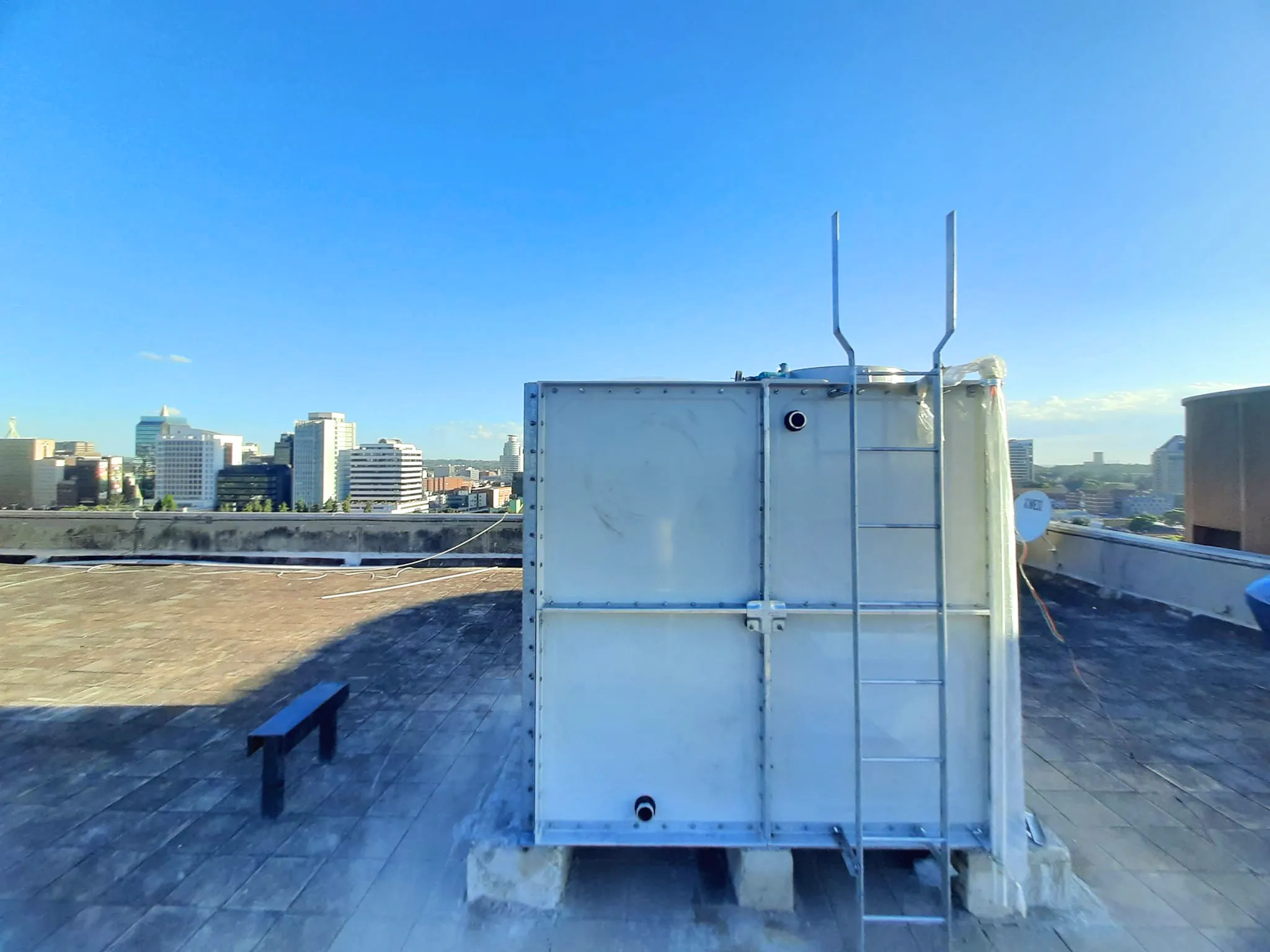
In seismic zones or high-wind regions, anchorage systems may be required to prevent sliding or overturning of rooftop GRP square shape tanks.
Anchorage design should account for horizontal forces while allowing limited thermal movement of the tank structure, avoiding excessive stress concentration.
Successful rooftop installation of a GRP square shape tank requires close coordination between:
All designs should comply with local building codes, structural design standards, and manufacturer installation guidelines.
Installing a GRP square shape tank on a rooftop is a structural engineering task that requires careful planning and professional design. Accurate load calculation, adequate foundation bearing capacity, uniform structural support, and proper anchorage are critical to long-term safety and performance.
When these requirements are properly addressed, GRP square shape tanks provide a reliable, durable, and efficient solution for rooftop water storage systems in modern buildings.
Experience the brand Trusted by Renowned Companies across the GLOBE.
Pipeco stands at the forefront of the market, recognized as a premier manufacturer, supplier, and exporter specializing in top-tier GRP water tanks, stainless steel water tanks, and FRP Water Tank, Fiberglass Tank, SMC Water Tank committed to delivering unparalleled quality and excellence.
Get In Touch
Email: master@pipeco.cn
Tel: 0086-576-84616026
Address: No.2 Zhaofeng Road, Xinqian Street, Huangyan District, Taizhou City, Zhejiang Province, China