
Reliable water storage is essential for schools, colleges, boarding campuses and educational facilities. A properly planned system must support daily domestic consumption, kitchen operations, cleaning, landscaping and, where required, dedicated fire protection reserves.
This guide explains how to assess campus water demand, determine preliminary storage capacity, select suitable GRP sectional tank configurations and plan maintenance without unnecessarily interrupting essential water services.
School water demand is different from that of many commercial buildings. Consumption is often concentrated around class breaks, meal periods and scheduled activities. Boarding schools may also have significant morning and evening demand, while residential campuses can require water throughout the day and night.
Before selecting a storage tank, project designers should identify the main water-use zones and determine whether each requires potable water, general domestic water or a separate non-potable supply.
| Campus Water Service | Usage Pattern and Peak Demand | Water Quality Requirements | Recommended Storage Arrangement |
|---|---|---|---|
| Washrooms and Showers | Short demand peaks during class breaks, morning routines and residential periods | Domestic water quality suitable for the intended application | Main domestic water storage tank |
| Canteens and Kitchens | Concentrated demand during food preparation, meal service and dishwashing | Potable water meeting applicable local requirements | Approved potable water storage and distribution system |
| Cleaning and Landscaping | Scheduled daily, weekly or seasonal demand | Non-potable water may be used where permitted for the intended application | Separate non-potable storage where required, with suitable backflow protection |
| Fire Protection | Emergency demand requiring a protected water reserve | Compliance with applicable fire protection design requirements | Dedicated fire water storage or an approved reserved-volume arrangement |
These categories should not automatically be connected to one common storage compartment. The required water quality, backflow protection, fire reserve and operating arrangements must be reviewed before different services are combined.
The required storage volume depends on more than the number of students. A practical assessment should consider student and staff populations, daily consumption, boarding arrangements, supply reliability, peak demand and the period for which the campus must operate without replenishment.
A simple preliminary estimate can be made using the following formula:
Estimated daily water demand = Number of users × Assumed daily water allowance per person
For example, consider a school with:
The preliminary calculation is:
1,300 × 25 = 32,500 litres/day = 32.5 m³/day
The 25 litres per person per day figure is an illustrative planning assumption, not a universal school water consumption standard. Actual demand may be significantly different depending on local regulations, climate, sanitary facilities, boarding accommodation, kitchen operations and landscaping requirements.
The final design should distinguish between nominal tank capacity, usable operating volume and any protected reserve. This avoids selecting a tank based only on a daily consumption figure while overlooking the actual operating conditions.
For a more detailed procurement checklist, see the GRP Water Tank Specification Checklist.
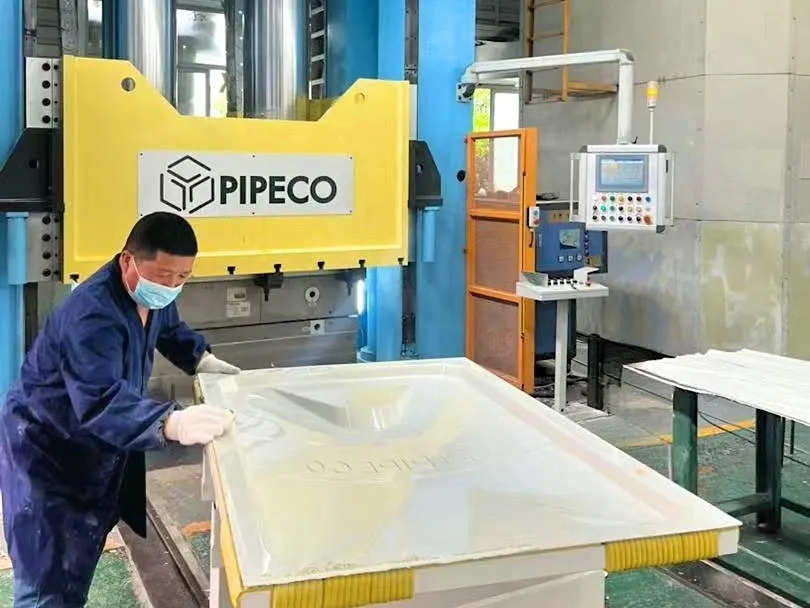
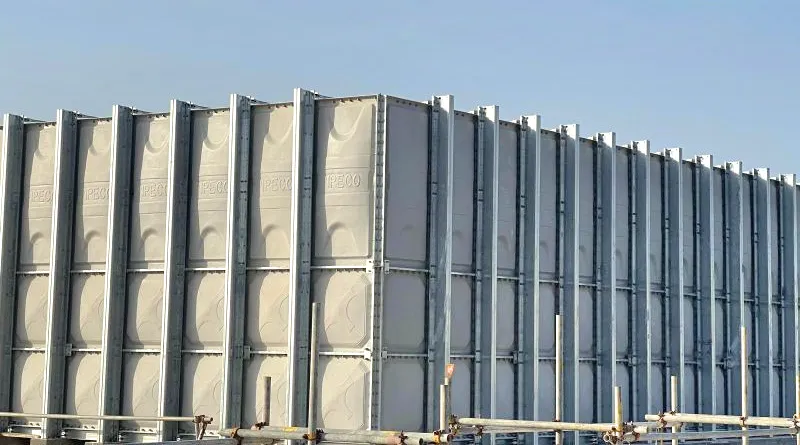
GRP sectional water tanks are assembled from prefabricated panels and configured according to the required storage volume and installation conditions. Their sectional construction can be useful for schools where access routes, plant room dimensions or installation locations restrict the movement of large one-piece tanks.
Individual panels can be transported separately and assembled at the installation location. This can simplify logistics for projects involving rooftop plant areas, indoor service rooms or buildings with restricted access.
However, panel dimensions, lifting arrangements, access routes and the available assembly space should be checked before the tank configuration is finalized.
A sectional tank can be configured to suit the required length, width and height within the manufacturer's available panel system and engineering limits. The final arrangement should consider usable storage volume, maintenance access, pipe connections and the supporting structure.
GRP is a non-metallic composite material that does not develop iron rust in the same way as conventional carbon steel. Its suitability for a particular campus water supply nevertheless depends on the specified resin system, water quality, exposure conditions, panel construction and component selection.
For larger campuses, a GRP sectional tank may be designed with an internal partition to create two independently isolatable storage compartments, subject to structural and hydraulic design review.
With separately arranged inlets, outlets and isolation valves, one compartment can be drained, cleaned and inspected while the other remains in service. This arrangement can reduce the need for a complete campus water shutdown during planned maintenance.
The operating compartment must have sufficient usable capacity to meet essential campus demand during the maintenance period. Partition design, valve arrangement and temporary operating conditions should therefore be confirmed during the project design stage.
A divided tank should not be sized only by its total nominal volume. The remaining compartment must be checked against essential demand during the planned maintenance period.
A preliminary estimate can use the following formula:
Required usable volume = Essential daily demand × Maintenance duration
For example, if a campus requires 12 m³ of essential water per day during a two-day cleaning period, the operating compartment would need at least 24 m³ of usable storage, before applying any additional project-specific reserve or operational allowance.
This is a preliminary sizing example, not a universal design requirement. Actual capacity should account for available inflow, peak demand, pump operation, minimum operating levels and local project requirements.
A partitioned tank does not automatically guarantee uninterrupted water supply. The compartment layout, isolation valves, outlet arrangement and operating procedure must all support the intended maintenance sequence.
For schools, potable water compliance must be assessed across the complete water-contact system, including tank panels, sealing materials, internal fittings and connected components. Depending on the destination market, project specifications may refer to requirements such as WRAS in the UK, NSF/ANSI/CAN 61 in North America, or equivalent national drinking water regulations.
These standards and approval schemes have different scopes. Compliance should be verified for the specific materials, components and product configuration rather than assumed from a general statement about the tank material.
Contractors should confirm that the specific tank materials and water-contact components are covered by the required approvals or test documentation before specifying a storage system. PIPECO can review project documentation requirements and confirm the applicable product compliance information for the proposed configuration.
A suitable tank material alone does not guarantee hygienic water delivery. Correct installation, protected access openings, appropriate ventilation, cleaning procedures and routine inspection are also necessary.
School water storage planning should distinguish between normal domestic consumption and emergency firefighting demand. These services have different operating purposes and may be governed by different design requirements.
Domestic storage supports washrooms, showers, kitchens and other normal campus activities. Its usable volume is determined by expected consumption, supply reliability and the required operating reserve.
Fire protection storage must provide the effective reserve required by the approved fire protection design. The tank arrangement, pump suction, outlet configuration and reserve protection should be checked against the applicable fire regulations and project specifications.
A shared storage arrangement should not be assumed to be acceptable. Where a project proposes a combined tank, the design must demonstrate how the required fire reserve is protected from normal domestic consumption and how the arrangement complies with the applicable fire protection requirements.
A dedicated fire water tank or an engineered reserved-volume arrangement may be appropriate depending on the project. The final decision should be made by the responsible fire protection designer and approved where required by the relevant authority.
The location of a school water tank affects structural loading, installation access, maintenance arrangements and the reliability of the water distribution system. Common locations include ground-level service areas, dedicated plant rooms and rooftop installations.
Ground-level tanks can offer convenient access for inspection, cleaning and maintenance. The foundation must provide a suitable, level and adequately designed support surface. Drainage, overflow routing and protection against unauthorized access should also be considered.
Rooftop storage can reduce the need for some pumping operations, depending on the building's hydraulic design. However, the structural capacity of the roof must be checked before installation.
Water is a major part of the total operating load. As a preliminary reference, 1 m³ of water has a mass of approximately 1 tonne. A tank holding 30 m³ of water therefore contains approximately 30 tonnes of water, excluding the tank structure, accessories and other imposed loads.
Structural engineers should assess the supporting beams, slabs, load distribution, seismic conditions where applicable and the tank's operating and maintenance loads. A lightweight GRP tank does not remove the need for a structural assessment.
The installation layout should provide sufficient space for panel assembly, inspection, cleaning and component replacement. Access openings, manholes, ladders and surrounding clearance should be considered during the building coordination stage.
For further guidance, see FRP Water Tank Foundation Design.
School maintenance schedules often follow academic calendars. Long holidays may provide a convenient period for tank inspection and cleaning, but some campuses continue operating during these periods because of boarding students, security teams, maintenance personnel or other essential services.
Maintenance planning should therefore consider both the physical condition of the tank and the campus's minimum water supply requirements.
Where the tank has been designed with independently isolatable compartments, the maintenance team may be able to clean one compartment while keeping the other in operation.
Before starting work, the facility team should confirm that the remaining compartment has sufficient usable capacity, that the required valves can isolate the section safely and that water quality can be maintained during the temporary operating arrangement.
If the tank has only one storage compartment, alternative arrangements may be needed, such as temporary storage, scheduled supply interruption or a planned maintenance period when campus demand is low.
For more information, see GRP Water Tank Maintenance.
A clear project specification helps manufacturers and contractors evaluate the correct tank configuration. Before requesting a quotation, school developers, consultants and EPC contractors should prepare the following information:
These details allow the tank manufacturer to assess the panel configuration, connection arrangement, accessories and documentation required for the project.
You can also review PIPECO's GRP Water Tank solutions or contact the team through the PIPECO contact page to discuss a school or campus water storage requirement.
Start with the number of students and staff, then estimate daily water demand using the applicable local planning allowance. Adjust the result for boarding facilities, kitchens, showers, supply interruptions, peak demand and the required reserve period. Domestic and fire water requirements should be assessed separately.
Yes, when the specified tank materials and water-contact components meet the applicable drinking water requirements for the project location. The relevant approvals or test documentation should be checked for the actual product configuration before procurement.
A GRP sectional tank may be designed with an internal partition to create independently isolatable compartments, subject to structural and hydraulic design review. This can allow one compartment to be cleaned while the other remains in operation, provided the remaining usable capacity is sufficient for essential demand.
Domestic and fire water have different operating requirements. A dedicated fire water tank is one possible arrangement. A shared tank or reserved-volume configuration should only be used when it is permitted by the applicable fire protection requirements and the required fire reserve is reliably protected.
It may be suitable if the roof structure, support arrangement, load distribution and maintenance access are properly assessed. The structural design must account for the full water load, tank weight and applicable additional loads before installation.
This is possible with a properly designed divided tank, separate isolation arrangements and sufficient usable capacity in the operating compartment. The temporary operating procedure should be established before maintenance begins.
A reliable campus water storage system starts with an accurate assessment of demand, water quality, fire protection requirements, installation conditions and future maintenance needs.
PIPECO supplies GRP sectional water tank solutions for different water storage applications. For school, college and campus projects, provide the required capacity, installation dimensions and project specifications so that the proposed configuration can be reviewed against the actual site conditions.
Experience the brand Trusted by Renowned Companies across the GLOBE.
Pipeco stands at the forefront of the market, recognized as a premier manufacturer, supplier, and exporter specializing in top-tier GRP water tanks, stainless steel water tanks, and FRP Water Tank, Fiberglass Tank, SMC Water Tank committed to delivering unparalleled quality and excellence.
Get In Touch
Email: master@pipeco.cn
Tel: 0086-576-84616026
Address: No.2 Zhaofeng Road, Xinqian Street, Huangyan District, Taizhou City, Zhejiang Province, China