
For an EPC project, specifying a GRP water tank requires more than stating the required storage capacity. The technical specification should define the tank configuration, water service, panel construction, structural support, internal components, connections, applicable standards, inspection requirements, documentation and site interfaces.
A well-prepared GRP water tank specification also gives EPC contractors and procurement teams a common technical baseline for comparing supplier quotations. Instead of comparing different manufacturers only by price, buyers can evaluate whether each quotation satisfies the same engineering requirements.
This guide provides a practical GRP water tank EPC specification checklist covering technical parameters, applicable standards, materials, accessories, FAT, documentation and RFQ requirements.
A complete specification should normally address the following engineering categories:
The exact requirements should always be adapted to the project's water quality, environmental conditions, local regulations and approved engineering documents.
The following matrix can be used as a starting point for an EPC technical specification or RFQ comparison sheet.
| Specification Item | Recommended EPC Requirement | Procurement Verification |
|---|---|---|
| Tank Type | GRP sectional / modular water storage tank | Approved GA drawing |
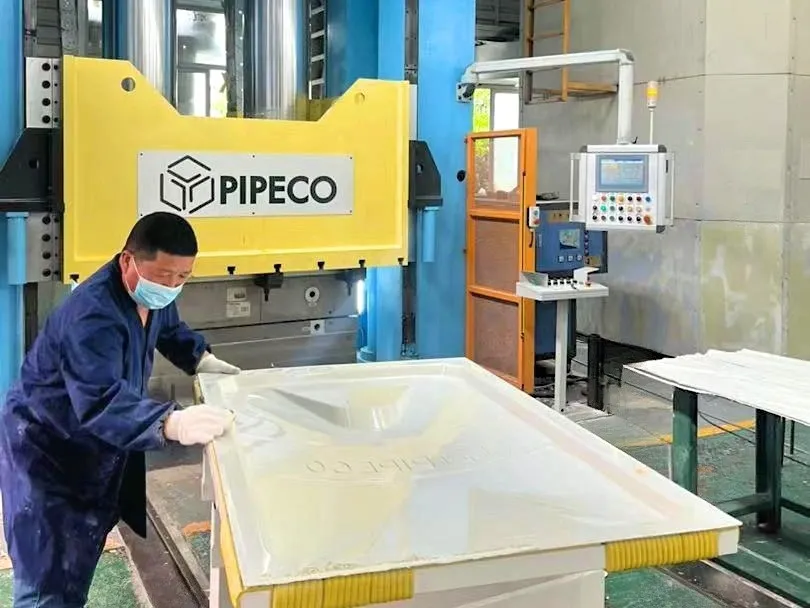
| Panel Technology | Hot-pressed SMC compression-moulded GRP panels | Material and manufacturing documentation |
| Design Standard | BS EN 13280:2001 and/or project-specified standard | Compliance statement |
| Singapore Projects | SS 245:2014 where specified by the project | Technical compliance review |
| Panel Tensile Strength | ≥ 70 MPa where specified by the approved project specification | Test report / manufacturer data |
| Panel Flexural Strength | ≥ 100 MPa where specified by the approved project specification | Test report / manufacturer data |
| Light Transmission | < 0.1% where required for algae-control performance | Manufacturer test data |
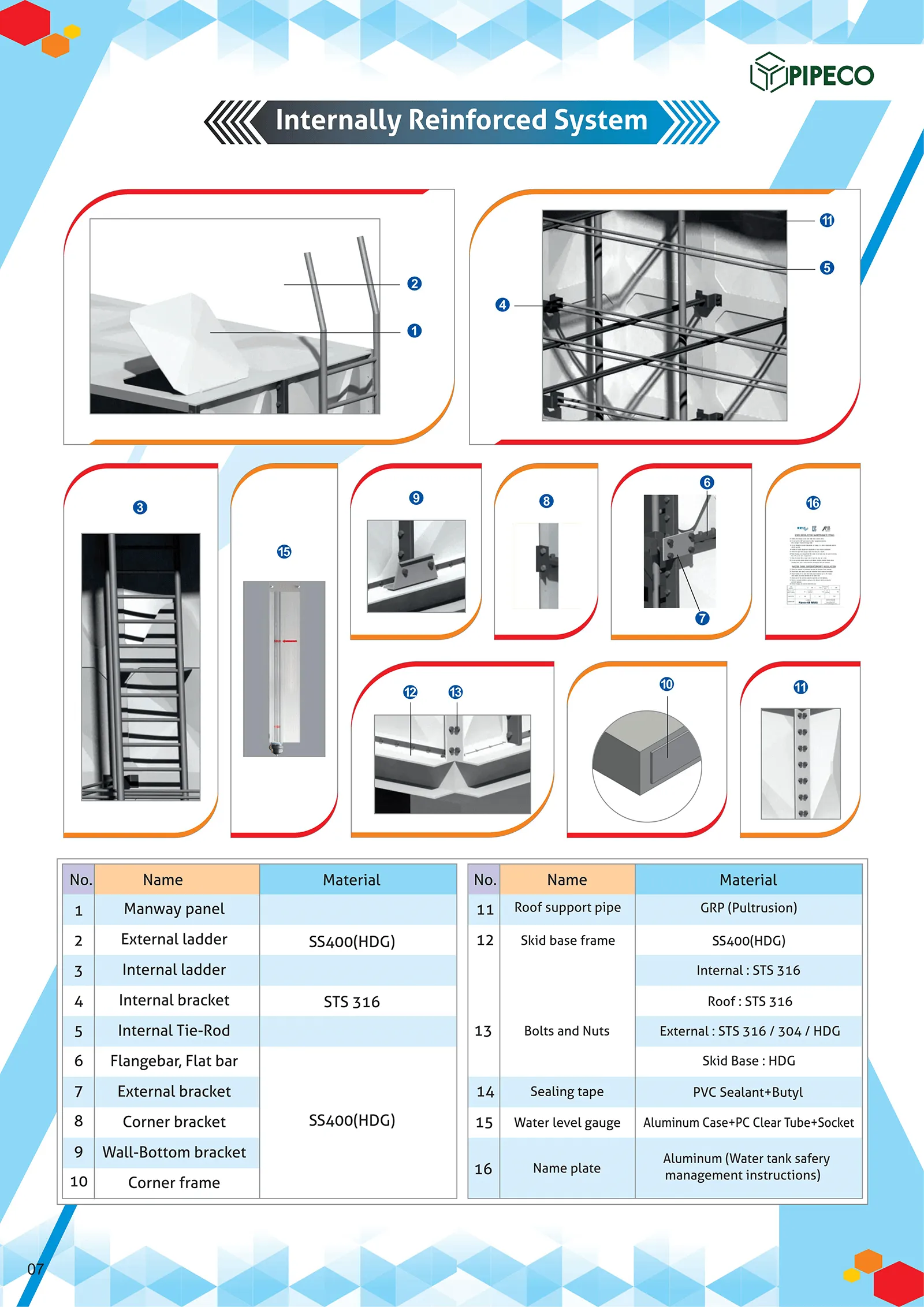
| Internal Tie-Rods | SS304 or SS316; SS316 preferred where required for water-contact service | Material certificate |
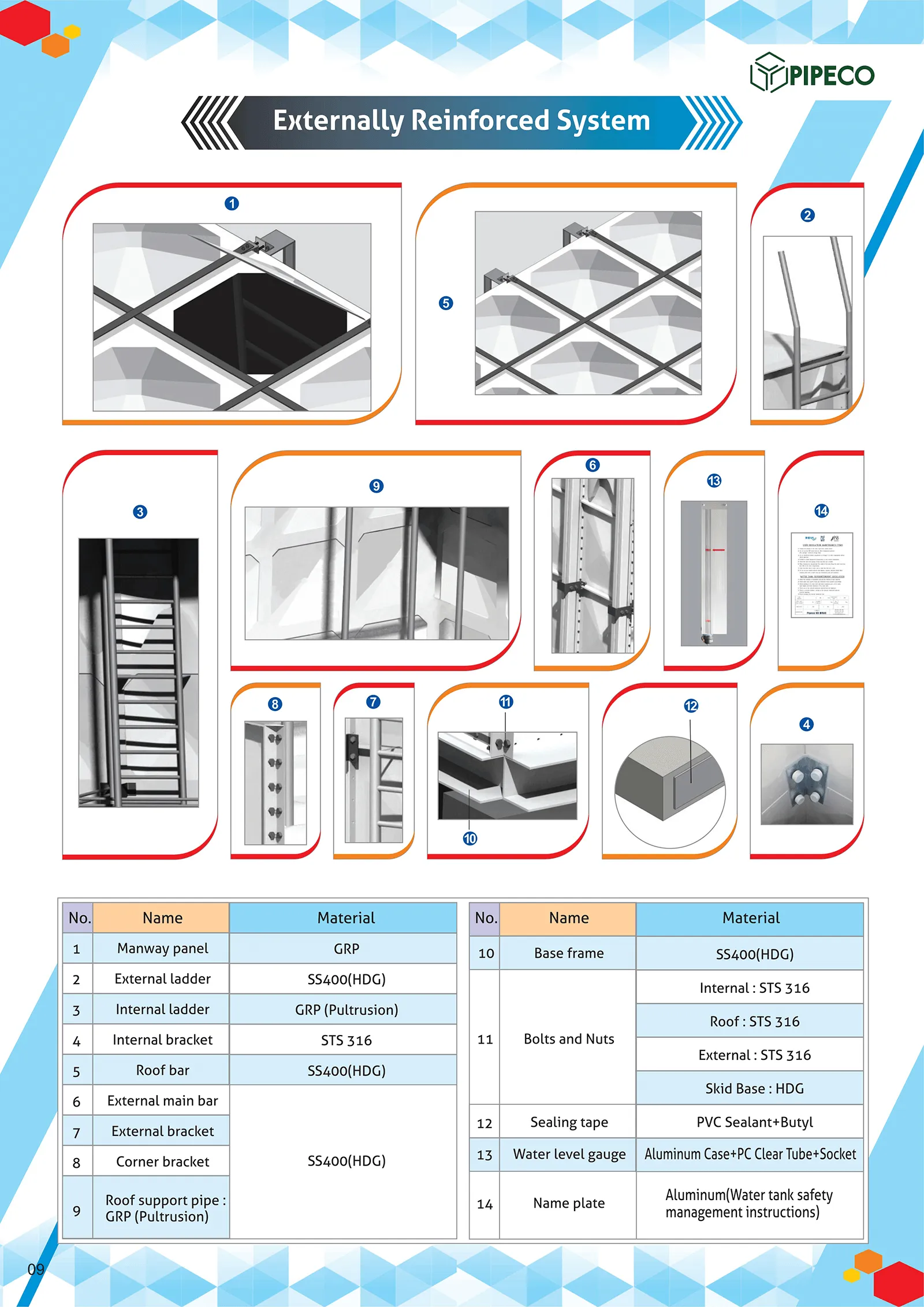
| External Support | Hot-dip galvanized steel (HDG) | Material / coating documentation |
| Roof Support | GRP or project-specified corrosion-resistant support system | Approved drawing |
| Gaskets | Non-toxic, water-service-compatible sealing material | Material documentation |
| Fasteners | SS304 / SS316 according to project environment and water-contact requirements | Material certificate |
| FAT | Dimensional, visual, component and documentation inspection as specified | FAT report |
| Potable Water | Applicable drinking-water material approval where required | Approval / compliance documents |
Important: numerical values in an EPC specification should be tied to the approved project datasheet, purchase specification or manufacturer's verified test data. They should not automatically be presented as universal minimum values of every international tank standard.
BS EN 13280:2001 is a key reference for glass fibre reinforced cisterns of one-piece and sectional construction used for above-ground cold-water storage. Its scope covers rectangular sectional tanks and one-piece cisterns, with sectional tanks starting from 500 litres in the stated standard scope.
The standard includes requirements and test methods covering areas such as materials, configuration, deformation, impact resistance, sectional panel pressure testing, leakage-related testing and other tank characteristics.
For an EPC specification, the correct approach is to identify BS EN 13280:2001 as an applicable design or compliance reference where appropriate and then define any additional project-specific requirements separately.
SS 245:2014 is the Singapore Standard titled Specification for glass reinforced polyester sectional water tanks. It specifies requirements for GRP sectional tanks with a nominal capacity of at least 500 litres for above-ground storage of water.
For Singapore projects, SS 245 should be considered where the project specification, authority requirements or consultant documentation calls for compliance with this standard.
For UK drinking-water applications, the project may require WRAS approval or another applicable drinking-water compliance route.
Procurement teams should verify the exact approval scope rather than treating the phrase “WRAS approved” as a generic product characteristic. WRAS approvals can apply to complete products, materials or components, and the approval scope can include specific models, materials, operating conditions and installation requirements.
Therefore, an EPC specification should request the applicable approval documentation and confirm that the supplied tank configuration falls within its stated scope.
For modern sectional GRP water tanks, the panel is one of the most important engineering components because it must provide both structural performance and long-term resistance to the stored water and surrounding environment.
Where hot-pressed SMC panels are specified, the procurement document should identify the material system and manufacturing process rather than simply stating “fiberglass panel.”
A typical specification can identify:
For projects requiring specific mechanical values, the tender document should state the required test method and acceptance criteria together with the numerical target.
For an engineering procurement specification, qualitative descriptions such as “high strength” are less useful than measurable performance requirements.
| Parameter | Example Specification Target | Verification |
|---|---|---|
| Tensile Strength | ≥ 70 MPa where specified | Material test report |
| Flexural Strength | ≥ 100 MPa where specified | Material test report |
| Light Transmission | < 0.1% where specified for algae-control purposes | Optical/light transmission test |
| Panel Thickness | According to approved tank design and panel location | Thickness inspection |
| Dimensional Accuracy | According to approved drawing and applicable standard | Dimensional inspection |
| Panel Pressure Performance | According to approved design and applicable standard | Specified pressure test |
The actual panel design should not be determined from tensile strength alone. Tank panel performance depends on panel geometry, thickness, reinforcement, hydrostatic head, tank dimensions, internal support configuration, joint design and other load conditions.
Internal tie-rods transfer and distribute loads between opposite or adjacent tank panels. Because internal components can be exposed directly to the stored water, their material selection is an important part of the tank specification.
A project specification may allow SS304 or SS316 for internal components, depending on water chemistry, environmental exposure and project requirements.
For more demanding corrosion environments or where the project specifically requires it, SS316 internal tie-rods and internal hardware can be specified.
The procurement document should identify:
The final tie-rod arrangement should be based on the approved structural design rather than using a universal number of rods for every tank size.
External structural members are normally exposed to atmospheric conditions rather than stored water. For this reason, hot-dip galvanized steel is commonly specified for external support and bracing systems where corrosion protection is required.
The specification should distinguish between:
For external steelwork, the specification can identify HDG — hot-dip galvanized construction together with the applicable coating requirement or project standard.
For Singapore specifications, SS 245 references ISO 1460 and ISO 1461 among its normative references for metallic coatings, which provides a useful framework when galvanized steel components are specified.
The water being stored should be identified before the tank is selected.
| Application | Specification Considerations |
|---|---|
| Potable Water | Water-contact materials, hygiene requirements and applicable approvals |
| Fire Protection Water | Required capacity, fire-system interface and project fire-code requirements |
| Process Water | Temperature and chemical compatibility |
| Irrigation Water | Water quality and environmental exposure |
| Rainwater | Collection system, filtration and overflow arrangement |
| Wastewater | Chemical compatibility and application-specific design |
A GRP tank specification should never assume that “water” represents identical service conditions in every project.
The RFQ should distinguish between nominal tank capacity and the usable storage volume required by the project.
The EPC contractor should provide:
Tank capacity calculations should also consider the actual panel configuration and internal components.
For detailed capacity planning, refer to PIPECO's GRP water tank capacity guide.
The EPC specification should define the available installation envelope before the tank configuration is finalized.
Important information includes:
A modular GRP tank can be assembled on site from individual panels, which can simplify access to buildings where a factory-assembled tank cannot be transported through existing openings.
The specification should include a connection schedule before the tank is released for production.
| Connection | Information Required |
|---|---|
| Inlet | Location, size, flange standard and design flow |
| Outlet | Location, size, flange standard and operating flow |
| Drain | Location, size and drainage arrangement |
| Overflow | Location, size and discharge route |
| Vent | Location and ventilation requirements |
| Level Instrumentation | Connection/interface requirements where applicable |
This information should be coordinated with the mechanical piping drawings before final tank fabrication.
The joint between adjacent GRP panels is an important part of the water-retaining system.
The EPC specification should identify:
For potable-water applications, the sealing system should be compatible with the applicable drinking-water requirements and project approvals.
The roof should be considered as part of the tank system rather than as an optional cover.
The specification may include:
For tanks installed in areas with significant environmental exposure, the specification should also address UV exposure, rainfall, wind and local climatic conditions.
The tank specification should state the design environment instead of assuming standard indoor conditions.
Relevant conditions may include:
For cold climates, the specification should consider insulation and freeze protection requirements separately.
See PIPECO's guide to GRP water tank freeze protection for additional engineering considerations.
A project specification should define the inspection process before manufacturing begins.
A typical GRP tank FAT package may include:
The actual FAT procedure should follow the approved Inspection and Test Plan and project-specific requirements.
For more information, see PIPECO's GRP water tank FAT guide.
A complete RFQ should define the documentation required from the tank supplier.
| Document | Purpose |
|---|---|
| General Arrangement Drawing | Overall dimensions and configuration |
| Panel Layout | Panel arrangement and identification |
| Connection Schedule | Inlet, outlet, drain, overflow and other interfaces |
| Material Data | Panel, gasket and hardware information |
| Quality Plan / ITP | Manufacturing inspection stages |
| Material Certificates | Verification of specified materials |
| FAT Report | Final inspection evidence |
| Installation Manual | Site assembly instructions |
| Packing List | Shipment identification |
| Compliance Documents | Applicable project standards and approvals |
Before requesting a final quotation, the EPC contractor should provide enough information for the supplier to develop a technically valid proposal.
For customized tanks, the buyer should also provide any available GA drawings, piping drawings, structural drawings and project specifications.
| Comparison Item | Supplier A | Supplier B | Supplier C |
|---|---|---|---|
| Tank Capacity | |||
| Tank Dimensions | |||
| Applicable Standard | |||
| Panel Manufacturing Process | |||
| Tensile Strength | |||
| Flexural Strength | |||
| Light Transmission | |||
| Internal Tie-Rod Material | |||
| External Support Material | |||
| Gasket Material | |||
| Potable Water Approval | |||
| FAT Included | |||
| Third-Party Inspection | |||
| Installation Support | |||
| Warranty | |||
| Delivery Time |
This comparison format helps procurement teams separate the commercial quotation from the underlying technical compliance.
A statement such as “500 m³ GRP water tank” does not define the complete engineering requirement.
Different panel technologies, resin systems, reinforcement structures and manufacturing processes can produce different mechanical and water-contact characteristics.
BS EN 13280:2001, SS 245:2014 and drinking-water approval requirements should be applied according to the actual project and jurisdiction.
The material of internal tie-rods and fasteners should be stated because these components may be exposed directly to stored water.
External steel supports should have an appropriate corrosion-protection system, such as hot-dip galvanizing where specified.
Approval and documentation requirements should be identified before manufacturing. This reduces the risk of receiving a technically acceptable product that cannot satisfy the project's documentation requirements.
A basic EPC RFQ should normally include capacity, water type, installation location, available space, foundation conditions, connection requirements, environmental conditions, applicable standards, inspection requirements and delivery expectations.
BS EN 13280:2001 is a key reference for above-ground cold-water GRP cisterns and sectional tanks. Singapore projects may additionally specify SS 245:2014. The applicable project specification and local regulatory requirements should always be checked.
WRAS requirements depend on the application and jurisdiction. For UK drinking-water applications, the project may require an applicable WRAS product or material approval. The approval scope should be checked against the actual tank configuration and components.
SS304 or SS316 may be specified depending on the project. SS316 is commonly selected where higher corrosion resistance is required or where the project specification requires SS316 for water-contact components.
Hot-dip galvanized steel is a common specification for external structural supports where corrosion protection is required. The final coating requirements should follow the project specification.
Mechanical requirements should be defined by the approved project specification and verified through appropriate test data. Where a project specifies target values such as tensile strength of at least 70 MPa and flexural strength of at least 100 MPa, those values should be included in the supplier compliance matrix and supported by test documentation.
Connection locations and sizes must coordinate with the mechanical piping system. Defining them before production reduces the risk of conflicts between the tank, pipework and surrounding equipment.
Yes. For EPC projects, the GA drawing, panel layout and connection schedule should normally be reviewed and approved before production so that the supplier manufactures the tank according to the agreed configuration.
A professional GRP water tank EPC specification should define much more than tank capacity.
The most important procurement information includes:
The objective is not to make every GRP tank specification identical. The objective is to make every requirement clear enough that the manufacturer, EPC contractor, consultant and procurement team are working from the same technical baseline.
PIPECO supplies GRP sectional water tank solutions and can support project-specific technical clarification, tank configuration, documentation and EPC procurement requirements.
Need custom GRP tank calculation or technical clarification for your EPC project? Contact the PIPECO engineering team at sales@pipeco.cn for a complete RFQ package, including tank configuration, technical specification and project documentation requirements.
Experience the brand Trusted by Renowned Companies across the GLOBE.
Pipeco stands at the forefront of the market, recognized as a premier manufacturer, supplier, and exporter specializing in top-tier GRP water tanks, stainless steel water tanks, and FRP Water Tank, Fiberglass Tank, SMC Water Tank committed to delivering unparalleled quality and excellence.
Get In Touch
Email: master@pipeco.cn
Tel: 0086-576-84616026
Address: No.2 Zhaofeng Road, Xinqian Street, Huangyan District, Taizhou City, Zhejiang Province, China