
Water treatment plants handle several types of water at different stages of operation. Raw water, filtered water, treated water, filter backwash supply and plant service water may all require different storage arrangements.
Selecting a tank therefore involves more than matching nominal capacity to a project drawing. The stored water characteristics, process flow, operating schedule, material compatibility and maintenance requirements all influence the specification.
This guide focuses on drinking water and industrial water treatment facilities. Wastewater treatment tanks, sludge storage systems and dedicated chemical vessels require separate process and material assessments.
Storage may be required at several points between raw water intake and finished water distribution. The purpose of each tank depends on the treatment stage and the plant's operating strategy.
| Treatment Stage | Water Condition | Storage Purpose | Main Design Concern |
|---|---|---|---|
| Raw Water Intake | Untreated source water | Raw water balancing | Suspended solids and source variability |
| Filtration | Filtered water | Process buffering or transfer | Hydraulic coordination and water quality |
| Filter Backwashing | Clean washwater supply | Filter media cleaning | Peak flow, duration and pump capacity |
| Disinfection and Clearwell | Treated water | Contact and operational storage | Effective volume and hydraulic flow pattern |
| Distribution | Finished water | Balancing treatment output and demand | Water turnover and hygiene |
| Plant Utilities | Service water | Cleaning and general plant use | Water quality and cross-connection control |
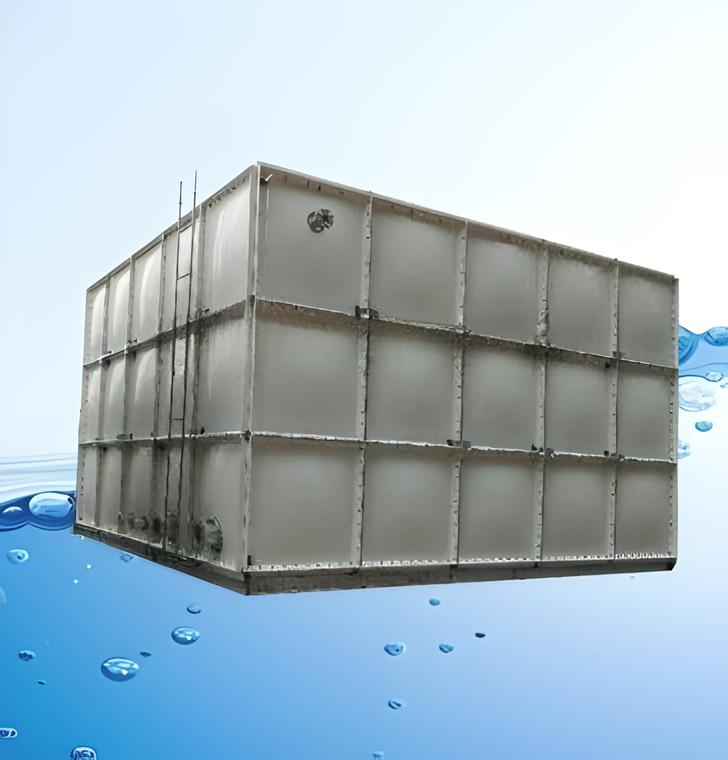
GRP sectional tanks may be suitable for selected atmospheric storage duties, particularly treated water, backwash supply and plant service water. Raw water containing significant solids, spent backwash, sludge and chemical solutions require separate assessment.
The key is to specify the tank for a defined storage duty rather than assuming that every liquid described as water can use the same tank configuration.
After filtration and disinfection, treated water may be stored before transfer to a distribution network or another facility. Storage helps balance differences between treatment output and downstream demand.
The specification should address water-contact compliance, internal fittings, access, ventilation, overflow protection and cleaning arrangements. Usable volume and water turnover should also be considered to avoid creating unnecessary water quality management problems.
Filtration systems periodically require backwashing to remove accumulated particles from filter media. This creates a short-duration water demand that may be considerably higher than normal plant consumption.
A dedicated storage tank can provide a controlled supply for the backwash pumping system. Its capacity should be based on the filter operating sequence and required washwater flow, not simply the plant's average daily water demand.
Water treatment facilities also use water for equipment washing, general cleaning and other utility services. Where these duties do not require potable water quality, a separate service-water storage arrangement may be appropriate.
Potable and non-potable systems should be clearly identified in the process and piping drawings. Cross-connections must be prevented through an approved system design and suitable backflow protection.
Backwash storage is a particularly important design consideration because the required flow can be high over a relatively short period.
A preliminary estimate of gross backwash demand can be calculated as:
Gross backwash demand = Flow rate × Duration × Number of filters
For example, assume:
The preliminary gross demand is:
90 × (10 ÷ 60) × 2 = 30 m³
This is the estimated water demand for the stated sequence, not the final tank capacity.
A simplified water balance can be expressed as:
Required storage = Gross backwash demand − Replenishment during backwash + Operating reserve
The final usable storage volume must also account for the minimum operating level and any volume that cannot be withdrawn by the pumping arrangement.
The process designer should verify the actual backwash sequence, pump performance, replenishment conditions and any additional wash stages before confirming the tank size.
A backwash supply tank stores suitable water before it passes through the filter media. A spent backwash collection tank receives discharged water containing removed particles and potentially other treatment residues.
These two applications have different water quality and cleaning requirements. A GRP sectional tank may be considered for suitable clean backwash supply, while spent backwash collection requires a separate assessment of solids loading, settling, drainage and material compatibility.
A clearwell is not simply another name for a general storage tank. In a drinking water treatment plant, it may provide finished water storage, flow balancing and disinfectant contact time.
These functions must be considered separately during process design.
If a clearwell contributes to disinfection contact time, nominal geometric capacity alone is not sufficient to demonstrate performance. Effective volume and hydraulic conditions must be considered.
Inlet and outlet positions, internal baffling, short-circuiting, flow conditions and operating water levels can affect the effective contact performance.
A distribution storage tank should therefore not automatically be assumed to provide the required disinfectant contact time. The treatment process designer must confirm the applicable hydraulic and regulatory requirements.
A GRP sectional tank may be considered for treated water storage when the complete tank system meets the relevant structural, hygiene and project requirements.
However, where disinfectant contact time is part of the tank's function, the effective volume, baffling arrangement and flow pattern must be validated as part of the treatment design. A standard sectional tank should not automatically be described as a compliant clearwell.
Water characteristics change as treatment progresses. A tank storing filtered water may face different conditions from one storing finished water with a disinfectant residual.
| Parameter | Why It Matters | Information to Confirm |
|---|---|---|
| pH | Can influence material compatibility | Normal operating range and variation |
| Residual disinfectant | May affect long-term exposure conditions | Disinfectant type and concentration |
| Temperature | Influences material operating limits | Normal and maximum temperature |
| Suspended solids | Can increase sediment accumulation | Solids concentration and settling characteristics |
| Treatment additives | May introduce specific compatibility requirements | Chemical names and potential carryover |
For drinking water storage, compliance must be considered across the complete water-contact system. Depending on the project location, specifications may refer to WRAS, NSF/ANSI/CAN 61 or equivalent national requirements.
The relevant approval or test documentation must apply to the specific materials and components used in the proposed tank configuration. Panels, gaskets, internal fittings and pipe connections should all be reviewed.
A general statement about GRP material properties is not a substitute for product-specific compliance documentation. The project water analysis and expected disinfectant residual should be provided before the material specification is approved.
Water treatment plants use chemicals for coagulation, pH adjustment, disinfection and other process operations. These substances are normally handled through dedicated chemical storage and dosing systems.
A standard GRP sectional water tank should not automatically be used for storing sodium hypochlorite, acids, alkalis or concentrated treatment chemicals.
Chemical tank selection requires assessment of:
Purpose-designed chemical storage tanks may use specialized FRP material systems, but their suitability must be confirmed for the actual chemical and operating conditions.
After the storage duty has been defined, the tank configuration must be coordinated with the treatment plant layout.
| Configuration | Main Advantage | Design Consideration |
|---|---|---|
| Single compartment | Simpler layout and operation | The tank may need to be taken out of service for internal maintenance |
| Two compartments | Allows one section to be isolated while the other remains available | Each section needs adequate usable capacity and suitable independent isolation |
| Multiple compartments | Greater operational flexibility | More complex hydraulic, structural and maintenance coordination |
A compartmented GRP sectional tank can support maintenance without a complete shutdown, provided the remaining compartment has sufficient capacity and the system is designed for independent isolation.
Partition walls, water levels, connection arrangements and structural loading must be considered in the tank design. Compartmentation should not be treated as a simple internal divider added without engineering review.
The foundation must accommodate the full operating water load, tank self-weight and applicable additional loads. For preliminary reference, 1 m³ of water has a mass of approximately one tonne.
A tank containing 100 m³ of water therefore holds approximately 100 tonnes of water, before accounting for the tank structure and accessories. The supporting slab and foundation should be checked by the responsible structural engineer.
Inlet, outlet, overflow and drain positions should be coordinated with the plant's piping layout. External pipe loads, vibration and movement should not be transferred inappropriately to the tank panels or connection points.
The layout should also provide suitable access for inspection, cleaning, sampling and component replacement. Manholes, ventilation, drainage and water-level instruments should be included in the project drawings.
For additional foundation guidance, see FRP Water Tank Foundation Design.
Water treatment plants may operate continuously or according to a production schedule. Taking a storage tank out of service can affect backwash availability, treatment output or downstream distribution.
Before specifying compartmented storage, confirm that each section can be isolated independently and that the remaining usable volume can support the required plant demand.
Routine inspection should cover:
Cleaning and disinfection should follow applicable water quality requirements and the manufacturer's instructions. Maintenance frequency should reflect actual operating conditions rather than one universal schedule.
See also GRP Water Tank Maintenance.
A clear request for quotation helps the manufacturer assess the intended storage duty, tank configuration and documentation requirements.
| RFQ Category | Information to Provide |
|---|---|
| Project and Process | Plant type, treatment capacity, storage duty and operating schedule |
| Water Characteristics | Water analysis, pH, temperature, residual disinfectant and additives |
| Capacity and Hydraulics | Required volume, flow rates, replenishment rate and operating reserve |
| Tank Configuration | Dimensions, compartment arrangement and access requirements |
| Connections | Inlet, outlet, overflow, drain, ventilation and instrument positions |
| Installation | Foundation drawings, available footprint and site access conditions |
| Compliance | Applicable standards, water-contact requirements and test documents |
EPC teams should also identify the technical documents required from the supplier, such as:
For a broader procurement reference, see GRP Water Tank Specification Checklist.
Depending on water quality and project requirements, GRP sectional tanks may be considered for treated water storage, filter backwash supply and plant service water. Each application requires assessment of water chemistry, material compatibility, structural conditions and applicable regulations.
A GRP sectional tank may be considered for treated water storage, but it should not automatically be treated as a validated clearwell. If the tank provides disinfectant contact time, effective volume, hydraulic baffling and flow conditions must be confirmed by the process designer.
A preliminary calculation uses backwash flow rate multiplied by backwash duration and the number of filters in the design sequence. Replenishment during backwashing, unusable volume, pump capacity and operating reserve must also be considered.
A GRP sectional tank may be designed with separate compartments where the tank structure and hydraulic arrangement allow it. Independent isolation and sufficient remaining storage capacity are required if one compartment is to be maintained while the other remains in service.
A standard GRP sectional water tank should not automatically be used for chemical storage. Chemical type, concentration, temperature, resin compatibility, tank construction and containment requirements need a separate engineering assessment.
An RFQ should identify the storage duty, water quality, required capacity, flow rates, operating schedule, tank dimensions, compartment requirements, pipe connections, installation conditions and applicable compliance documents.
Water treatment plants need different storage arrangements for different stages of operation. Treated water storage, filter backwash supply and plant service water may all be suitable applications for GRP sectional tanks when the material system and configuration meet the project requirements.
Clearwell duties involving disinfectant contact time, chemical storage and spent backwash collection require additional process-specific assessment. They should not be treated as interchangeable with ordinary atmospheric water storage.
Defining the stored liquid, hydraulic duty, operating conditions and maintenance requirements before procurement is the most reliable way to select an appropriate tank configuration.
PIPECO supplies GRP sectional water tank solutions for commercial, municipal and industrial water storage applications.
For a water treatment plant project, provide the intended storage duty, required capacity, water characteristics, installation dimensions and project specifications. These details help determine whether a GRP sectional tank is appropriate for the proposed application.
Explore PIPECO GRP Water Tank solutions or contact PIPECO to discuss your project.
Experience the brand Trusted by Renowned Companies across the GLOBE.
Pipeco stands at the forefront of the market, recognized as a premier manufacturer, supplier, and exporter specializing in top-tier GRP water tanks, stainless steel water tanks, and FRP Water Tank, Fiberglass Tank, SMC Water Tank committed to delivering unparalleled quality and excellence.
Get In Touch
Email: master@pipeco.cn
Tel: 0086-576-84616026
Address: No.2 Zhaofeng Road, Xinqian Street, Huangyan District, Taizhou City, Zhejiang Province, China