
Water is essential to almost every part of daily life. We use it for drinking, cooking, cleaning, farming, manufacturing and maintaining public services. Yet access to water is not always constant. Supply interruptions, changing demand, seasonal conditions and infrastructure limitations can all affect when water is available.
This is why water storage plays such an important role in modern communities. A properly designed water storage system helps create a reserve between the water source and the point of use, making it easier to manage fluctuations in supply and demand.
From residential buildings to hospitals, farms and industrial facilities, water storage systems support everyday activities that depend on a dependable supply. Understanding their importance helps explain why water tanks remain an essential part of modern infrastructure.
Many people turn on a tap without thinking about the infrastructure behind it. Water may travel through treatment plants, pipelines, pumping stations and distribution networks before reaching a home or business.
Although public water systems are designed to provide a continuous supply, actual availability can be affected by maintenance work, equipment failures, power interruptions, extreme weather and unexpected increases in demand.
Water storage provides an additional layer of supply management. Instead of depending entirely on water arriving at the exact moment it is needed, users can draw from a stored reserve.
Water storage can support everyday activities in several ways:
Water storage does not replace a reliable public water network. Instead, it complements the network by providing a buffer that helps users manage changes in availability.
A water supply interruption can affect more than drinking water. It may disrupt cooking, sanitation, cleaning, business operations and essential building services.
The impact depends on how long the interruption lasts, how much water is available in reserve and what activities depend on the supply.
For households, even a short interruption can make normal routines difficult. Cooking, washing dishes, bathing and cleaning may all be affected.
A properly maintained household or building storage system can provide a temporary reserve for essential uses, depending on its available volume and the amount of water consumed.
Hotels, offices, shopping centres and other commercial buildings often have multiple water requirements operating at the same time. Bathrooms, kitchens, cleaning services and other facilities may all depend on a stable supply.
Without sufficient reserve storage, an interruption can affect customer experience, building operations and business continuity.
Some industrial processes require water for equipment cleaning, cooling, production support and other operations. An interruption may affect production schedules or require temporary operational adjustments.
Industrial water storage should be designed around the actual process requirements. Water intended for general utility use should not automatically be considered suitable for every production or chemical application.
Water storage is used in a wide range of environments. The purpose may differ, but the basic principle remains the same: keeping an available supply for the time and place where it is needed.
Residential water tanks can support domestic water distribution, particularly in buildings where water must be pumped to upper floors or where supply conditions vary.
In apartment buildings, shared storage systems may serve multiple households. Their operation needs to be coordinated with pumps, plumbing networks and building management requirements.
Hotels, restaurants, offices and shopping centres have changing water demand throughout the day. Occupancy levels, business hours and service activities all influence consumption.
Water storage can help balance these demand patterns and provide a reserve for normal building operations.
Schools, healthcare facilities and other public institutions depend on water for sanitation, cleaning, kitchens and daily services.
Their storage systems may need to follow specific local regulations and operational requirements. Hospitals and other critical facilities may also require additional planning for emergency water availability.
Agriculture depends heavily on water availability. Irrigation schedules, crop requirements, livestock needs and seasonal weather can all influence demand.
Storage tanks can help farms manage the timing of water supply and irrigation activities, particularly where water sources are intermittent or demand changes significantly during the growing season.
Read more about GRP water tanks for agricultural irrigation.
Factories may use water for general utilities, equipment cleaning, cooling systems and selected manufacturing processes.
A dedicated storage system can help separate water supply management from immediate production demand. The required water quality and tank material depend on the intended use.
A water storage tank acts as an intermediate reserve within a water supply system. It receives water from a source, stores it under controlled conditions and supplies it to users when required.
A typical building water storage arrangement may include:
Water supply and consumption do not always occur at the same rate. A building may receive water steadily while demand rises sharply in the morning or evening.
A storage tank helps bridge this difference. It can collect water when supply is available and release it as demand increases, provided that the system has been properly sized and configured.
In some buildings, water needs to be pumped to upper floors or distributed across different areas. Storage tanks can form part of this arrangement, working together with pumps and the building's plumbing system.
The exact configuration depends on building height, pressure requirements, local plumbing codes and the selected water supply design.
A stored water reserve can help users respond to certain unexpected interruptions. However, the reserve is only useful if it is maintained, protected from contamination and sufficient for the intended duration and demand.
Not every water storage application requires the same type of tank. The material, construction method and system configuration should reflect the intended use and installation environment.
GRP stands for Glass Reinforced Plastic. It is a composite material made by combining a polymer resin with glass fiber reinforcement.
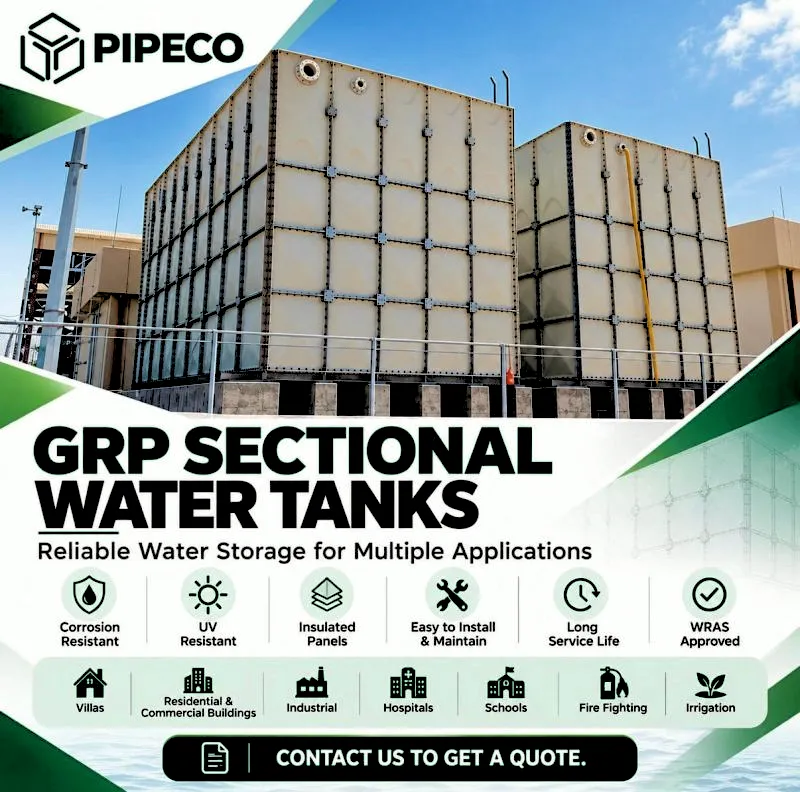
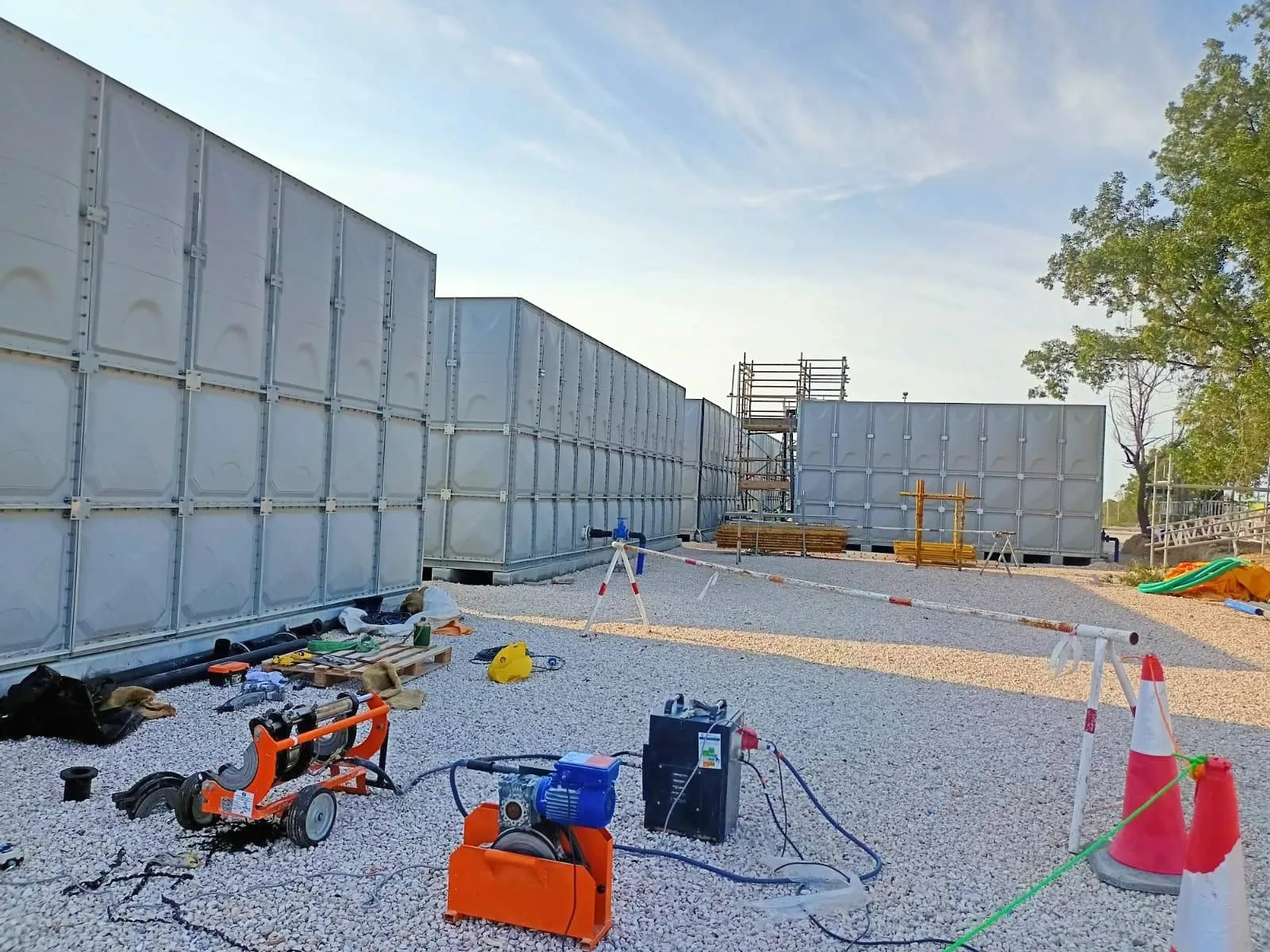
GRP sectional water tanks are assembled from individual panels, allowing the tank dimensions and capacity to be configured for different projects. This makes them a practical option for many commercial buildings, schools, hotels and industrial facilities.
Their modular construction can also be helpful where access is restricted or transporting a large one-piece tank is difficult.
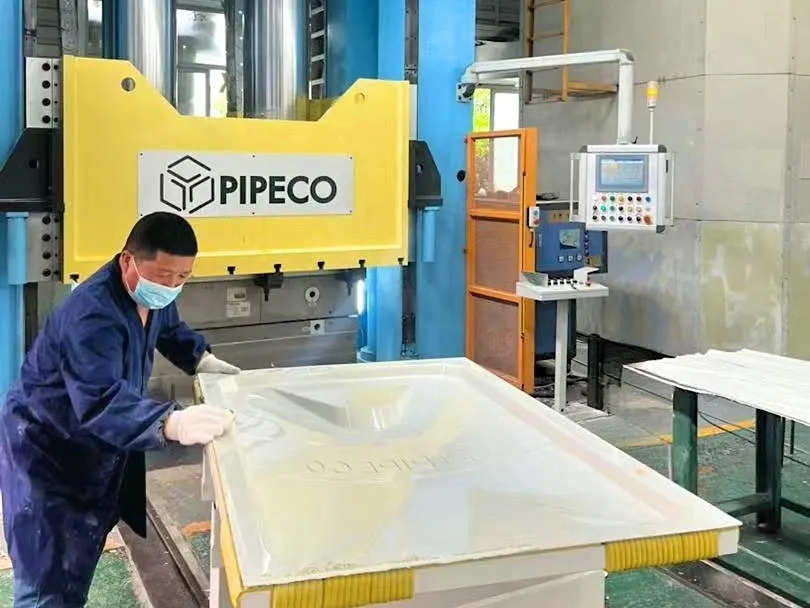
SMC, or Sheet Molding Compound, is a fiber-reinforced composite molding material. It is commonly used to manufacture molded tank panels through a controlled compression molding process.
SMC tank panels are produced individually and assembled into a sectional water storage system. Product quality depends on the compound formulation, molding conditions, panel design and assembly details.
Stainless steel tanks are used in a variety of commercial and industrial applications. They may be considered where metal construction or specific surface and hygiene requirements are important.
Their suitability depends on the steel grade, water chemistry, chloride exposure, fabrication quality and operating conditions.
Plastic tanks are widely used for smaller-scale applications, including residential and garden water storage. Concrete tanks may be selected for certain large-scale or underground installations.
Each material has different installation and maintenance requirements. The right choice depends on the project rather than on a universal ranking of materials.
For an overview of composite water storage products, visit PIPECO's GRP water tank page.
Water storage is useful only when the stored water remains suitable for its intended purpose. Poorly maintained tanks can become contaminated through damaged covers, unprotected openings, sediment accumulation or unsuitable maintenance practices.
Maintaining water quality requires attention to both the tank and the surrounding water supply system.
Tank covers and access openings should be properly fitted to reduce the risk of debris, insects and other contaminants entering the stored water.
Ventilation and overflow arrangements are necessary for normal tank operation. Their openings should be appropriately protected while maintaining the required airflow and discharge capacity.
Regular inspections can help identify leaks, damaged seals, loose fittings and other problems before they affect the storage system.
Sediment and deposits may accumulate over time, depending on the water source and operating conditions. Cleaning frequency should follow local regulations, water quality guidance and the tank manufacturer's recommendations.
Chemicals, waste and other potential contamination sources should be kept away from tank openings and surrounding areas. Potable water systems require particular attention to the suitability of all water-contact materials.
For practical maintenance guidance, see our water tank maintenance guide.
As buildings and communities grow, water demand becomes more complex. A single residential property may have relatively predictable consumption, but a large apartment complex, hotel, school or commercial development may serve hundreds or thousands of users.
These facilities need to manage water availability across different floors, service areas and operating periods.
Water consumption can vary considerably throughout the day. Storage systems help balance supply and demand so that the water distribution network does not have to respond directly to every short-term change in consumption.
Large buildings may need water for bathrooms, kitchens, cleaning, landscaping and other services. A centralized storage arrangement can form part of the building's overall water management system.
A properly maintained reserve can support essential activities during certain temporary supply interruptions. For facilities with critical operations, water storage planning should be coordinated with emergency procedures and applicable regulations.
Water demand may increase as buildings expand or occupancy changes. Storage infrastructure should therefore be considered as part of broader building and community planning.
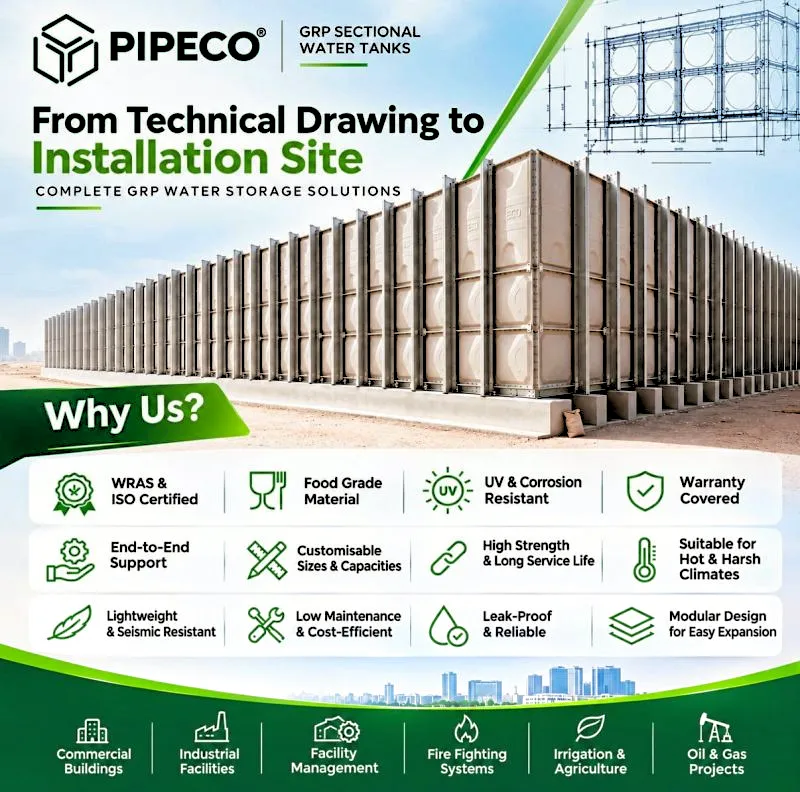
For larger projects, sectional tank systems can offer flexibility in configuration and on-site assembly. Their suitability still depends on structural design, access conditions and project specifications.
Modern water infrastructure requires storage solutions that can adapt to different building sizes, site conditions and operational needs. GRP sectional water tanks are one option used in this area.
Their composite construction combines glass fiber reinforcement with a polymer resin system. In sectional tank designs, individual panels are assembled to form the required storage structure.
Several characteristics make GRP tanks relevant to modern water storage projects:
However, the performance of a GRP water tank depends on more than the material name. Panel specifications, internal supports, joint sealing, structural calculations, installation quality and water compatibility all matter.
For this reason, project owners and buyers should review the manufacturer's technical documentation and confirm that the complete tank system meets the intended application requirements.
Learn more about GRP sectional water tank solutions from PIPECO.
Reliable water management is becoming increasingly important as cities grow, weather patterns change and demand for water increases across different sectors.
Water storage systems are part of a wider approach to managing available resources. They can work alongside water treatment, rainwater harvesting, efficient plumbing, leak detection and responsible consumption practices.
In buildings, storage systems may help manage supply interruptions and changing demand. In agriculture, they can support irrigation planning. In industrial facilities, dedicated storage can help separate water supply arrangements from immediate process demand.
No single storage solution can address every water challenge. Effective water management requires suitable system design, responsible operation and regular maintenance.
Water storage helps maintain a reserve when normal supply is interrupted or demand temporarily exceeds available supply. It supports residential, commercial, agricultural and industrial activities.
A storage system creates a buffer between the water source and the point of use. When properly sized and operated, it can help maintain supply during short interruptions and periods of higher demand.
Water storage tanks are used in homes, apartment buildings, hotels, schools, hospitals, factories, farms and many other facilities where a dependable water supply is required.
GRP water tanks are used in various water storage applications, including commercial buildings, industrial facilities and institutional projects. Sectional GRP tanks can be configured for different capacities and site conditions.
No. Stored water can deteriorate in quality if tanks are poorly maintained or exposed to contamination. Proper tank design, covered openings, regular inspection and appropriate cleaning are important.
Many commercial buildings use water storage systems to manage daily demand, support building services and provide a reserve during supply interruptions. The need and capacity depend on occupancy, building design and local requirements.
Water storage supports everyday life in ways that are often overlooked. From residential buildings and public institutions to farms and industrial facilities, stored water helps users manage changing demand and prepare for certain supply interruptions.
A suitable water storage system should reflect its intended use, required water quality, installation conditions and maintenance needs. GRP sectional tanks, SMC tanks, stainless steel tanks and other storage solutions each have a role in different applications.
As water management becomes increasingly important, well-designed storage systems will continue to support reliable supply across communities and industries.
PIPECO provides water storage solutions, including GRP and stainless steel water tanks, for a range of project applications.
If you are planning a water storage project for a commercial building, institution, farm or industrial facility, contact PIPECO to discuss your requirements.
Experience the brand Trusted by Renowned Companies across the GLOBE.
Pipeco stands at the forefront of the market, recognized as a premier manufacturer, supplier, and exporter specializing in top-tier GRP water tanks, stainless steel water tanks, and FRP Water Tank, Fiberglass Tank, SMC Water Tank committed to delivering unparalleled quality and excellence.
Get In Touch
Email: master@pipeco.cn
Tel: 0086-576-84616026
Address: No.2 Zhaofeng Road, Xinqian Street, Huangyan District, Taizhou City, Zhejiang Province, China